Cast aluminum refers to parts made by melting aluminum and pouring it into molds to form complex shapes. In practice, specialized alloys (typically aluminum plus silicon, magnesium, and other elements) are used to give the molten metal the right fluidity and strength. The result is a component that’s lightweight yet strong, and often much cheaper per pound than a comparable wrought (rolled or extruded) aluminum piece. Because of these advantages, cast aluminum is common in manufacturing – from automotive engines to electronics enclosures. This guide covers the materials, processes, properties, uses, pros/cons and design tips for aluminum castings.
What Is Cast Aluminum?
Definition: Cast aluminum is any part made by pouring molten aluminum alloy into a mold and letting it solidify. Typical casting alloys have high silicon content (often 6–12% Si) and other alloying elements (e.g. Mg, Cu) to improve flow and castability. When the aluminum cools, it takes the exact shape of the mold cavity. Cast aluminum alloys can be easily made into complicated 3D shapes that are difficult or impossible to forge or machine from solid stock.
Unlike wrought aluminum (which is rolled, extruded, or hammered into shape), cast aluminum is formed in liquid state. Wrought alloys tend to have higher tensile strength and better surface finish, but cast alloys allow complex designs at lower cost. Aluminum itself is especially well-suited to casting because it has a relatively low melting point and excellent fluidity (when alloyed). Molten aluminum fills molds easily and shrinks predictably on cooling, and its oxide layer makes the finished part corrosion-resistant (see below).
Examples: Cast aluminum appears in many familiar parts. Engine components like cylinder heads and blocks are classic examples. For instance, cast aluminum cylinder heads (shown) are common in automotive engines because they can be poured in one piece with all the coolant passages and mounting bosses in place. Other cast-aluminum parts include pump and valve housings, structural frames, gearboxes, wheels, and even consumer items like cookware or furniture components. Basically, any part that benefits from a complex shape, lightweight structure, or good thermal performance can be a candidate for aluminum casting.
Fig. Cylinder head (an aluminum casting) used in automotive engines. Such parts are made by pouring molten aluminum into a mold.
Why Cast Aluminum Is Widely Used
Aluminum casting is popular because it strikes an excellent balance of properties, cost and manufacturability. Key advantages include:
- Light weight: Aluminum’s density (~2.7 g/cm³) is far lower than iron or steel. This means cast aluminum parts can weigh about one-third of a similar cast iron part while still providing good strength. For vehicles and aircraft, this weight saving is a big performance and fuel-efficiency advantage.
- Corrosion resistance: Aluminum forms a self-healing oxide film that protects it from rust and many chemicals. Cast aluminum components often last for decades outdoors or in corrosive environments with minimal treatment. This makes them ideal for pumps, outdoor equipment, marine parts, and architectural hardware.
- Strength-to-cost balance: Cast aluminum alloys deliver solid mechanical properties (especially after heat treatment) at a relatively low cost. The casting process allows near-net shapes that save material and machining time, reducing overall cost. Compared to similar-weight metals, aluminum is inexpensive, recyclable, and has lower processing temperatures (melting at ~660°C vs steel’s ~1500°C), saving energy.
- Complex shapes: Because molten aluminum fills molds, virtually any geometry is possible, including complex shapes. No machining or assembly is needed to make hollow or intricate parts. This freedom means designers can optimize parts for performance without being limited by manufacturing constraints.
- High-volume efficiency: Processes like die casting and permanent-mold casting allow very fast, repeatable production. Once a (often costly) mold is made, parts can be churned out with high consistency. For medium to large production runs, this makes aluminum casting extremely cost-effective.
In short, cast aluminum lets industries make lightweight, durable parts cheaply and in complex forms. It’s widely used in automotive and aerospace (for weight-critical parts), electronics (for thermal housings), and many other fields where those traits matter.
Main Properties of Cast Aluminum
Aluminum casting alloys bring a mix of useful properties that suit industrial use:
- Lightweight Structure: Aluminum castings weigh about one third of steel equivalents. The lower mass saves on fuel and allows easier handling of large parts.
- Corrosion Resistance: The natural oxide layer on aluminum renders cast parts highly corrosion-resistant. This extends part life without expensive coatings.
- High Thermal Conductivity: Aluminum alloys conduct heat about four times better than cast iron. This makes cast aluminum great for heat exchangers, engine blocks (which dump heat quickly), and cookware.
- Electrical Conductivity: Pure aluminum is a good electrical conductor (about 60% IACS). Some cast alloys are used for electrical housings and components. (They don’t match copper, but are lighter and cheaper.)
- Machinability: Compared to steel, aluminum alloys are relatively easy to machine, with low cutting forces and good chip breaking. High-silicon cast alloys are a bit harder on tooling than wrought aluminum, but are still quite manageable. In fact, many castings are machined for final critical dimensions or finishes. For example, copper-containing 319 aluminum has “good machinability characteristics” even after casting.
- Strength and Stability: Modern cast alloys (especially heat-treatable ones like A356-T6 or A380) can reach ultimate tensile strengths in the 300–400 MPa range. They also hold their dimensions well under thermal and mechanical load. While not as strong as some forged alloys, cast aluminum’s strength-to-weight ratio is excellent for many applications.
These properties align well with industrial needs. Parts that must be light yet stiff (brackets, housings), or parts that must dissipate heat (engine or electronics components), can leverage these strengths. At the same time, aluminum’s ability to be cast cheaply helps keep manufacturing costs in check.
How Aluminum Casting Works
The basic workflow of aluminum casting is as follows:
- Preparing the Mold: A mold or pattern is made in the desired shape. For sand casting, the pattern is pressed into sand (or ceramic-filled sand) to form a cavity. For permanent mold casting, reusable metal molds (often steel) are prepared. For die casting, precision steel dies are fabricated. Molds may also include cores to create internal passages.
- Melting the Alloy: Aluminum ingots or scrap are melted in a furnace (gas, electric, or induction) and alloying elements are added. The melt is refined to remove impurities and degassed to minimize dissolved hydrogen (which causes porosity).
- Pouring or Injecting: The molten aluminum (around 650–700°C) is transferred to the mold. In gravity casting (sand or permanent mold), it is simply poured. In die casting, it is shot under high pressure into the die. The metal fills the mold cavity, even into fine details.
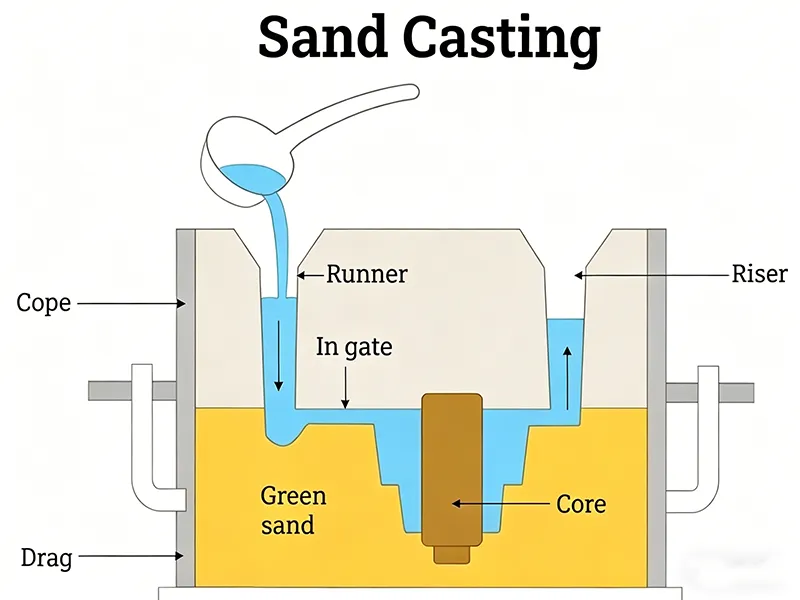
- Cooling and Solidification: The molten metal is allowed to cool. As it solidifies, it typically shrinks slightly, so molds often have risers or vents to feed more metal and prevent voids. Controlled cooling (with chills, coolants, or insulation) can optimize metal structure and reduce defects.
- Removing the Casting: Once solid, the mold is opened or broken. In sand casting the sand mold is dumped; in die/permanent molds the halves separate. The raw casting is ejected or pulled out, often still attached to gates and runners.
- Trimming and Finishing: Excess metal from sprues, gates and flash is cut off. The part may be heat-treated (e.g. solution and aging) for strength. Surfaces are then finished – common operations include sandblasting, polishing, painting or machining. Critical surfaces are milled or drilled to final dimensions.
This sequence – melt, pour, cool, remove, finish – applies broadly to all casting methods. The key differences between processes are in how the mold is made (sand vs machined die) and how the metal is introduced (gravity vs pressure).
Common Aluminum Casting Processes
Several casting processes are used, each suited to particular part types:
- Sand Casting: Molten aluminum is poured into sand molds. This is a very flexible, low-tooling-cost process suitable for large or odd-shaped parts. Sand casting works well for prototypes or low-volume runs. It can accommodate heavy sections and core passages. Advantages: Low cost to make or alter patterns, can cast very large parts, complex geometries. Limitations: Rough surface finish (needs machining or polishing), less dimensional accuracy than other methods, slower cycle times. (Typical example: large pump housings, engine blocks.)
- Die Casting: Molten aluminum is injected under high pressure into hardened steel dies. This yields very high production rates and excellent repeatability, making it ideal for high-volume manufacturing (e.g. automotive and consumer products). Die casting parts have smooth surfaces, fine details and tight tolerances (often ±0.1 mm or better). Advantages: Fast cycles (seconds per part), high precision, good surface finish, little machining needed. Limitations: Very high tooling cost, limited size (usually smaller parts up to a few kg), and moderate scrap from runners. (Example: die-cast engine components, appliance housings.)
- Permanent Mold Casting: Also called gravity die casting, this uses reusable metal molds (often steel or cast iron). Molten aluminum is poured (or sometimes slush cast) into the mold under gravity. Parts come out more uniform than sand-cast, with smoother surfaces and better mechanical properties. Advantages: Good dimensional control, long mold life, better surface finish and material strength than sand. Limitations: Molds still cost more than sand patterns, typically fewer cavities than die-cast dies, and still requires some machining. It’s a middle ground for medium-volume parts that need better quality than sand casting. (Example: medium-run auto components or aerospace fittings.)
- Investment Casting (Lost-Wax): A sacrificial wax pattern is coated with ceramic, melted out, and molten aluminum is poured into the ceramic mold. This process can produce very intricate, thin-walled shapes with excellent accuracy and surface finish. It is more expensive per part than die casting, so it’s used for high-value, complex parts (e.g. aerospace brackets, medical parts, turbine blades). Advantages: Extreme detail and thin sections possible (down to <1 mm walls), minimal parting lines, excellent dimensional accuracy. Limitations: Slow and labor-intensive (wax build-up cycles), higher cost, usually low to moderate volume. For aluminum, investment casting alloys like A356 are common.
Each of these processes has its niche. Sand casting and permanent molds serve large or medium runs, die casting dominates high-volume precision parts, and investment casting excels at the most complex shapes.
Common Cast Aluminum Alloys
Typical aluminum casting alloys combine aluminum with silicon, magnesium, copper and other elements, as summarized in this cast alloy designation reference.
- A356 (AlSi7Mg): One of the most widely used sand/die casting alloys. It has about 7% silicon and 0.3–0.5% magnesium. A356 is valued for its good castability, strength, and corrosion resistance. It can be heat-treated (T6) to achieve high strength (~300–320 MPa UTS). Common applications include automotive transmission cases, differential housings, and other structural parts. In China it’s often called ZL104.
- 319 (AlSi6Cu4): An aluminum-silicon alloy with ~6% Si and 3–4% copper. The copper boosts tensile strength (to ~240 MPa as-cast) and hardness, but reduces corrosion resistance somewhat. 319 is usually used in the as-cast (F) condition, since copper makes heat treatment less effective. It’s commonly found in engine crankcases, gear housings and other powertrain parts. This alloy has very good castability, making it easy to fill complex molds, and also machines well for a casting.
- A380 (AlSi9Cu3FeZn): A die-casting alloy with roughly 8–11% Si, ~3–4% Cu, and Zn up to 3%. The high copper and zinc content give A380 relatively high strength (UTS ~320 MPa) and hardness. However, these alloying elements can hurt corrosion resistance and weldability. A380 is the classic “workhorse” die-casting alloy for automotive and consumer parts (knobs, housings, valves, etc.), where its combination of strength and castability is valued.
- A356.2 / 356: Similar to A356, these are also Al–7Si–0.3Mg alloys but often used for gravity and sand castings with slightly different specs. They have very good corrosion resistance (because of low Cu) and can be age-hardened. You’ll find them in gear housings, oil pans, and any application needing a good strength/corrosion combo.
- Other Alloys: Many other variants exist. For very high fluidity, alloys like A413 (11–13% Si) are used in complex aerospace castings. Some foundries use Japanese ADC12 (roughly Al–10Si–3Cu) for die castings in Asia. Alloys with more copper (like 356.0F vs T6) trade some corrosion resistance for extra strength. The choice of alloy typically depends on needed strength, hardness, fluidity and corrosion resistance. In general: high-Si alloys flow best and make thin walls; Cu-bearing alloys are stronger but less corrosion-resistant; Mg provides age-hardening.
The rule of thumb is to pick an alloy that meets the mechanical and casting requirements of the part. For example, if corrosion/weldability is critical, use low-Cu grades (356 or A356). If maximum strength or wear resistance is needed, you might accept an A380 or A413 alloy and then apply coatings or corrosion allowance.
Advantages of Cast Aluminum
Aluminum casting offers several practical advantages in manufacturing:
- Complex Shapes: You can cast into virtually any geometry. Internal cavities, thin walls, bosses and intricate detail can be created in one piece. This reduces assembly labor and weight. (For instance, a single die-cast gearbox housing might replace many welded or machined parts.)
- Lightweight: As noted, cast aluminum parts are much lighter than comparable iron or steel parts, which is essential in aerospace, automotive, and other transport industries.
- Good Thermal Performance: Aluminum’s high thermal conductivity makes castings good for heat sinks, brake calipers, engine parts, etc., where heat transfer or dissipation is important.
- High Production Efficiency: Processes like die casting run very fast. A well-designed aluminum die casting line can produce hundreds of parts per hour, lowering per-unit cost. Also, aluminum melts at a relatively low temperature, so furnaces heat up quickly and energy use is less than with ferrous metals.
- Material Utilization: Casting is a near-net-shape process, so there is minimal waste. Unlike milling from a block (where 80–90% of material might be cut away), a sand or die cast blank only needs trimming and small machining allowances.
- Good for Hybrid Processes: Cast parts combine well with CNC machining. You can cast a rough shape and then machine only the critical features. This often yields better tolerances and surface finish at lower cost than full-machined parts.
Limitations of Cast Aluminum
No process is perfect, and cast aluminum has some downsides:
- Porosity: The casting process can trap tiny gas bubbles or shrinkage voids inside the metal. This porosity can weaken parts or cause leaks, especially if in critical areas. Proper melt and mold management is needed to minimize this.
- Mechanical Limits: Generally, cast aluminum (especially as-cast, non-heat-treated) has lower tensile strength and ductility than forged/wrought aluminum. Its fatigue resistance is also lower. So high-load or highly-vibrating parts sometimes use forged aluminum or steel instead.
- Surface and Dimensional Variation: Cast parts often have rougher surfaces and larger tolerances than machined parts. Achieving tight dimensions means extra machining steps. Fine surface finish also usually requires polishing or coating.
- Casting Defects: Issues like cold shuts, shrink cracks, or inclusions can occur if the mold design or pouring practices aren’t perfect. These affect yield and consistency.
- High Tooling Costs (for Some Processes): Die casting and permanent-mold casting require expensive steel molds. If the production volume is small, those initial costs may not be justified. (Sand casting has lower tooling cost, but then per-part labor can be higher.)
In practice, designers must weigh these limitations against the benefits. For many applications, the advantages of casting outweigh the downsides. And good casting engineers can control many defect causes to keep quality high.
Cast Aluminum vs Other Aluminum Forms
- Cast vs Wrought Aluminum: Cast alloys (used in casting) contain higher levels of silicon and other elements that improve flow. Wrought alloys (used for sheets, plates, extrusions) are purer or have other alloying blends for formability. Wrought parts (like extrusions or forgings) typically have superior tensile strength and fatigue life. However, they can only be shaped into certain profiles. Cast aluminum allows more complex 3D forms and is often cheaper for those shapes. In short, if you need extreme strength in a simple shape, wrought might be better; but for a one-piece complex geometry, casting is usually preferable.
- Cast vs Machined Aluminum: “Machined aluminum” usually refers to parts cut from solid stock (billets or forgings). Purely machined parts give excellent precision and surface finish but involve more waste and machining time. Cast + machine hybrid approaches (casting the rough shape then CNC finishing) are common. The cast blank speeds up production and reduces waste, while the machining step ensures critical dimensions. So cast+machine often hits a good balance of economy and precision.
- Cast vs Extruded Aluminum: Extrusion produces long parts with constant cross-sections (like rods, rails, tubes). It cannot make enclosed volumes or highly irregular shapes. Cast aluminum complements extrusion by handling closed sections and fully 3D parts. Also, extruded alloys (6xxx series) anodize extremely well for a smooth finish, whereas cast alloys (with high Si) can anodize to a slightly mottled grey color. Designers might choose extrusion for long frames or rails, and casting for housings and boxes.
- When to Choose Casting: Cast aluminum is generally chosen when a part is too complex, thick, or three-dimensional to form by rolling/extruding, or when volumes justify a mold. If the part is simple (like a sheet metal panel or barstock) and needs very high strength or a seamless surface, wrought or extruded may be better.
Cast Aluminum vs Other Cast Metals
- Cast Aluminum vs Cast Iron: Aluminum is only about one-third the weight of iron (density ~2.7 vs ~7.2 g/cm³). An aluminum part corrodes less (no rust) and dissipates heat faster. Iron castings (like engine blocks or gears) are much stronger (tensile 200–400 MPa for ductile iron) and cheaper per cubic volume, and iron tolerates compression well, but iron is heavy and rusts if unprotected. In many applications (e.g. auto engines, compressors, frames), engineers choose aluminum for light weight and corrosion-resistance, but iron if cost and wear-resistance are paramount.
- Cast Aluminum vs Cast Steel: Cast steels are significantly stronger than aluminum but even heavier (density ~7.8). They handle extreme stress and temperature better. However, steel parts need heat treatment and coatings to avoid rust, and steel casting requires much higher melting temperatures. For components that must be light (like a wheel hub) or must not corrode, aluminum often wins. For something like a heavy-duty structural component (machine frame, structural bracket) requiring very high strength, steel might be chosen despite weight.
- Cast Aluminum vs Zinc Alloys: Zinc die-casting alloys (like ZA-8 or Zamak series) are denser than aluminum (close to steel density) and have lower melting points. Zinc parts are very strong (especially in impact resistance) and easier on mold life, but zinc’s extra weight and higher cost of material often make aluminum preferable in weight-sensitive parts. Zinc does have superb detail reproduction and even better corrosion resistance than some aluminum alloys, so it’s often used in small precision parts (like hardware components). Aluminum, on the other hand, produces lighter parts and has excellent overall corrosion resistance itself.
- Examples: In practice, designers compare density, strength, corrosion and cost. For example, an electrical vehicle battery housing (complex, needs heat dissipation) might be cast aluminum for its light weight and cooling. A heavy machinery gear housing might be cast iron to save cost and handle shock. Small mechanical parts like bearings housings sometimes go to zinc because of precision. Each metal has its niche.
Common Applications of Cast Aluminum
Cast aluminum finds use across many industries for the reasons above:
- Automotive: Engine blocks, cylinder heads, transmission cases, wheels, suspension components, intake manifolds, pistons (in some engines). Automakers favor cast aluminum wherever weight savings can improve fuel economy or performance. For example, many modern car engines have cast aluminum blocks and heads (as shown), reducing weight by tens of kilograms compared to cast iron. Other parts like gearbox housings and brackets are also commonly cast.
Fig. Cast aluminum engine blocks and cylinder heads are ubiquitous in today’s automotive industry for their light weight and good strength.
- Aerospace: Aircraft structural components such as wing ribs, brackets, and fittings; jet engine housings; landing gear parts (for smaller aircraft); and even some fuselage or interior parts. Weight is crucial in aerospace, so aluminum castings (often high-end alloys) are used wherever possible. Investment casting in particular is used for intricate aerospace parts like actuator housings or turbine support brackets.
- Pump and Valve Bodies: Pump casings, valve bodies, impellers and housings are commonly cast from aluminum, especially for water pumps, HVAC pumps, and hydraulic equipment. Aluminum’s corrosion resistance helps in water or chemical environments, and its lightness makes large pump stations easier to install.
Fig. Aluminum pump or valve housings (pictured) are often cast for industrial fluids applications. The cast metal provides a rigid, corrosion-resistant enclosure.
- Electronics Housings: Enclosures for outdoor electronics, LED housings, heat sinks, and other electronic components often use cast aluminum. Its thermal conductivity helps dissipate heat (e.g. in power electronics), and cast shapes allow internal channels or fins. Unibody aluminum cases (like for laptops or lighting) can be investment cast for precision and then anodized for appearance.
- Industrial Equipment: Many factory machines, HVAC equipment, and energy-generation systems have cast aluminum parts (gearbox housings, fan casings, support frames) to cut weight and resist corrosion. Example: electrical motor housings are sometimes cast aluminum for light weight.
- Consumer Products: Items like cookware, patio furniture parts, camera tripods, and sporting goods (bicycle rims, etc.) are often cast from aluminum for the light weight and aesthetic. Decorative hardware (lamps, handles) uses investment cast aluminum. Even architectural elements (window frames, handrails) can be cast when the geometry is complex.
Surface Finishing Options for Cast Aluminum
After casting, parts often undergo surface treatments and machining to achieve the final look and properties:
- Powder Coating: A durable polymer finish is applied as a free-flowing powder and baked on. Powder coating on aluminum provides a tough, weather-resistant surface that resists corrosion and scratches. It’s common for automotive and outdoor applications.
- Painting: Standard liquid paints can be used as well (often after primer). Paint is less durable than powder, but allows many color choices and is often cheaper for small batches.
- Anodizing: An electrochemical process that thickens the natural oxide layer on aluminum. Anodized cast aluminum parts gain a hard, corrosion-resistant surface that can also be dyed in colors. However, high-silicon casting alloys tend to produce a slightly greyish finish under anodizing, unlike the bright finish of pure aluminum extrusions. Still, anodizing is widely used for aerospace and consumer parts that need both wear resistance and a finished look.
- Shot Blasting: Blasting the casting with abrasive beads or grit cleans off sand or slag and slightly roughens the surface. This is often done before painting or powder coating to ensure good adhesion. Shot blasting also gives a uniform matte finish.
- Polishing: Cast parts can be mechanically polished or buffed to a smooth sheen if a shiny metal finish is desired. However, this is mostly for small parts or decorative pieces, since most castings have tool marks or parting lines that must first be removed.
- Secondary Machining: Finally, critical surfaces are machined to final dimensions. For example, bearing bores, threaded holes, or sealing surfaces are milled or bored to tight tolerance. Machining can also be used to smooth cast surfaces that need high precision. Many die-cast parts skip heavy finishing because their as-cast finish is already good, but most sand-cast parts require significant machining.
Each finishing method affects appearance and performance. For example, anodizing greatly increases corrosion and wear resistance without adding thickness, while powder coating adds color and chemical protection. Designers often choose based on functional need: “paint it for color and low cost, or anodize it for durability,” etc.
Common Defects in Cast Aluminum
Common ones include porosity, shrinkage, and cold shuts, which are discussed in this aluminum casting handbook reference:
- Porosity: Tiny voids or gas bubbles trapped in the metal. Porosity can occur from dissolved hydrogen in the melt or from shrinkage during solidification. These pores reduce strength and can cause leaks in pressure parts. Preventing porosity requires good melt quality (degassing, filtration) and proper riser placement to feed any shrinkage.
- Shrinkage: As aluminum solidifies, it contracts. Without proper risers or feeders, that contraction leaves cavities (shrinkage defects) inside thick sections. These voids are generally larger than porosity. A well-designed mold with insulated risers will channel additional molten metal to areas that shrink most.
- Cold Shuts / Misruns: These occur when the metal flow meets itself too cool and fuses poorly, or doesn’t completely fill the mold. The result is a weld line or an incomplete portion of the casting. Cold shuts happen if pouring temperature is too low or if the mold geometry impedes flow. Designers avoid them by ensuring smooth flow paths, proper gating and high enough melt temperature.
- Cracks: Solidification cracks (hot tears) can occur if thermal stress builds up during cooling. For example, a casting with one thick section cooling and contracting against a thin, already-solid section may crack at the junction. Avoiding sharp corners and controlling the cooling rate can help reduce cracks.
- Surface Defects (Scars, Blisters, Inclusions): These are cosmetic flaws. Scars or laps result from metal folding over (often due to cold shuts). Blisters are raised bumps from trapped gas under the surface. Sand or oxide inclusions can cause rough spots. Good mold cleaning, coated cores, and controlling venting help minimize these.
In practice, foundries inspect castings (visually or with X-rays) to catch defects. Careful alloy selection and mold design (gates, vents, chills) are the primary ways to prevent these issues. For example, using a low-shrinkage alloy or adding extra vents at sharp corners can greatly reduce voids.
How to Choose the Right Aluminum Casting Process
Selecting a process depends on the part requirements:
- Part Size: Large parts (over 50–100 kg) typically go to sand casting because huge permanent dies are impractical. Very small, highly detailed parts favor die casting or investment casting.
- Production Volume: Die casting and investment casting have high tool costs but very low unit cost in mass production. Sand casting is cost-effective for low to medium volumes (even single prototypes), since patterns are cheap. Permanent-mold sits in between.
- Tolerances and Surface Finish: Die and investment casting achieve tight tolerances and fine finishes, reducing need for machining. Sand casting often needs more machining and finishing.
- Surface Finish and Appearance: If the final look is important (smooth walls, few visible parting lines), die casting or investment casting is better. Sand-cast surfaces are usually rougher.
- Cost Targets: In early design, weigh tooling vs piece cost. If you only need a few parts, sand casting or CNC machining of a cast block may be cheapest. For millions of parts, the initial mold cost of die casting can be justified by the low unit cost.
In summary, small complex parts in high quantity → die or investment cast; very large or low-volume parts → sand cast; mid-volume precision parts → permanent mold. Discussions with the foundry at the design stage (Design for Manufacturability, or DFM) often yield the best process choice.
Is Cast Aluminum Good for Machining?
Aluminum in general machines more easily than steel, but cast alloys require slightly different considerations. Cast aluminum (especially high-silicon grades) is less ductile and can be more abrasive to cutting tools than wrought aluminum. In fact, machinability of a typical cast aluminum alloy is roughly half that of a soft wrought alloy, so tools wear faster. However, most modern tooling and speeds handle cast alloys well. Importantly, cast parts often need CNC work to finish holes, faces, and threads. Many components are designed assuming a cast blank will be machined to final dimensions. This “cast + machine” approach often gives the best of both worlds: the casting provides the near-net complex shape, and machining yields the precise features.
In short, cast aluminum machines quite well, just not quite as effortlessly as the softest alloys. Its chips are easy to break and aluminum doesn’t harden the way steel does, so the overall machining process is still easier. The main challenge is tool wear from silicon particles – so carbide tools are standard. Overall, cast aluminum is generally considered friendly to machining, and using CNC on cast parts is a standard industry practice.
How to Improve Cast Aluminum Part Quality
A few key guidelines can greatly reduce defects and boost quality:
- Optimize Mold Design: Ensure uniform wall thickness where possible, and avoid sharp corners or pockets that trap metal. Place gates and vents so molten metal flows smoothly and air can escape. For example, adding vents at the end of flow paths and making fillets in corners helps eliminate cold shuts and gas traps. Good gating (proper gate size and angle) also ensures complete mold fill.
- Choose the Right Alloy: Use an alloy suited to the part. For thin-wall or intricate castings, pick high-fluidity grades (high Si). If corrosion resistance is key, avoid high-copper alloys and consider low-Fe, high-Mg alloys. The wrong alloy choice can make porosity or hot tears unavoidable.
- Control Melting and Pouring: Melt quality is crucial. Degas the melt to remove hydrogen (a common cause of porosity) and skim off dross. Use clean, dry charge stock (water in ingots will flash to gas). Pour at the right temperature: too cool and you get cold shuts, too hot and shrinkage porosity can increase. Consistent pouring speed (as in controlled shot in die casting) helps avoid turbulence and gas entrapment.
- Manage Solidification: Use chills or controlled cooling to even out solidification. A “hot spot” in thick sections should solidify last so it is fed by the riser rather than shrinking internally. Good process control (timing of mold closing, ejection, cool-off) also ensures uniform material properties.
- Inspection and Finishing: Employ quality checks (like X-ray or dye penetrant) especially on critical sections to catch porosity early. Machining or grinding away the outer skin of a casting (which sometimes has more defects) can also improve performance. Surface treatments (like shot peening or annealing) can relieve stresses.
- Design for Manufacturability (DFM): In the design phase, review the part geometry with casting in mind. Simplify where possible (for example, avoid internal reentrant corners). Incorporate draft angles on vertical walls, smooth transitions, and visible parting lines. All of these steps make the mold easier to fill and eject.
By addressing these areas—mold layout, alloy choice, process control, and inspection—manufacturers can dramatically reduce defects and get reliable cast components. In practice, manufacturers follow guidelines like those above and work closely with engineers to fine-tune each design.
Summary
Cast aluminum refers to components made by pouring molten aluminum alloys into molds. It’s a cornerstone of manufacturing because it offers light weight, corrosion resistance, and the ability to form complex shapes at reasonable cost. Common casting processes include sand casting (for large or low-volume parts), die casting (for high-volume precision parts), permanent mold, and investment casting (for very fine, complex parts).
Typical alloys like A356, 319 and 380 combine aluminum with silicon, magnesium and copper to balance fluidity, strength, and corrosion resistance. Cast aluminum shines in industries like automotive (engine blocks, wheels), aerospace (brackets, housings), electronics (cases and heat sinks), pumps/valves, and consumer products – essentially anywhere a strong, light, and thermally good metal is needed.
The advantages of casting include near-net-shape forming, minimal waste, and fast production. However, designers must watch for porosity, dimensional tolerances, and initial tooling cost. When choosing a solution, consider part size, volume, tolerance and finish requirements. In many cases, a hybrid strategy (cast the rough shape, then CNC machine critical surfaces) gives the best results.
In the end, cast aluminum is a practical, versatile way to make real-world parts. By understanding the materials, processes and trade-offs, engineers can leverage casting to get lightweight, durable components that perform well and cost less. The right alloy and process selection – along with good design practices (DFM) – ensure cast aluminum continues to play a key role in modern manufacturing.
FAQ
What is cast aluminum used for?
Almost anything that benefits from a lightweight metal. Common uses include automotive engine blocks and heads, transmission cases, wheels, pump and valve bodies, electronics housings, and structural components in aerospace or machinery.
Is cast aluminum strong?
Yes, aluminum castings can be quite strong (especially after heat treatment). Modern casting alloys like A356-T6 can reach 300+ MPa tensile strength. While it’s generally not as strong as forged steel or high-strength wrought alloys, its strength-to-weight ratio is excellent. Cast aluminum is more than strong enough for many structural applications.
Does cast aluminum rust?
No. Aluminum does not rust like iron; instead it forms a hard, protective oxide layer almost instantly. This makes cast aluminum highly corrosion-resistant, especially compared to steel. In corrosive environments, it often outlasts uncoated steel parts.
What is the difference between cast aluminum and wrought aluminum?
Cast aluminum alloys are formulated and processed differently from wrought alloys. Cast alloys contain more silicon (for fluidity) and are poured into a mold; wrought aluminum is rolled or extruded from a solid billet. Wrought aluminum typically has higher ductility and better surface finish, while cast aluminum allows more complex shapes. Also, cast aluminum parts often have more porosity or internal defects compared to wrought parts.
Is cast aluminum good for machining?
Generally yes – aluminum is easier to machine than most metals. Cast aluminum, however, contains more silicon, which can be abrasive, so tooling wears faster than on pure wrought alloys. Still, cutting forces are low and the metal chips easily. In practice, most cast aluminum parts are designed for some CNC finishing, and doing so yields precise, high-quality components.
What is the most common cast aluminum alloy?
One of the most common is A356 (also known as A356.0 or AlSi7Mg). Its silicon-rich composition and good age-hardening response make it a workhorse for castings in many industries. Other very common alloys are 319 (for automotive powertrain parts) and A380 (a general-purpose die casting alloy).