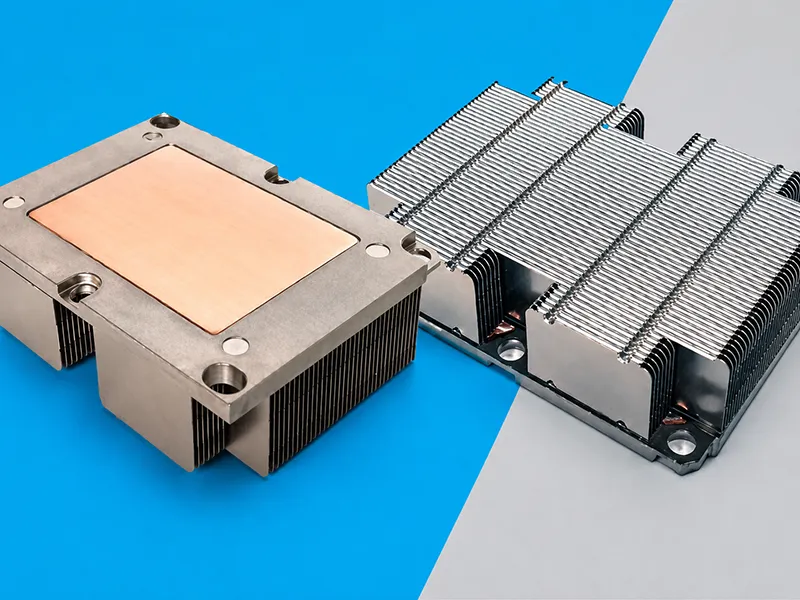
What are heat sinks? Heat sinks are thermal management components designed to move heat away from high-power electronic devices and release it into the surrounding air or another cooling medium. In practical terms, a heat sink performs three linked functions: it absorbs heat from the source, conducts that heat through its body, and dissipates it over a larger exposed surface. That is why heat sinks are widely used in electronics, LED lighting, power supplies, automotive electronics, and industrial systems where overheating can reduce performance or damage components.
A heat sink is not just a block of metal. A plain metal mass can store heat for a while, but a real heat sink is engineered around contact quality, thermal resistance, surface area, and airflow. Its base is shaped to mate with the heat source, and its fins or other features are designed to expose more metal to moving air so heat can leave the system efficiently.
What is a heat sink?
Heat sinks are one of the most fundamental cooling components in electronic design. They are used when a device cannot be cooled adequately through its own package, PCB copper, or housing, and a more efficient path is needed to carry heat away from the source. In that sense, a heat sink is best understood as a purpose-built heat exchanger for electronic thermal management.
The simplest way to answer the main keyword is this: what are heat sinks? They are specialized metal components, most often made from aluminum or copper, that increase the surface area available for heat dissipation while creating a better thermal path from the hot component to the ambient environment. This is the key difference between a heat sink and an ordinary metal block: the heat sink is designed for lower thermal resistance, better airflow interaction, and more reliable temperature control.
Common examples include CPU coolers, LED module heat sinks, heatsinks for power transistors and DC/DC converters, aluminum housings with cooling fins, and thermal structures used in EV power electronics, industrial SMPS, and aerospace electronics. In all of these cases, the purpose is the same: keep temperatures within the safe operating range defined by the component supplier or system designer.
How Do Heat Sinks Work?
Heat sinks work through the combined effects of conduction, convection, and, to a lesser degree in many air-cooled systems, radiation. Heat naturally moves from a hotter region to a cooler one. In a typical electronics assembly, heat first leaves the semiconductor package, travels into the heat sink body, and is then transferred from the heat sink surface to the surrounding air.
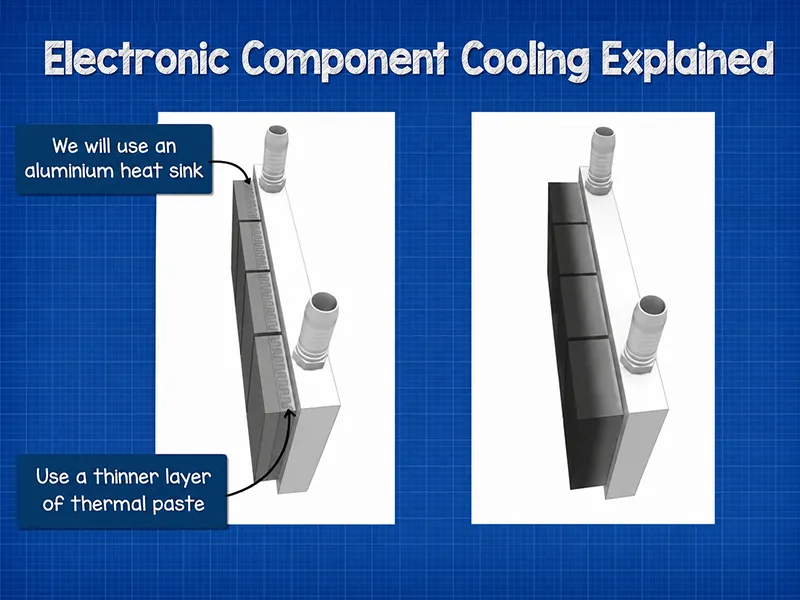
Conduction. The first stage is heat transfer by conduction. Heat moves from the device junction and case into the heat sink base through direct contact. Because real surfaces are never perfectly flat, interface gaps can trap air, and air is a poor heat conductor. That is why thermal interface materials such as grease, paste, pads, or tapes are commonly used between the component and the heat sink to reduce contact resistance and improve the effective thermal path.
Convection. Once heat reaches the sink, it must leave the metal and enter the surrounding air. Passive heat sinks rely on natural convection, where warm air rises without the help of a fan. Active heat sinks rely on forced convection, where a fan or blower pushes cooler air across the fins to increase turbulence and boost heat transfer. In natural convection, radiative heat loss can also make a meaningful contribution, especially in passive designs.
Surface area. The reason most heat sinks have fins, pin arrays, ducts, or other protruding shapes is simple: more exposed surface area usually means more opportunity to transfer heat to air. However, more area alone is not always enough. Fin spacing, fin height, and fin orientation must still allow air to move freely. Very dense fins can actually restrict airflow and reduce the expected thermal benefit, especially in LED and passive cooling applications.
Why Are Heat Sinks Important?
Heat sinks matter because excess temperature has a direct effect on electronic reliability, performance, and service life. Texas Instruments notes that maximum junction temperature is one of the primary factors limiting device power dissipation, while DigiKey explains that operating temperature is tightly linked to device longevity and reliability. Put simply, if the heat cannot escape, the component runs hotter; if the component runs hotter, the risk of drift, derating, and premature failure increases.
This is especially important for LEDs, where light output, forward voltage, color characteristics, and reliability all change with temperature. Bridgelux’s LED thermal management guidance notes that LED array performance and design life depend heavily on proper thermal management, and that exceeding maximum case or junction temperatures can permanently damage the product or shift its performance.
Heat sinks are equally important in high-power automotive and industrial electronics. onsemi’s application notes for automotive converters and top-side cooled packages show that better heat sink integration lowers device temperature, reduces thermal stress, and can improve reliability, compactness, and efficiency in systems such as onboard chargers, HV DC/DC converters, ECUs, and industrial SMPS.
Main Parts, Types, and Materials
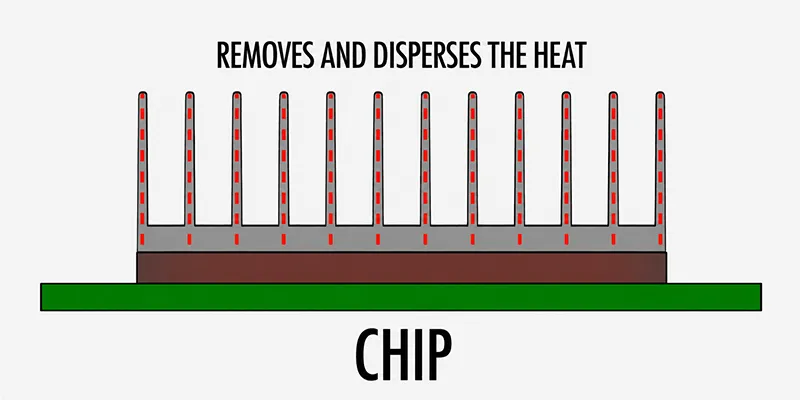
The core geometry of most heat sinks is built around a base plate and a fin structure. The base is the primary contact area with the heat source, and its job is to spread heat out from the hot spot. The fins then expose that heat to a much larger air-contacting surface so the sink can dissipate it more effectively than a flat plate with the same footprint. In custom assemblies, grooves or slots may also be machined into the base to attach bonded fin structures or add specialized cooling features.
Mounting features are just as important as the visible fin geometry. Screws, nuts, clips, solder tabs, spring clips, epoxy bonding, or adhesive pads are used to keep the sink aligned and pressed against the device surface. onsemi’s mounting guidance shows that hole size, torque, flatness, roughness, and contact pressure all influence heat transfer quality, because poor mounting creates higher contact resistance and worse cooling performance.
Surface finish matters for corrosion resistance, appearance, and in some cases radiative behavior. Boyd lists black or clear anodize as common finishes for many aluminum heat sinks. NIST’s anodizing reference explains that anodizing improves corrosion resistance, decorative appearance, abrasion resistance, and can provide a range of colors; it also notes that sufficiently thick anodic films increase emissivity, with black dyed films showing strong heat absorption characteristics.
In terms of types of heat sinks, the most basic distinction is between passive and active designs. Passive heat sinks rely on natural airflow and are common where simplicity, zero moving parts, and low maintenance matter most. Active heat sinks add a fan or blower and are used when the heat load is higher, the available space is smaller, or the required thermal resistance is lower than passive cooling alone can provide.
There are also several common fabrication styles. Extruded heat sinks are among the most popular because they are cost-effective, scalable, and well suited to low- and medium-power applications. CNC machined heat sinks are useful when a design needs custom lengths, tighter feature control, drilled holes, slots, threads, or special mounting geometry. Die cast heat sinks are attractive when the design calls for complex shapes, single-piece construction, or higher-volume near-net-shape production with good cosmetic surfaces.
When people search for heat sink materials, the discussion usually comes down to aluminum vs copper. Aluminum is favored because it is lightweight, relatively inexpensive, easy to extrude and machine, and compatible with anodizing. Copper offers higher thermal conductivity, but it is heavier and more expensive, so it is usually chosen when performance requirements justify the additional mass and cost.
Representative material trade-offs are summarized below. Exact thermal conductivity depends on alloy and temper, but a common engineering comparison uses roughly 235 W/m·K for aluminum and 400 W/m·K for copper as representative values, while Aluminum Association data shows aluminum alloys span a wider overall range depending on composition.
| Material | Thermal Conductivity | Weight | Cost | Machinability | Common Use |
|---|---|---|---|---|---|
| Aluminum | Good to very good | Light | Lower | Excellent | Electronics, LED modules, enclosures, general-purpose heat sinks |
| Copper | Excellent | Heavy | Higher | Good | High-performance cooling, compact high-heat applications |
In many commercial products, aluminum heat sinks are the default choice because they offer the best all-around balance of thermal performance, weight, cost, manufacturability, and finishing options. Copper is usually selected when space is limited and every degree of thermal margin matters.
Key Factors in Heat Sink Design
The phrase heat sink design covers much more than fin count. The most important starting points are thermal conductivity, allowable temperature rise, and total thermal resistance. TI’s heat sink thermal design guidance frames heat sink selection around the amount of heat that must be dissipated, the permissible junction-to-ambient temperature difference, and the thermal resistance required from the sink itself.
Lower thermal resistance means better cooling performance.
Fin geometry is one of the most load-bearing parts of the design. TI lists fin density, fin spacing, width, and length among the core selection parameters. Boyd and DigiKey both note that fin shape and pitch determine how well the sink works in passive or active cooling. More fins can increase available surface area, but if they are too closely packed, airflow may become less effective rather than more effective.
Airflow direction matters as much as fin size. Boyd’s thermal design guidance highlights the chimney or stack effect in natural convection, where orientation and spacing help heated air move upward more efficiently. TI also notes that width and length affect performance differently depending on airflow direction, and that the thermal resistance of a heat sink changes dynamically with the airflow available.
Surface area is still central, but it has to be balanced against size and weight limits. In real products, the ideal thermal design is often constrained by board area, housing dimensions, mass targets, cost, and service environment. Electronics Cooling notes that heat sink selection is often limited by space and weight requirements, while Boyd emphasizes that device shape, weight, and geometry all influence the choice of heat sink style and fabrication method.
Manufacturing method is another major design factor. Extrusion is fast and economical for repeatable profiles, die casting is attractive for complex near-net shapes at higher volume, and machining is useful when custom features or design iterations matter more than tooling efficiency. Surface treatment should be matched to the environment as well. Anodizing can improve corrosion resistance and appearance, and in some passive designs it can also increase emissivity.
How Are Heat Sinks Manufactured?
One of the most common ways to make a custom heat sink is CNC machining. In CNC machining, a CAD model is translated into controlled cutting operations that shape the final part with precise positioning. This approach is especially useful when the design needs drilled holes, slots, threads, custom lengths, unusual mounting geometry, or iterative development with minimal lead time. It is also widely used as a secondary process to finish extruded or near-net-shaped parts.
Aluminum extrusion is one of the most established heat sink manufacturing methods. A die is created for a fixed cross-section, softened aluminum is pushed through the die to create a long profile, and the resulting bar is cut to length and then machined or finished as needed. Boyd describes extruded aluminum heat sinks as one of the most popular and cost-efficient fabrications because the method is fast, scalable, and well suited to low- and medium-power cooling.
Die casting is typically used when the design requires complex geometry, single-piece construction, and higher production volume. In this process, a thermally conductive alloy is cast into a mold in near-net shape, then lightly machined and finished. Boyd notes that die cast heat sinks are particularly useful where weight sensitivity, cosmetic quality, or shape complexity are important.
After the core shape is made, surface finishing helps determine how the part will look and how it will perform in its environment. Common options for aluminum heat sinks include anodizing, clear finishing, and various polishing or brightening steps that change luster and improve corrosion resistance. In passive designs, darker or more emissive finishes may also help radiation contribute more to overall heat loss.
Applications, Selection, and Custom CNC Machined Heat Sinks
Heat sinks are used across a very wide range of industries. In electronics, they cool CPUs, GPUs, power transistors, MOSFETs, converters, and packaged ICs. In LED lighting, they help preserve light output, color stability, electrical characteristics, and long service life by controlling case and junction temperature. In power supplies and converters, they protect components that operate at higher heat density as systems become smaller and more powerful.
In automotive electronics, heat sinks are increasingly important in ECUs, onboard chargers, HV DC/DC converters, ADAS hardware, traction-related electronics, and other high-power modules where compact packaging and reliability both matter. In aerospace and industrial equipment, thermal management is equally critical because electronics must remain within allowable temperature limits while operating under strict reliability and environmental requirements. NASA’s thermal control guidance emphasizes that aerospace components must stay within defined survival and operating temperatures, while Boyd’s aerospace materials describe air-cooled heat sinks and liquid cooling structures used for high-reliability electronics.
When deciding how to choose the right heat sink, start with the heat load in watts, maximum allowable device temperature, and the heat sink selection process used to determine the required thermal resistance. Then evaluate ambient conditions, available airflow, orientation, space envelope, material choice, mounting method, interface material, quantity, finish, tolerance needs, and cost target. Vendor guidance from TI, DigiKey, Boyd, and onsemi all points to the same conclusion: good heat sink selection is a system-level exercise, not a one-variable decision based only on fin count.
For projects that do not fit a standard profile, custom CNC machined heat sinks are often the best option. They are especially useful when you need nonstandard fin layouts, custom pockets, grooves, slots, mounting holes, threads, or tightly controlled mating surfaces. CNC machining is also a strong choice for prototypes and low-volume production because it allows the thermal design and the mechanical design to evolve together before a product is locked into higher-volume tooling such as extrusion dies or die-cast molds.
The most effective heat sink is rarely the one with the most metal or the most fins. It is the one whose material, geometry, airflow strategy, mounting method, and manufacturing process are matched to the real thermal load, the available space, and the economics of the product. That is the core of good heat sink design, and it is what turns a basic cooling part into a reliable thermal management solution.
Conclusion
Heat sinks are critical components for thermal management in electronics, automotive systems, LED lighting, and industrial equipment. By understanding how heat sinks work, their materials, types, and design factors, engineers can choose a more efficient and cost-effective cooling solution. For custom aluminum heat sinks with precise fins, mounting holes, and surface finishes, CNC machining is a flexible and reliable manufacturing option.
FAQ About Heat Sinks
What are heat sinks used for?
Heat sinks are used to absorb and dissipate heat from electronic components, power devices, LED systems, and industrial equipment to prevent overheating.
How do heat sinks work?
Heat sinks transfer heat from a hot component to a larger metal surface, then dissipate that heat into the surrounding air through fins or pins.
What is the best material for heat sinks?
Aluminum is the most common heat sink material because it is lightweight, cost-effective, easy to machine, and offers good thermal conductivity. Copper provides higher conductivity but is heavier and more expensive.
Are aluminum heat sinks better than copper heat sinks?
Aluminum heat sinks are better for lightweight and cost-sensitive applications, while copper heat sinks are better for high-performance cooling where weight and cost are less important.
What are the main types of heat sinks?
Common types include passive heat sinks, active heat sinks, extruded heat sinks, CNC machined heat sinks, and die cast heat sinks.
Can heat sinks be CNC machined?
Yes. CNC machining is ideal for custom heat sinks that require precise fins, complex shapes, tight tolerances, mounting holes, or low-volume production.
What affects heat sink performance?
Heat sink performance depends on material, surface area, fin design, airflow, contact quality, surface finish, and the amount of heat generated by the component.
What industries use custom heat sinks?
Custom heat sinks are widely used in electronics, LED lighting, automotive electronics, aerospace, power supplies, telecommunications, and industrial equipment.