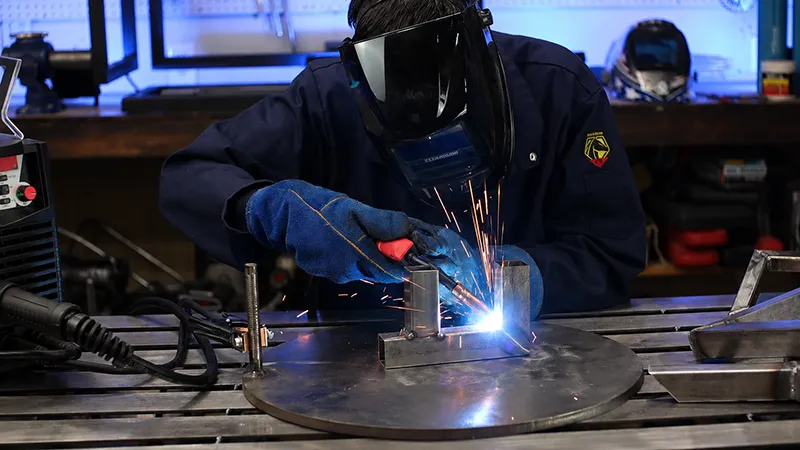
Tack welding is a fundamental step in metal fabrication used to temporarily fix components in place before final welding. In practice, it acts as a geometric “locking mechanism” that preserves alignment, spacing, and joint fit-up while the assembly is still flexible. In sheet metal and structural fabrication workshops, tack weld quality often determines whether the final weld will be dimensionally stable or require rework.
From shop-floor experience in CNC-fabricated enclosures and welded frames, we consistently observe that poor tack strategy—not final welding—causes most distortion and misalignment issues. Even a 1–2 mm deviation introduced at the tack stage can propagate through the entire assembly during heat cycling.
This guide explains what tack welding is, why it matters, how it is performed, and how experienced fabricators control it to improve weld accuracy, reduce distortion, and ensure repeatable manufacturing outcomes.
What Is Tack Welding?
Tack welding is a localized, short weld used to temporarily hold two or more metal parts in correct relative position prior to full welding. These welds are typically small in length and strategically placed along a joint line. For a general technical definition, the TWI tack weld definition guide explains how tack welds hold parts together before final welding and help maintain alignment and gap.
In fabrication practice, tack welds are not simply “small welds.” They function as part of the assembly control system. Once applied, they define the final geometry before thermal input from continuous welding locks the structure permanently.
Depending on process requirements, tack welds may:
- Remain and fuse into the final weld bead
- Be ground out before final welding
- Be removed entirely if misaligned
- Be reinforced in subsequent passes
Common processes used include MIG and TIG welding, stick welding (SMAW), resistance spot welding, and in high-precision environments, laser welding.
From workshop observation in CNC sheet metal enclosures (typically 1.5–3 mm aluminum panels), TIG tack welds are preferred when distortion control is critical because of their lower heat input compared with MIG.
Why Is Tack Welding Used?
Tack welding is primarily used to stabilize geometry before full thermal loading occurs.
Key functions include:
- Maintaining joint alignment under mechanical stress
- Preserving designed weld gaps (especially root openings)
- Preventing part movement after clamp release
- Reducing cumulative distortion during multi-pass welding
- Allowing intermediate inspection before final commitment
In our fabrication tests on welded machine frames (carbon steel square tubing), assemblies without sufficient tack points showed up to 3–5 mm angular drift after full welding. When symmetrical tack patterns were introduced, deviation dropped below 1 mm.
Typical applications:
- Sheet metal enclosure pre-assembly before seam welding
- Bracket positioning on load-bearing frames
- Pipe alignment prior to root pass welding
- Temporary fixation of multi-part assemblies
Tack welds are therefore not auxiliary—they are a structural control stage in the welding workflow.
How the Tack Welding Process Works
Step 1: Prepare the Metal Surfaces
Surface preparation directly affects tack weld integrity. In practice:
- Oil and cutting fluid residues must be removed
- For aluminum welding, oxide layers should be mechanically or chemically cleaned before tack welding because surface contamination can increase porosity, reduce fusion quality, and weaken the final weld.
- Rust and mill scale on steel must be eliminated
- Edge burrs from laser or plasma cutting should be deburred
In CNC laser-cut mild steel parts, we observed that unremoved oxide layers increased porosity occurrence in tack welds by a noticeable margin during MIG trials.
Step 2: Fit and Align the Parts
Parts are positioned according to drawing specifications using:
- Mechanical clamps
- Welding fixtures
- Magnetic holders (for non-critical assemblies)
- Alignment jigs for repeatability
Critical checks include:
- Joint gap consistency
- Angular alignment
- Hole-to-edge positioning
- Flatness before welding
In production runs of sheet metal boxes, fixture-based alignment reduced rework rate by approximately half compared to manual alignment.
Step 3: Place the Tack Welds
Tack welds are applied at predefined positions along the joint.
Best practice from shop-floor application:
- Use minimal heat input sufficient for fusion
- Keep tack size consistent
- Avoid oversized weld “bulges”
- Place tacks symmetrically to balance thermal stress
For thin 2 mm stainless steel panels, excessive tack size was found to cause local warping even before final welding began.
Step 4: Inspect the Tack Welds
Inspection typically checks:
- Cracks at weld toe
- Porosity or contamination
- Lack of fusion
- Excess reinforcement height
- Local distortion or pull-in
- Misalignment after tack cooling
In practical fabrication, we reject tack welds immediately if cracking appears, because they almost always propagate during final welding.
Step 5: Complete the Final Weld
Final welding strategy depends on tack condition:
- Sound tacks are incorporated into the weld bead
- Defective tacks are removed or ground flush
- Welding sequence is planned to minimize heat concentration
- Inter-pass cooling is applied for distortion-sensitive parts
In production environments, welding work should also follow applicable safety requirements, including fire prevention, ventilation, equipment control, and operator protection. OSHA provides relevant welding, cutting, and brazing standards for general industry operations.
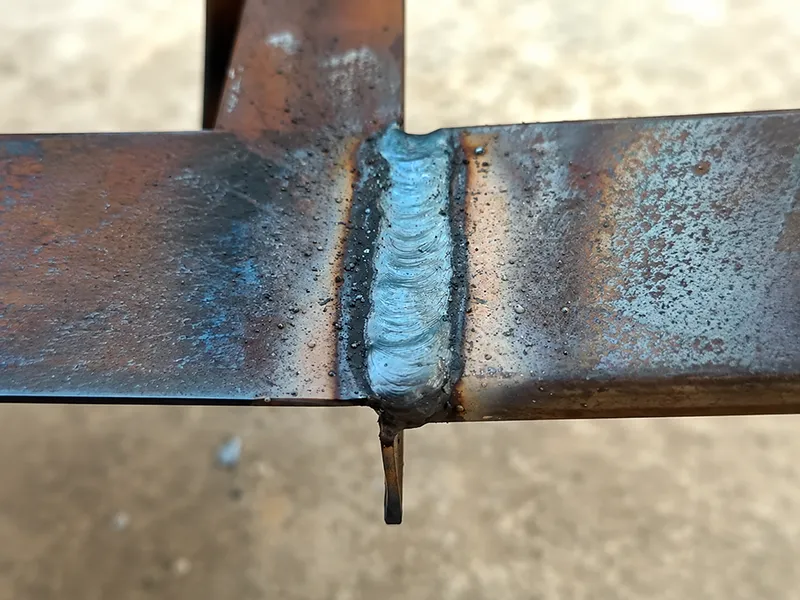
Common Types of Tack Welds
Small Tack Welds
Used for lightweight assemblies such as sheet metal brackets. Low heat input minimizes distortion.
Bridge Tack Welds
Used to close gaps in pipe or structural joints. Common in field welding where perfect fit-up is not achievable.
Strong Tack Welds
Applied in heavy structures. Must be controlled carefully to avoid stress concentration.
Temporary Tack Welds
Used only for positioning; removed before final weld in cosmetic assemblies.
Tack Welds Incorporated Into Final Welds
Remain in structure and must meet full weld quality requirements.
Tack Welding Materials and Applications
Sheet Metal Fabrication
Used extensively in CNC-cut enclosures, panels, cabinets, and HVAC ducting.
Structural Welding
Frames, supports, machine bases, and industrial platforms.
Pipe and Tube Welding
Alignment of pipelines, exhaust systems, and fluid transport structures.
Automotive and Aerospace Parts
often use tack welding during rapid prototyping validation for prototype frames, lightweight structural assemblies, brackets, and test fixtures before final welding or production tooling is confirmed.
Industrial Fixtures
Jigs, tooling frames, and production supports.
Tack Welding vs Spot Welding
Tack welding is often confused with spot welding, but they are fundamentally different:
- Tack welding: temporary positioning weld using MIG/TIG/SMAW
- Spot welding: resistance welding process using electrodes and current
In our comparative shop testing:
- Tack welds allowed manual adjustment before final welding
- Spot welds created permanent joints immediately
Spot welding is common in automotive sheet metal body panels, while tack welding is dominant in structural fabrication and custom assemblies.
Common Tack Welding Defects and Problems
Frequent defects include:
- Cracking due to rapid cooling
- Porosity from contamination
- Burn-through on thin sheet metal
- Excessive weld size interfering with final bead
- Misalignment locked into structure
- Thermal distortion accumulation
In practice, most dimensional errors traced back to either excessive tack size or incorrect tack placement rather than final weld parameters.
Best Practices for Tack Welding
Use Correct Tack Size
Tacks must be strong enough to hold parts but not large enough to distort geometry.
Place Tacks Strategically
Symmetrical placement reduces thermal imbalance. The TWI distortion control guidance also discusses tack welding sequence, back-stepping methods, and assembly techniques that help maintain joint gap and reduce welding distortion.
Control Heat Input
Especially critical for aluminum and thin stainless steel sheets.
Clean Before Welding
Contamination is a primary source of porosity.
Inspect Before Final Welding
Defective tacks should never be trusted structurally.
Use Fixtures When Possible
Fixtures significantly outperform manual alignment in repeatability testing.
Design Considerations for Tack-Welded Parts
From a manufacturing engineering perspective:
- Avoid placing holes near weld zones
- Reserve space for welding access
- Account for distortion in thin-wall structures
- Define weld locations explicitly in drawings
- Plan post-weld machining for precision interfaces
- Consider coating thickness after surface finishing processes, especially when tack-welded assemblies require powder coating, anodizing, passivation, polishing, or painting after welding.
In CNC sheet metal assemblies, lack of weld access is one of the most frequent causes of assembly failure during production scaling.
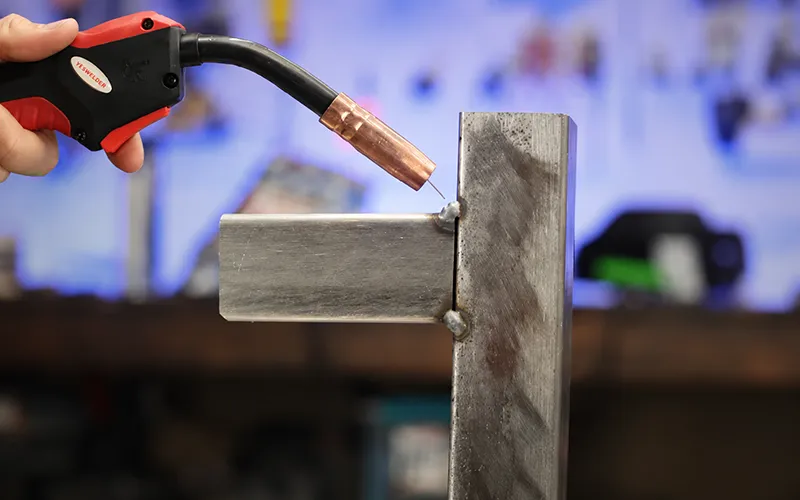
When Should Tack Welds Be Removed or Ground?
Tack welds should be:
- Retained if structurally sound and incorporated into final weld
- Removed if cracked or contaminated
- Ground if they interfere with weld bead geometry
- Eliminated in cosmetic or high-precision assemblies
In aerospace-style fabrication practice, even minor tack imperfections are often removed due to strict surface integrity requirements.
Conclusion
Tack welding is not a secondary operation but a critical geometric control stage in welded fabrication. It determines alignment stability, distortion behavior, and final weld quality.
Across sheet metal, structural, pipe, and precision assemblies, proper tack strategy consistently reduces rework and improves dimensional accuracy. Key factors include surface preparation, correct tack size, controlled heat input, and systematic inspection before final welding.
In real manufacturing environments, the difference between a stable assembly and a distorted one is often determined at the tack welding stage—not during final welding.
FAQs About Tack Welding
What is tack welding?
Tack welding uses small temporary welds to hold components in position before final welding.
Is tack welding permanent?
It can be either temporary or integrated into the final weld depending on quality and design requirements.
What is the purpose of tack welding?
It ensures alignment, controls gaps, reduces distortion, and stabilizes assemblies before final welding.
Can tack welds cause defects?
Yes. Poor tack welds can introduce cracks, porosity, and dimensional errors in final welds.
Should tack welds be removed before final welding?
Only if defective or interfering with weld geometry. Otherwise, they may be fused into the final weld structure.