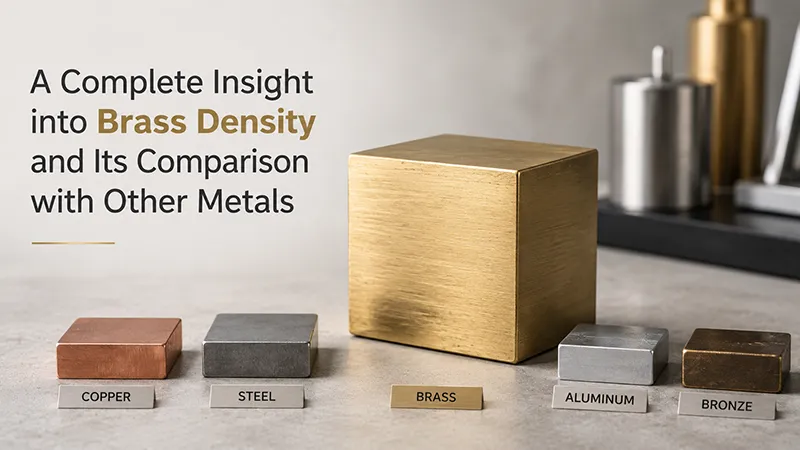
Brass density is a small data point with outsized practical impact. For engineers, product designers, CNC machinists, purchasing teams, and manufacturers, density affects how heavy a part will be, how much raw stock is required, how shipping cost is estimated, and whether brass is a better fit than copper, bronze, steel, aluminum, or stainless steel for a specific job. For a broader material comparison, you can also read our guide to Brass vs Bronze vs Copper and our overview of Types of Metals. Brass itself is not a single metal but a family of copper-zinc alloys used widely in machined parts, electrical connectors, decorative hardware, valves, tube fittings, plumbing components, marine parts, and precision screw-machine products. Copper.org alloy data also shows that different brass grades are selected for different strengths, forming behavior, conductivity, corrosion resistance, and machinability.
In practice, brass is often chosen not because density alone is “best,” but because density sits inside a broader package of useful properties: good corrosion resistance, attractive appearance, solid electrical performance, and, for alloys such as C36000, excellent machinability. That is why understanding density is valuable not only for material science, but also for quoting, machining, assembly design, and supply-chain planning.
What Is Brass Density
The density of brass is commonly given as about 8.4–8.7 g/cm³, although the exact value depends on the alloy grade, copper-zinc ratio, and whether the source is using a generic family value or a specific grade datasheet. Grade-specific data from Copper.org show representative values such as 8.53 g/cm³ for C26000, 8.50 g/cm³ for C36000, 8.41 g/cm³ for C46400, and 8.39 g/cm³ for C28000, while MISUMI’s engineering density table lists generic brass around 8.4–8.5 g/cm³ depending on whether it is cast or rolled/drawn. Density means mass per unit volume, expressed by the relationship D = m/v.
Because engineers and buyers work in different systems, brass density is often written in several unit formats. The most common are g/cm³, kg/m³, and lb/in³. Converting the practical brass range of 8.4–8.7 g/cm³ gives approximately 8,400–8,700 kg/m³ and about 0.303–0.314 lb/in³.
| Unit | Typical Brass Density |
|---|---|
| g/cm³ | 8.4–8.7 g/cm³ |
| kg/m³ | 8,400–8,700 kg/m³ |
| lb/in³ | About 0.303–0.314 lb/in³ |
The reason different websites and datasheets show slightly different values is straightforward: brass is an alloy family, not one fixed composition. Some sources round to a general range for “brass,” while others publish grade-specific values measured at a stated reference temperature, usually around 20°C or 68°F.
Why Brass Density Matters in Manufacturing
In manufacturing, density matters because it directly controls part weight once volume is known. If two components have the same geometry but are made from different metals, the higher-density material will weigh more. That affects raw material estimates, freight cost, handling on the shop floor, fixture loading, and sometimes assembly balance. Since density is mass divided by volume, it is one of the first properties used when estimating the finished mass of a CNC part or a casting, and it can also influence CNC Machining Cost through material weight, stock size, and production planning.
For quoting and procurement, density helps convert stock dimensions into purchase weight. For machining, it influences how much material is being moved, how large turned parts behave in rotation, and how much finished inventory weighs in bulk. For design, it affects whether brass is a sensible substitute for copper, bronze, steel, or aluminum when corrosion resistance, conductivity, appearance, and machinability are all part of the decision. In other words, density rarely acts alone, but it does shape cost, logistics, and performance in a very concrete way.
Factors That Affect Brass Density and Common Grades
Brass does not have one single fixed density because its composition changes from grade to grade. Comparing commonly used wrought brasses makes that clear: C26000 cartridge brass is listed at 8.53 g/cm³, C36000 free-cutting brass at 8.50 g/cm³, C46400 naval brass at 8.41 g/cm³, and C28000 Muntz metal at 8.39 g/cm³. Those differences are tied to composition ranges published by Copper.org, including changes in copper, zinc, lead, and tin content.
A practical way to understand the trend is this: higher-copper yellow brasses are often somewhat denser, while higher-zinc brasses tend to come in a bit lower. For example, C26000 is roughly a 70/30 brass with 68.5–71.5% Cu, while C28000 is a 60/40 brass with 59.0–63.0% Cu; their published densities drop from 8.53 to 8.39 g/cm³ across that composition shift. Leaded brass grades such as C36000 also change density slightly and are especially important in machining because the leaded structure supports chip breaking and very high machinability.
Manufacturing route matters too. MISUMI’s engineering table lists brass-casting at 8.4 g/cm³ and rolled/drawn brass at 8.5 g/cm³, which is a useful reminder that processing history can move the practical density value even when the metal family is still called “brass.” For precise calculations, use the datasheet value for the exact alloy and product form you are buying. If a casting contains internal porosity, its effective or apparent density can also be lower because void space adds volume without adding equivalent metal mass; that conclusion follows directly from the density formula.
| Factor | How It Affects Brass Density |
|---|---|
| Copper content | Higher copper content often corresponds to slightly higher density in common yellow brasses. |
| Zinc content | Increasing zinc content can lower density somewhat and also changes mechanical behavior. |
| Lead or tin addition | Alloying additions change density and may also improve machinability or corrosion resistance. |
| Brass grade | Different UNS/CDA grades have different published density values. |
| Manufacturing method | Cast, rolled, and drawn products can show slightly different practical values. |
| Porosity | Internal voids can lower effective density in cast parts. |
| Reference temperature | Datasheets typically state density at about 20°C/68°F; use that exact basis for precision work. |
The most commercially important brass grades for density-related searches are shown below. C36000 deserves special attention for CNC work because Copper.org lists it with a machinability rating of 100, making it the benchmark free-cutting brass alloy.
| Brass Grade | Common Name | Typical Use | Density Range |
|---|---|---|---|
| C26000 | Cartridge brass | Electrical connectors, hardware, radiator parts, decorative items, formed parts | Around 8.53 g/cm³ |
| C36000 | Free-cutting brass | CNC machined parts, fittings, fasteners, screw-machine components | Around 8.50 g/cm³ |
| C46400 | Naval brass | Marine hardware, shafts, corrosion-resistant components | Around 8.41 g/cm³ |
| C28000 | Muntz metal | Architectural and marine applications, hot-worked hardware | Around 8.39 g/cm³ |
These typical uses are drawn from Copper.org alloy application and property pages, which show C26000 in electrical and decorative uses, C36000 as a machining-focused leaded brass, and C46400 as naval brass for corrosion-resistant service.
Brass Density Compared with Other Metals
When brass is compared with other engineering metals, it sits in the upper-middle range. It is less dense than copper, often similar to or slightly less dense than many bronzes, heavier than aluminum and titanium, and usually somewhat denser than carbon steel and many common stainless steels. Pure copper is listed by the Royal Society of Chemistry copper data at 8.96 g/cm³, aluminum at 2.70 g/cm³, and titanium at about 4.5 g/cm³; the MISUMI engineering density table lists carbon steel, stainless steel, brass, bronze, titanium, and other common engineering materials for density comparison.
| Metal | Approximate Density | Compared with Brass |
|---|---|---|
| Brass | 8.4–8.7 g/cm³ | Baseline |
| Copper | About 8.96 g/cm³ | Slightly denser than brass |
| Bronze | About 8.7–8.9 g/cm³ | Often similar or slightly denser |
| Aluminum | About 2.70 g/cm³ | Much lighter than brass |
| Steel | About 7.85 g/cm³ | Usually slightly lighter than brass |
| Stainless steel | About 7.9–8.0 g/cm³ | Usually slightly lighter than brass |
| Titanium | About 4.5 g/cm³ | Much lighter than brass |
The comparison above uses elemental densities for copper, aluminum, and titanium from the Royal Society of Chemistry and typical engineering alloy values for bronze, carbon steel, and stainless steel from MISUMI and grade-specific stainless references. Since these are families rather than single compositions, exact numbers vary by grade.
Brass Density vs Copper Density
Copper is usually denser than brass. A useful baseline is 8.96 g/cm³ for elemental copper versus the common brass range of about 8.4–8.7 g/cm³ and grade values such as 8.53 for C26000 and 8.50 for C36000. That is one reason copper parts of the same size normally weigh a little more than brass parts. Brass is still often preferred when the job benefits from lower cost, better machinability, easier forming, or a balance of appearance and corrosion resistance rather than maximum conductivity.
Brass Density vs Bronze Density
Brass and bronze can be close in density, but bronze is often equal or somewhat higher in typical engineering tables. MISUMI lists bronze broadly at 8.70–8.90 g/cm³, while CSA/Concast data for C93200 bearing bronze show 8.91 g/cm³. Brass, by contrast, commonly sits around 8.39–8.53 g/cm³ in the widely used wrought grades covered above. In application terms, bronze is often chosen for bushings, bearings, and wear-heavy service, while brass is very common in fittings, machined hardware, decorative parts, and electrical connectors.
Brass Density vs Steel Density
Brass is generally denser than ordinary carbon steel. MISUMI lists carbon steel around 7.85 g/cm³, below the usual brass range, so a brass part and a carbon-steel part with the same volume will often show the brass part as slightly heavier. That does not mean brass is automatically “better”: steel is often selected for structural strength and high-load applications, while brass is favored in many corrosion-resistant, decorative, electrically conductive, and precision-machined components.
Brass Density vs Aluminum Density
Aluminum is far lighter than brass. The Royal Society of Chemistry lists aluminum at 2.70 g/cm³, which is only about one-third of common brass density. That makes aluminum a better choice when lightweight design is the priority, while brass remains attractive when extra mass, richer appearance, corrosion resistance, wear behavior, or machining performance is more valuable. In practical terms, if you simply swap a same-size brass part for aluminum, the part becomes dramatically lighter.
How to Calculate the Weight of a Brass Part Using Density
The basic formula is simple: weight (or mass) = density × volume. In engineering practice, the part volume is usually taken from a drawing, a stock-size calculation, or a CAD model, and then multiplied by the material density listed for the selected alloy. When estimating raw material weight, the form of stock also matters, so it is useful to understand the difference between Bar vs Plate Stock. The underlying density relation is D = m/v, which can be rearranged to m = D × V.
For example, if a brass part has a volume of 100 cm³ and you use a representative brass density of 8.5 g/cm³, the estimated mass is:
100 × 8.5 = 850 g.
That same workflow is used every day for raw-stock planning, finished-part weight estimates, and shipping calculations. CAD software does the same thing automatically once the correct material density is assigned, which is why choosing the right brass grade in the material library matters. If the CAD system uses a generic “brass” entry while your shop is actually buying C28000 or C46400, the mass estimate can be slightly off.
Applications and CNC Material Selection
Brass density matters in real products such as CNC machined fittings, bushings, bearings, electrical connectors, valves, plumbing components, marine hardware, decorative hardware, and precision turned parts. Copper.org’s brass resources specifically document long-standing brass use in tube fittings, valves, plumbing, seawater lines, condensers, and desalination equipment, while alloy-specific pages show C26000 in electrical connectors and decorative hardware, C36000 in machining-oriented applications, and leaded brasses broadly in valves, fittings, bearings, and screw-machine parts.
From a CNC perspective, brass is relatively dense compared with aluminum, but it remains very attractive because it machines cleanly and predictably. Copper.org describes C36000 as a free-cutting brass with a machinability rating of 100, and its technical literature notes that free-cutting brass forms short broken chips and can deliver better surface finishes than many competing materials. That combination is one reason C36000 is so common in turned fittings, fasteners, nozzles, pins, and other precision parts.
For material selection, density should be assessed together with the rest of the job requirements. A heavier brass part may still be the right answer if the design needs corrosion resistance, stable machining, decent conductivity, attractive surface appearance, or marine suitability. On the other hand, if part mass is the dominant concern, aluminum or titanium may be the better route. Good material selection therefore compares several properties at once: density, machinability, corrosion resistance, conductivity, wear behavior, and total manufacturing cost.
Conclusion
Brass density is typically around 8.4–8.7 g/cm³, with common wrought grades clustering near 8.39–8.53 g/cm³ depending on composition and grade. Brass is generally heavier than aluminum and carbon steel, slightly less dense than copper, and often similar to or somewhat below common bronzes. In manufacturing, that matters because density influences part weight, stock estimates, shipping cost, handling, and how a material compares with alternatives in CNC machining and product design.
For companies sourcing custom brass parts, the most useful rule is simple: do not treat brass as one number. Always match the density used in your calculations to the specific brass grade and product form you plan to machine or purchase. That is the best way to make quoting, CAD mass calculations, and production planning more accurate. If you need help with brass material selection, CNC machining, or custom part production, you can Contact Us to discuss your project requirements.
FAQ About Brass Density
What is the density of brass?
Brass density is commonly around 8.4–8.7 g/cm³, although specific grades such as C26000, C36000, C46400, and C28000 are commonly published at 8.53, 8.50, 8.41, and 8.39 g/cm³, respectively.
Is brass heavier than steel?
Usually, yes. Common brass grades are generally denser than carbon steel, which is often referenced at about 7.85 g/cm³, so the same volume of brass will typically weigh more.
Is brass denser than copper?
No. Copper is typically denser than brass, with elemental copper listed at about 8.96 g/cm³.
Is brass heavier than aluminum?
Yes. Aluminum is about 2.70 g/cm³, far below brass, so a brass part of the same size is much heavier than an aluminum part.
Why does brass density vary?
Because brass is an alloy family. Changing the amounts of copper, zinc, lead, tin, and other additions changes the published density, which is why different grades such as C26000, C36000, C46400, and C28000 do not all share the same value.
What is the density of brass in kg/m³?
A typical engineering range is about 8,400–8,700 kg/m³.
What is the density of brass in lb/in³?
A typical engineering range is about 0.303–0.314 lb/in³.
Does brass density affect CNC machining?
Yes. Density affects part weight, how stock and finished parts are handled, shipping estimates, and some fixturing and planning decisions. But brass selection in CNC work should still be made together with machinability, grade, corrosion resistance, conductivity, and surface-finish requirements. C36000 is especially important because Copper.org lists it with a machinability rating of 100.