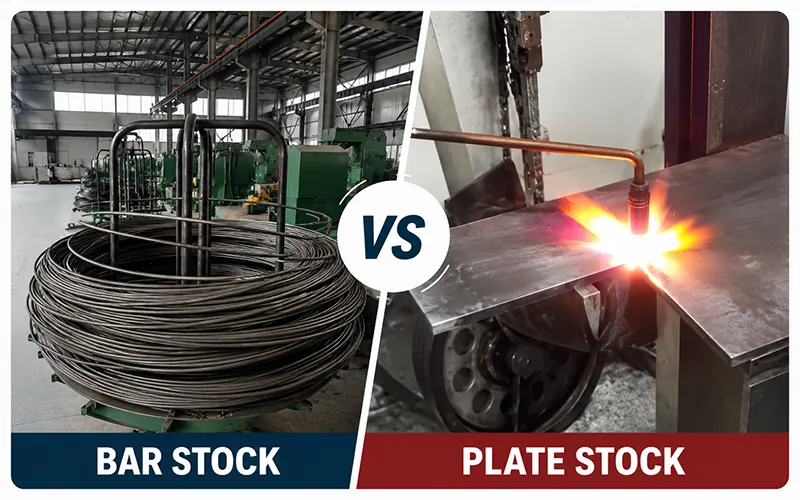
Bar stock and plate stock are two common forms of CNC machining materials used in metal fabrication and industrial manufacturing. Although both may be produced from the same alloy, their shape and supply condition can affect purchasing, blank preparation, workholding, machining efficiency, dimensional stability, and total production cost. Bar stock is generally suitable for long, narrow, round, or rotational components, while plate stock is commonly selected for wide, flat, rectangular, or plate-like parts. Choosing the stock form closest to the finished geometry can reduce material waste, setup time, tool wear, and unnecessary machining. This guide explains the key differences between bar and plate stock, how each form is processed, and how to choose the most practical starting material for a manufacturing project.
What Is Bar Stock?
Bar stock is metal or engineering plastic supplied in long, continuous sections with a consistent cross-sectional shape. Manufacturers normally cut the bar into shorter blanks before turning, milling, grinding, forging, or other production processes.
Bar stock is available in standard and custom dimensions. Its dimensional tolerance, straightness, surface condition, and mechanical properties depend on the material grade and how the bar was produced. Common manufacturing routes include hot rolling, cold drawing, extrusion, forging, peeling, centerless grinding, and precision finishing. For applicable carbon and alloy steel products, the ASTM A29/A29M steel bar requirements provide general specification guidance for hot-wrought and cold-finished bars.
Bar stock is widely used in CNC machining because it can be ordered in dimensions close to many finished part shapes. Round bar is particularly suitable for turned components such as shafts, pins, bushings, and rollers, while square and rectangular bar can provide efficient blanks for smaller milled parts.
Common Bar Stock Shapes
Common bar stock shapes include:
- Round bar: Used for shafts, pins, bushings, rollers, fittings, and other rotational parts.
- Square bar: Suitable for small blocks, tooling components, brackets, and parts with four equal sides.
- Rectangular bar: Used for narrow prismatic parts, mounting blocks, rails, and small plates.
- Hexagonal bar: Common for nuts, fittings, adapters, fasteners, and components requiring wrench flats.
- Flat bar: A long rectangular section with a relatively narrow width compared with plate.
- Hollow bar or tube: Used when a central bore is required and solid stock would create excessive material waste.
The difference between rectangular bar, flat bar, and plate is not always defined consistently across suppliers. A thick rectangular section may be sold as flat bar by one company and as plate cut to width by another. Therefore, purchasing specifications should focus on dimensions, material condition, tolerances, and manufacturing route rather than the product name alone.
Common Bar Stock Materials
Bar stock is available in many metals and engineering materials, including:
- Aluminum
- Carbon steel
- Alloy steel
- Stainless steel
- Brass
- Copper
- Bronze
- Titanium
- Tool steel
- Nickel alloys
- Engineering plastics such as POM, nylon, PEEK, and polycarbonate
Material availability varies by shape. For example, aluminum and steel are commonly supplied in round, square, hexagonal, and rectangular forms, while some specialty alloys may be available only in a limited selection of diameters or widths.
Typical Bar Stock Applications
Bar stock is commonly used to manufacture:
- Shafts
- Pins
- Bushings
- Bolts
- Spacers
- Fittings
- Couplings
- Rollers
- Fasteners
- Valve components
- Threaded adapters
- Small milled blocks
- Turned housings
- Precision cylindrical components
Round and hexagonal bars are especially suitable for CNC turning and Swiss machining. Square and rectangular bars are commonly cut into short blanks for CNC milling.
What Is Plate Stock?
Plate stock is flat material supplied with a relatively large width and length compared with its thickness. It may be purchased as a full standard plate, a sheet-sized product, or a custom saw-cut or profile-cut blank.
Plate stock is generally used for large, flat, rectangular, structural, or prismatic parts. It provides broad surfaces that can be clamped to a milling table, fixture plate, vacuum system, or custom fixture.
Depending on the material, thickness, and applicable specification, flat stock may be classified as sheet, plate, or slab. However, these classifications are not universal. The transition between sheet and plate can vary according to the alloy, industry, supplier, or manufacturing standard.
Plate stock may be:
- Hot rolled
- Cold rolled
- Cast
- Forged
- Heat-treated
- Stress-relieved
- Surface ground
- Blanchard ground
- Precision machined
- Cut from a larger slab
The production method affects flatness, thickness tolerance, residual stress, grain direction, surface condition, and machining behavior.
Plate Stock vs. Sheet Metal
Sheet metal and plate stock are both flat raw materials, but they are usually intended for different manufacturing methods.
Sheet metal is generally thinner and is commonly processed by:
- Laser cutting
- Punching
- Bending
- Stamping
- Roll forming
- Deep drawing
- Welding
Plate is generally thicker and is more commonly used for:
- Structural components
- Machine bases
- Mold plates
- Heavy brackets
- Fixtures
- Large CNC-machined parts
- Thick mounting panels
The exact thickness at which sheet becomes plate varies. For this reason, an engineering drawing should specify the required:
- Alloy
- Temper or heat-treatment condition
- Thickness
- Thickness tolerance
- Flatness
- Surface condition
- Grain direction, when critical
- Material specification
Using only the words “sheet” or “plate” may not provide enough information for accurate purchasing or manufacturing.
Common Plate Stock Materials
Common plate materials include:
- Aluminum plate
- Carbon steel plate
- Stainless steel plate
- Tool steel plate
- Alloy steel plate
- Titanium plate
- Copper plate
- Brass plate
- Nickel-alloy plate
- Engineering plastic plate
Aluminum tooling plate is frequently used for fixtures, inspection equipment, electronic components, and automation systems because selected grades offer good flatness, machinability, and dimensional stability.
Typical Plate Stock Applications
Plate stock is commonly used for:
- Machine bases
- Mounting plates
- Structural brackets
- Fixtures and jigs
- Mold plates
- Equipment panels
- Enclosures
- Heat sinks
- Manifolds
- Robot mounting plates
- Aerospace structural components
- Large CNC-milled housings
- Test equipment
- Industrial frames
Bar Stock vs. Plate Stock: Key Differences
The main difference between bar stock and plate stock is their general geometry. Bar stock is supplied as a long section with a consistent cross-section, while plate stock is broad and flat with a controlled thickness.
| Factor | Bar Stock | Plate Stock |
|---|---|---|
| Basic form | Long material with a consistent cross-section | Wide, flat material with controlled thickness |
| Common shapes | Round, square, rectangular, hexagonal, flat, hollow | Primarily flat rectangular sections |
| Width-to-thickness relationship | Usually narrow relative to length | Width and length are large relative to thickness |
| Best suited for | Shafts, pins, bushings, fittings, and narrow blocks | Bases, brackets, panels, molds, and large prismatic parts |
| Primary machining | Turning, Swiss machining, milling, grinding | Milling, drilling, boring, profiling, and grinding |
| Typical supply form | Long standard lengths | Full plates or custom-cut blanks |
| Blank preparation | Band saw or circular saw | Saw, waterjet, laser, plasma, or abrasive cutting |
| Typical workholding | Chuck, collet, bar feeder, vise | Vise, clamps, fixture plate, vacuum fixture |
| Material utilization | High for cylindrical or narrow parts | High for flat or wide parts |
| Machining access | Efficient for axial and radial features | Efficient for broad top and side surfaces |
| Main dimensional concern | Diameter, cross-section, and straightness | Thickness, flatness, and parallelism |
| Common applications | Turned parts and small prismatic parts | Large milled, structural, or plate-like components |
These names can overlap. A rectangular section may be produced by cutting a strip from a larger plate but sold as flat bar. Conversely, a supplier may classify a wide, thick rectangular bar as plate.
For CNC machining, the most important questions are not what the supplier calls the material, but:
- How was it produced?
- What dimensions and tolerances are available?
- What is its flatness or straightness?
- What is the grain direction?
- Has it been stress-relieved?
- How closely does it match the finished part geometry?
How Part Geometry Affects Stock Selection
The geometry of the finished component is usually the first factor to evaluate when choosing between bar and plate stock.
The stock form that most closely matches the finished envelope generally requires less cutting and produces less waste.
Round and Rotational Parts
Bar stock is normally preferred for parts such as:
- Shafts
- Pins
- Bushings
- Sleeves
- Threaded fittings
- Rollers
- Cylindrical housings
- Valve stems
- Couplings
- Parts produced primarily by turning
Round bar already has a cylindrical geometry close to the final part. It can be loaded directly into a chuck, collet, or automatic bar feeder.
Using round bar for a turned part offers several advantages:
- Less rough material removal
- Simple workholding
- Efficient centering
- Reduced blank preparation
- Compatibility with automatic bar feeding
- Easier repeated production
- Lower material waste for cylindrical components
Hexagonal bar is useful when a turned component also requires wrench flats. Manufacturing a fitting from hexagonal bar may eliminate the need to mill six flats after turning.
Flat and Prismatic Parts
Plate stock is normally preferred for:
- Mounting plates
- Covers
- Brackets
- Frames
- Manifolds
- Mold plates
- Large rectangular housings
- Fixtures
- Structural panels
- Machine bases
Plate provides broad, flat surfaces close to the finished dimensions. A manufacturer can cut a blank near the final length and width before machining.
The main advantages include:
- Easier milling setup
- Reduced roughing time
- Efficient profile cutting
- Better material utilization for wide components
- Ability to nest several parts within one plate
- Easier access to broad faces
- Availability in large dimensions
For example, manufacturing a 300 × 200 × 20 mm mounting plate from a large round bar would require removing a substantial amount of material. Starting with a 22 or 25 mm plate blank would normally be more efficient.
Mixed-Geometry Parts
Some components contain both cylindrical and flat features. In these cases, stock selection depends on which starting form results in the least material removal and simplest machining route.
Examples include:
- A round shaft with two milled flats
- A rectangular housing with a cylindrical boss
- A flange with a central turned hub
- A round adapter with multiple cross holes
- A plate with several bearing bores
A mostly cylindrical part with a few milled flats will often remain economical to manufacture from round bar. A wide rectangular component with one circular boss may be better produced from plate.
For complex or high-volume components, neither standard bar nor plate may be the most economical solution. Alternatives include:
- Forging
- Casting
- Extrusion
- Near-net-shape blanking
- Additive manufacturing
- Welded fabrication
These processes may reduce material waste and machining time when production volume justifies tooling or process-development costs.
Manufacturing Processes for Bar and Plate Stock
Stock form strongly influences the available manufacturing route, blank preparation, machine selection, and workholding method.
CNC Turning from Bar Stock
CNC turning is one of the most common manufacturing processes used with round and hexagonal bar stock. It efficiently produces shafts, pins, bushings, fittings, sleeves, and other components with rotational geometry.
The bar can be held using:
- A three-jaw chuck
- A collet chuck
- A hydraulic chuck
- A bar feeder
- A guide bushing in Swiss machining
Turning efficiently produces:
- External diameters
- Internal bores
- Grooves
- Threads
- Tapers
- Shoulders
- Faces
- Radii
- Parting features
Modern CNC lathes with live tooling can also add:
- Cross holes
- Flats
- Slots
- Off-center holes
- Milled threads
- Engraving
Automatic bar feeders allow repeated production with less operator involvement. This makes bar stock especially efficient for medium- and high-volume turned parts.
Long or slender parts may require a tailstock, sub-spindle, guide bushing, or steady rest to control deflection and vibration.
CNC Milling from Bar Stock
Square, rectangular, and flat bar can be cut into shorter blanks for CNC milling.
Bar stock is often practical for:
- Small mounting blocks
- Narrow brackets
- Fixture components
- Clamps
- Tooling inserts
- Small housings
Standard bar widths can reduce blank-preparation time. The operator can saw the bar into individual pieces and load them directly into a vise.
However, using an oversized rectangular bar for a wide, thin component may create unnecessary roughing. In that situation, a near-net plate blank may be more economical.
CNC Milling from Plate Stock
Plate stock is well suited for large prismatic components and parts with broad machined faces.
A common manufacturing route is:
- Cut the plate into a near-net blank.
- Face mill one side to establish a reference surface.
- Flip the blank and machine it to thickness.
- Mill the outside profile.
- Machine pockets, holes, slots, and other features.
- Finish critical surfaces.
- Deburr and inspect the part.
Plate machining may require multiple setups to access both sides. Large or thin components may need:
- Custom fixtures
- Low-profile clamps
- Vacuum workholding
- Adhesive workholding
- Fixture plates
- Sacrificial support material
- Stress-relief operations
Thin plate parts can distort if clamping pressure or cutting heat is not controlled.
Blank-Cutting Processes
Bar and plate stock must often be cut into individual blanks before final machining.
Common blanking processes include:
- Band sawing: Economical for bars and thick plate blanks.
- Circular sawing: Produces fast, relatively straight cuts with good repeatability.
- Waterjet cutting: Suitable for near-net profiles without a significant heat-affected zone.
- Laser cutting: Efficient for thinner metal plate and detailed profiles.
- Plasma cutting: Cost-effective for medium and thick conductive metal plates.
- Abrasive cutting: Useful for hardened materials or selected bar-cutting applications.
The best cutting method depends on:
- Material type
- Material thickness
- Production quantity
- Edge-quality requirement
- Dimensional allowance
- Heat sensitivity
- Required lead time
- Equipment availability
Thermal cutting methods may produce a heat-affected edge that must be removed during machining. Waterjet cutting avoids thermal effects but may cost more or produce tapered edges, depending on process settings.
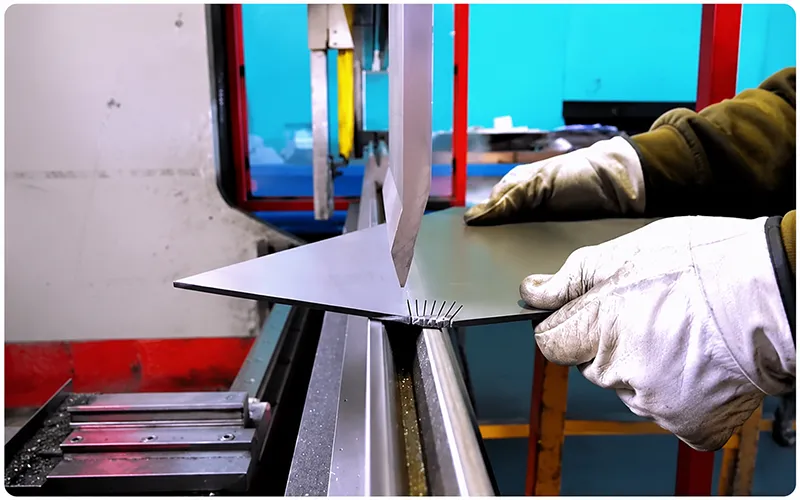
Material Waste and Machining Efficiency
Stock selection directly affects material yield, cycle time, tool wear, and energy consumption.
A starting shape close to the finished component normally reduces:
- Scrap volume
- Rough-machining time
- Cutting-tool consumption
- Machine occupancy
- Coolant use
- Energy consumption
Round bar is highly efficient for cylindrical parts but inefficient for wide rectangular parts. Plate is efficient for flat parts but may be inefficient for small cylindrical components.
For example, consider a rectangular mounting bracket. A near-net blank cut from plate may require only facing, profiling, drilling, and pocket milling. Producing the same bracket from an oversized round bar could require removing most of the original cross-section.
When calculating material utilization, manufacturers should include:
- Saw kerf
- Waterjet or laser kerf
- Edge cleanup allowance
- Facing allowance
- Clamping area
- Part spacing
- Defective edge zones
- Reusable offcuts
- Nesting efficiency
Multiple flat components can often be nested within one plate. Efficient nesting reduces scrap by arranging the parts closely while preserving sufficient spacing for cutting and workholding.
Metal chips are frequently recyclable, but recycling does not recover the machining time, tooling cost, energy, and machine capacity used to remove excessive material.
| Finished Part Shape | Preferred Stock Form | Main Efficiency Benefit |
|---|---|---|
| Long cylindrical shaft | Round bar | Minimal turning stock and simple chucking |
| Hexagonal fitting | Hex bar | Wrench flats already present |
| Small rectangular block | Square or rectangular bar | Fast sawing and vise setup |
| Wide mounting plate | Plate | Reduced material removal |
| Large bracket | Profile-cut plate | Near-net blank minimizes roughing |
| Thin flat panel | Plate or sheet | Minimal thickness reduction |
| Hollow cylindrical sleeve | Hollow bar or tube | Less internal material removal |
Dimensional Stability, Grain Direction, and Residual Stress
The choice between bar and plate stock affects more than the external dimensions of the blank. Production method, grain flow, residual stress, flatness, and straightness can influence final part performance.
Grain Direction
Rolled, extruded, forged, and cold-worked materials often have directional grain structures.
Mechanical properties may differ between:
- Longitudinal direction
- Transverse direction
- Short-transverse or thickness direction
Grain direction can affect:
- Fatigue resistance
- Fracture behavior
- Impact strength
- Bend performance
- Crack propagation
- Stress-corrosion resistance
For critical aerospace or structural components, grain orientation may need to follow a specified direction relative to the main load.
For example, a long load-bearing bracket may perform differently depending on whether its primary stress follows or crosses the rolling direction of the plate.
Material certificates and supplier documentation may be necessary when grain orientation is critical.
Residual Stress
Residual stresses can remain in bar and plate after:
- Rolling
- Extrusion
- Cold drawing
- Heat treatment
- Quenching
- Straightening
- Forging
- Welding
Machining removes material that previously balanced these internal stresses. Uneven material removal can cause the remaining blank to bend, twist, or warp. NIST research on residual stress and part distortion also highlights the relationship between machining-related residual stresses and dimensional changes in finished components.
Wide, thin plate components are particularly sensitive when:
- A deep pocket is machined on one side
- Most material is removed from one face
- The part has an asymmetric design
- Heavy roughing and finishing occur in the same setup
- Excessive heat is generated
Cold-drawn bar can also move after heavy asymmetric machining. For example, milling a deep flat along one side of a round bar may release stress and cause the component to bow.
Ways to reduce distortion include:
- Selecting stress-relieved stock
- Using cast tooling plate
- Balancing material removal
- Roughing both sides before finishing
- Allowing the part to rest between operations
- Applying intermediate stress relief
- Using lower clamping pressure
- Controlling cutting heat
- Leaving uniform finishing allowance
Flatness and Straightness
Plate stock should be evaluated for flatness, while bar stock should be evaluated for straightness.
Commercial material tolerances may be acceptable for fabrication but insufficient for precision machining.
A plate that is not flat can create problems with:
- Workholding
- Thickness control
- Parallelism
- Fixture stability
- Final-part distortion
A bent bar can create problems with:
- Bar feeding
- Turning concentricity
- Vibration
- Chucking
- Long-part machining
Precision-ground or precision-machined plate can reduce facing and finishing work. Ground bar or centerless-ground shaft stock can provide tighter diameter, roundness, straightness, and surface-finish control.
However, precision stock normally costs more. The additional material price should be compared with the machining and inspection time it may save.
Cost Differences Between Bar and Plate Stock
The raw-material price per kilogram is only one part of the manufacturing cost.
A complete comparison should include:
- Material price
- Minimum order quantity
- Standard-size availability
- Supplier cutting charges
- Profile-cutting cost
- Material yield
- Scrap percentage
- Setup time
- Roughing time
- Tool wear
- Number of machining operations
- Workholding requirements
- Inspection time
- Surface finishing
- Shipping and storage
- Production quantity
A cheaper raw material is not always the cheaper manufacturing option.
For example, a near-net aluminum plate blank may cost more than a section cut from standard bar. However, if the plate blank eliminates an hour of rough milling, it may produce a lower total part cost.
A practical cost model is:
Total Part Cost = Raw Material + Blank Preparation + Setup + Machining + Tooling + Inspection + Finishing + Scrap
When Bar Stock May Be More Cost-Effective
Bar stock is often more economical for:
- Turned cylindrical parts
- Long production runs using bar feeders
- Components matching standard bar diameters
- Small parts cut from continuous stock
- Hexagonal fittings
- Pins and shafts
- Parts requiring little blank preparation
- Small rectangular blocks matching standard bar widths
Bar-fed production can reduce operator handling and setup time. The benefit becomes more significant as quantity increases.
When Plate Stock May Be More Cost-Effective
Plate stock is often more economical for:
- Wide, flat, rectangular components
- Several parts nested in one blank
- Parts with large machined faces
- Thin components that would waste material if cut from thick bar
- Large fixtures and machine bases
- Mounting plates
- Structural brackets
- Profile-cut near-net blanks
For prototypes and low-volume production, plate stock can reduce lead time when an appropriate alloy and thickness are readily available. Near-net plate blanks can also reduce rough machining and simplify fixture preparation.
How to Choose Between Bar and Plate Stock
Stock selection should be based on the complete production route rather than one isolated factor.
Step 1: Review the Finished Part Geometry
Ask:
- Is the part mainly round, square, or rectangular?
- What are the final length, width, thickness, and diameter?
- Is the part long and narrow or broad and flat?
- Which stock form is closest to the final envelope?
- How much material must be removed from each option?
Round or rotational parts usually favor bar stock. Wide, flat parts usually favor plate stock.
Step 2: Identify the Primary Manufacturing Process
Determine whether the component will mainly be:
- Turned
- Swiss machined
- Milled
- Ground
- Profile cut
- Fabricated
- Forged
- Cast
A primarily turned component normally begins with round or hex bar. A heavily milled rectangular component normally begins with plate or rectangular bar.
Also consider:
- Can the part be bar-fed?
- Does it require large-area face milling?
- Will both sides need machining?
- Is near-net profile cutting practical?
- How many setups are required?
Step 3: Calculate Material Utilization
Compare the proposed blank dimensions with the finished component.
Include:
- Saw kerf
- Cutting kerf
- Facing stock
- Profile allowance
- Clamping material
- Nesting spacing
- Defect allowance
- Reusable offcuts
For production orders, nesting analysis can significantly change the preferred plate width or length.
Step 4: Check Material Availability
Confirm:
- Alloy availability
- Temper or heat treatment
- Standard diameter or thickness
- Standard width and length
- Supplier lead time
- Minimum order quantity
- Material certification
- Country-of-origin requirements
- Surface condition
- Grain orientation
An unusual stock size may reduce machining but create a long purchasing lead time or high minimum order. A slightly larger standard size may be more practical.
Step 5: Evaluate Stability and Tolerances
Review:
- Flatness
- Straightness
- Parallelism
- Thickness tolerance
- Diameter tolerance
- Grain direction
- Residual stress
- Heat-treatment condition
- Final geometric tolerances
A thin precision plate may require stress-relieved or ground material. A long precision shaft may require straightened or ground bar.
Step 6: Compare Total Manufacturing Cost
Calculate the complete cost of each manufacturing route:
- Raw material
- Blank preparation
- Setup
- Rough machining
- Finish machining
- Cutting tools
- Workholding
- Inspection
- Scrap
- Secondary finishing
| Project Requirement | Recommended Stock Form | Reason |
|---|---|---|
| Long cylindrical shaft | Round bar | Closest to final geometry and suitable for turning |
| Wide mounting bracket | Plate | Lower material waste and easier milling setup |
| Small square machined block | Square or rectangular bar | Simple sawing and workholding |
| Large machine base | Plate | Available in broad, thick dimensions |
| High-volume turned fitting | Bar stock | Supports automatic bar feeding |
| Thin flat enclosure component | Plate or sheet | Minimizes unnecessary material removal |
| Hexagonal adapter | Hex bar | Reduces or eliminates milling of wrench flats |
| Large circular flange | Plate or forged blank | Efficient profile blanking for a broad diameter |
| Precision sleeve | Hollow bar | Reduces internal boring volume |
Common Mistakes When Selecting Stock Material
Poor stock selection can increase machining time, distortion risk, and procurement cost.
| Mistake | Manufacturing Consequence | Recommended Solution |
|---|---|---|
| Selecting stock only by raw-material price | Higher machining time and total cost | Compare the complete manufacturing route |
| Ignoring machining allowance | Finished dimensions may not be achievable | Add facing, cutting, and finishing allowance |
| Using round bar for a wide rectangular part | Excessive material removal | Use plate or rectangular stock |
| Using thick plate for a long turned shaft | Difficult workholding and high waste | Use round bar |
| Ignoring grain direction | Reduced fatigue or structural performance | Specify required grain orientation |
| Ignoring residual stress | Part warping after machining | Use stress-relieved material and balanced roughing |
| Assuming commercial plate is perfectly flat | Fixturing and parallelism problems | Verify flatness or use precision-ground plate |
| Ignoring bar straightness | Feeding, turning, and vibration problems | Specify appropriate straightness tolerance |
| Forgetting saw kerf | Insufficient material or poor yield calculation | Include cutting losses in blank planning |
| Forgetting clamping allowance | Fixture cannot hold the blank securely | Add sacrificial or removable stock |
| Choosing an uncommon stock size | Long lead time and high minimum order | Compare standard available dimensions |
| Specifying unnecessarily tight raw-stock tolerances | Higher purchasing cost | Apply tight tolerances only where required |
| Ignoring certification requirements | Material may be rejected by the customer | Define certificates before purchasing |
| Failing to compare alternative processes | High machining cost at volume | Evaluate forging, casting, or extrusion |
Bar vs. Plate Stock Applications
Both stock forms are widely used across industrial sectors. The preferred form depends on the geometry and function of each component.
Aerospace
Common aerospace parts made from bar stock include:
- Pins
- Shafts
- Fasteners
- Bushings
- Cylindrical fittings
- Actuator components
- Spacers
Common aerospace parts made from plate stock include:
- Structural brackets
- Bulkheads
- Mounting plates
- Aircraft fixtures
- Machined frames
- Avionics housings
- Rib and support components
Aerospace applications may require controlled grain direction, traceable material certification, stress-relieved stock, and detailed inspection.
Automotive
Bar stock is commonly used for:
- Axles
- Pins
- Valve components
- Transmission shafts
- Fasteners
- Fittings
- Spacers
Plate stock is commonly used for:
- Battery trays
- Suspension brackets
- Mounting structures
- Prototype panels
- Test fixtures
- Structural supports
- Electric-vehicle components
High-volume automotive parts may eventually move from bar or plate machining to forgings, castings, stampings, or extrusions after the design has been validated.
Medical Equipment
Bar stock applications include:
- Surgical-tool components
- Pins
- Connectors
- Small cylindrical parts
- Instrument shafts
- Precision fittings
Plate stock applications include:
- Equipment frames
- Instrument plates
- Device housings
- Mounting brackets
- Diagnostic-machine components
- Laboratory fixtures
Medical components may require certified materials, controlled surface finishes, corrosion-resistant alloys, and careful traceability.
Electronics and Automation
Bar stock is frequently used for:
- Spacers
- Standoffs
- Small shafts
- Fittings
- Connectors
- Actuator components
Plate stock is frequently used for:
- Heat sinks
- Enclosures
- Robot mounting plates
- Machine frames
- Fixtures
- Control panels
- Equipment bases
Aluminum plate is particularly common because it combines low weight, good thermal conductivity, machinability, and multiple surface-finishing options.
Conclusion
Bar stock and plate stock may be made from the same alloy, but their shape, supply condition, and manufacturing route affect how efficiently they can be converted into finished components. Bar stock is generally the better starting point for round, long, narrow, and primarily turned parts such as shafts, pins, fittings, and bushings. Plate stock is normally more efficient for wide, flat, rectangular, and heavily milled components such as mounting plates, brackets, fixtures, and machine bases. The final decision should consider geometry, machining method, material yield, availability, tolerances, grain direction, residual stress, production quantity, and total manufacturing cost. Engineers should compare the full production route instead of choosing material based only on price per kilogram. An early DFM review can identify the stock form that provides the best balance of stability, lead time, machining efficiency, and cost.
FAQs About Bar vs. Plate Stock
What is the main difference between bar and plate stock?
Bar stock is supplied as a long material with a consistent cross-sectional shape, such as round, square, rectangular, or hexagonal. Plate stock is supplied as a broad, flat section with a controlled thickness. Bar is commonly used for turned or narrow components, while plate is commonly used for wide, flat, and prismatic parts.
Is flat bar the same as plate stock?
Not always. The terms can overlap, but flat bar is generally supplied in narrower standard widths and longer lengths. Plate is normally broader and may be purchased as a full plate or cut to the required width and length. Because supplier definitions vary, buyers should confirm dimensions, tolerances, material condition, and manufacturing route.
Is bar stock better for CNC turning?
Round or hexagonal bar stock is normally preferred for CNC turning because it can be held efficiently in a chuck, collet, or automatic bar feeder. Its geometry is already close to cylindrical finished parts, reducing material removal and simplifying repeated production.
Is plate stock better for CNC milling?
Plate stock is generally more efficient for wide, flat, rectangular, and large prismatic components. It provides broad surfaces for workholding and can be cut near the finished profile before milling. However, small block-like parts may be more economical when cut from square or rectangular bar.
Which stock form produces less material waste?
The stock form closest to the finished part geometry normally produces less waste. Round bar is efficient for shafts and bushings, while plate is efficient for brackets, mounting plates, and large flat components. Nesting several parts within a plate can further improve material utilization.
Does plate stock warp during machining?
Plate can distort when residual stress is released, especially if a large amount of material is removed from only one side. Thin, wide, or asymmetrical parts are particularly sensitive. Stress-relieved material, balanced roughing, controlled clamping, and suitable finishing sequences can reduce warping.
Is plate stock more expensive than bar stock?
The answer depends on the alloy, size, material condition, supplier availability, and order quantity. Even when plate has a higher raw-material price, it may reduce machining time and produce a lower total part cost. Material cost should therefore be evaluated together with blank preparation, setup, machining, tooling, inspection, and scrap.
How should I choose between bar and plate stock?
Review the finished geometry, primary machining process, required allowance, material availability, flatness or straightness, residual stress, grain direction, production quantity, and total manufacturing cost. For critical or high-value parts, a DFM review can help determine whether bar, plate, forging, casting, or another near-net-shape process is most suitable.