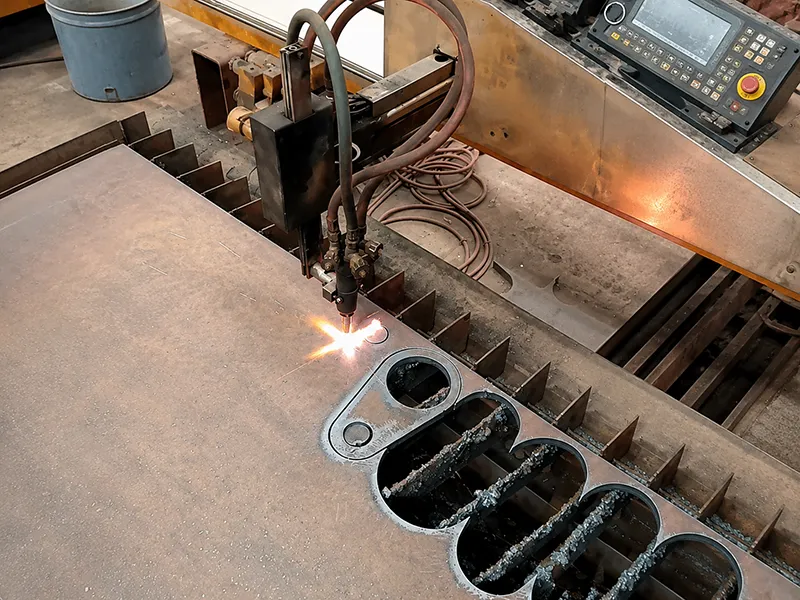
Plasma cutting is a thermal cutting process that uses a high-temperature plasma arc to melt and remove electrically conductive metals such as steel, stainless steel, aluminum, copper, and brass. It is widely used in metal fabrication because it cuts quickly, handles medium-to-thick plate efficiently, and often costs less than laser on thicker work. This guide explains how plasma cutting works, what materials it suits, its pros and cons, how it compares with laser and waterjet, and when it is the right choice.
What Is Plasma Cutting
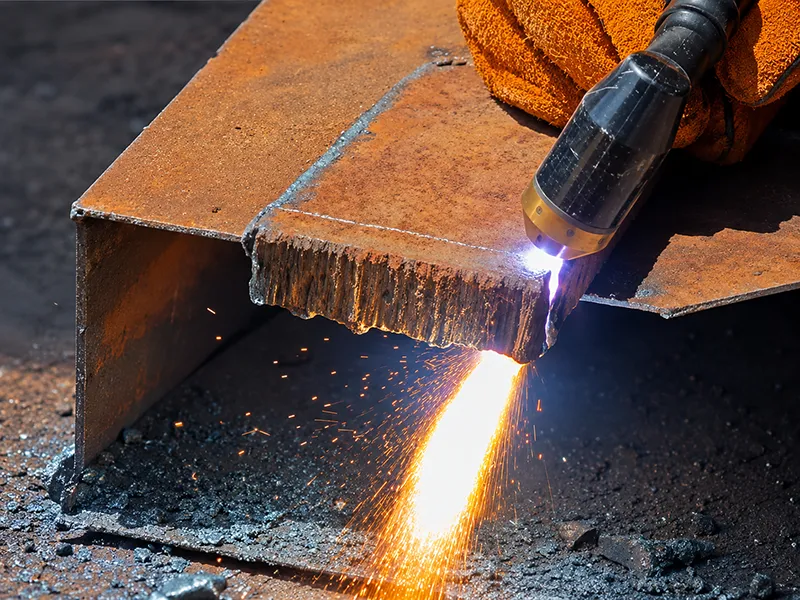
Plasma cutting is a thermal cutting process in which an electric arc ionizes a gas and turns it into plasma, creating a concentrated, high-energy cutting stream that melts metal and blows the molten material out of the kerf. Because the process relies on electrical conductivity, it is limited to conductive metals rather than wood, plastics, glass, or composites. Common plasma cutting materials include carbon steel, stainless steel, aluminum, copper, brass, and other conductive alloys.
In practical metal fabrication, plasma cutting is used in both handheld and automated forms. A handheld plasma cutter is common for repair, field work, trimming, and rough-to-medium precision cuts, while CNC plasma cutting machines are used for repeat parts, plate processing, profiles, holes, bevels, and production work. Modern mechanized systems are widely used for structural steel, HVAC and mechanical fabrication, shipbuilding, pressure vessels, heavy equipment, and general job-shop fabrication.
How Does Plasma Cutting Work
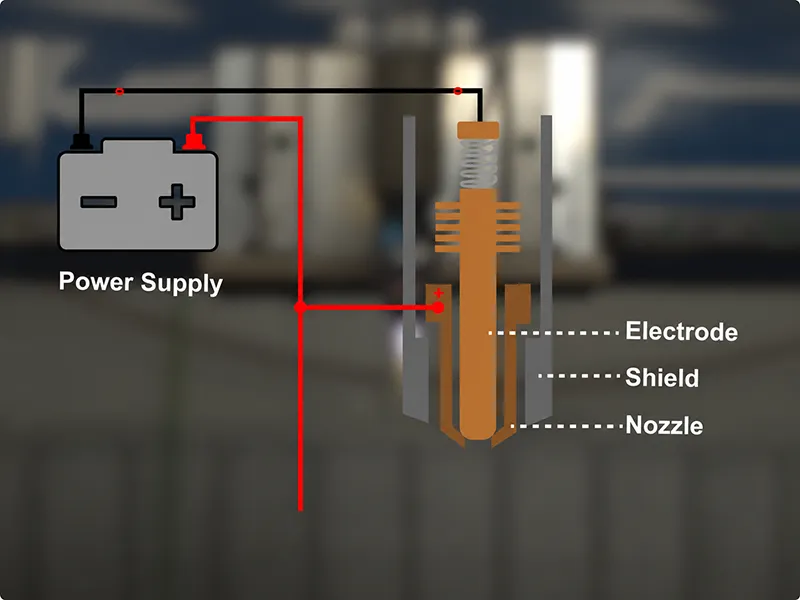
At a process level, plasma cutting follows a simple sequence: compressed gas → pilot arc → transferred arc → plasma jet → metal melting → molten material ejection → finished cut. In most systems, compressed air or another gas such as nitrogen, oxygen, argon, or an argon-hydrogen mix flows through the torch; Hypertherm’s plasma cutter guide explains that the electric arc ionizes this gas into a high-velocity plasma jet that melts the metal and blows molten material away. The power supply energizes an electrode, the gas is ionized into plasma, and the arc transfers to the grounded workpiece. Once transferred, the plasma jet becomes hot enough to melt the metal while the gas velocity blows molten material out of the cut. TWI and ESAB both describe plasma jet temperatures above 20,000°C, which helps explain the process’s high cutting speed.
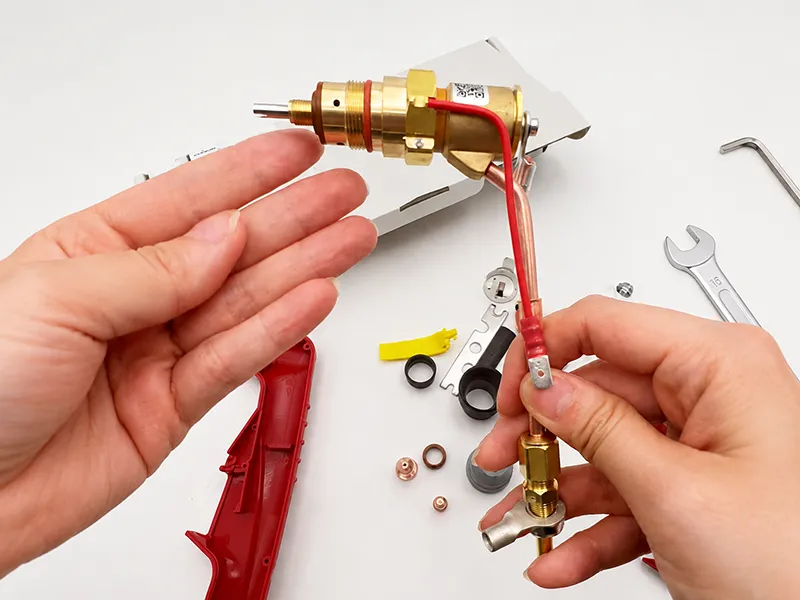
A plasma cutting system usually includes a power supply, plasma torch, electrode, nozzle, shield cap, gas supply, work clamp, cutting table or bed, and—on CNC systems—a controller plus torch height control. Hypertherm notes that an automated system also depends on the gantry, rails, motion drives, cables, and fume-mitigation setup such as a downdraft or water table. Torch consumables matter a great deal: the electrode carries current, the nozzle constricts and directs the arc, the swirl ring stabilizes gas flow, and the shield cap protects the nozzle and helps maintain the correct standoff distance.
Cut quality depends on much more than raw amperage. Manufacturer guidance consistently points to the same control variables: material type and thickness, process gas, gas pressure or purity, torch height, cutting speed, standoff distance, consumable condition, machine motion quality, and table tuning. In other words, even a good plasma cutter can produce poor results if the nozzle is worn, the torch sits too high, the speed is wrong, or the gas supply is inconsistent.
Which Materials, Thicknesses, and Cutting Modes Fit Plasma
Plasma cutting is especially well suited to conductive metals used in fabrication. Mild steel plates are usually among the easiest and fastest materials to plasma cut, which is one reason the process is common for structural plates, brackets, frames, and machine parts. Stainless steel can also be cut effectively, though gas choice and speed have a greater influence on oxidation, dross, and edge appearance. Aluminum plasma cuts well too, but its high thermal conductivity lowers cut speed and can make the edge less refined than laser or waterjet on appearance-critical parts. Copper and brass are conductive and can be plasma cut, but their even higher thermal conductivity makes them more challenging and can increase finishing needs. ESAB specifically notes that for occasional copper or brass cutting, plasma is practical, while waterjet or laser can be a better choice for higher-volume or higher-precision work.
Thickness capacity varies sharply by machine class. Commercial system ranges show the gap clearly: Hypertherm’s portable Powermax line lists recommended cut capacities from about 8 mm to 38 mm depending on model, while its industrial XPR300 system lists pierce capacities up to 50 mm and severance capacities up to 80 mm, with optimal cut-quality ranges lower than those maximums. That is why plasma is often chosen for medium and thick plate, while thin sheet with cosmetic or precision requirements is often routed to laser instead. Plasma can cut thin sheet, but the economic and quality sweet spot usually shifts upward as thickness increases.
The choice between manual and CNC plasma cutting is less about “can it cut?” and more about control, repeatability, and downstream work. Hand cutting is flexible and portable, but accuracy depends heavily on operator technique and torch control. CNC plasma cutting adds motion control, software, and torch height control, making it much better for repeated parts, consistent edge quality, and better hole performance.
| Factor | CNC Plasma Cutting | Manual Plasma Cutting |
|---|---|---|
| Control method | Computer-controlled path, speed, and height | Hand-guided torch |
| Accuracy | Higher and more repeatable | Depends strongly on operator skill |
| Repeatability | Good for repeated parts and batches | Limited |
| Best for | Production parts, plate profiles, repeated shapes, better holes | Repair, field work, trimming, rough cutting |
| Setup cost | Higher initial setup, better for recurring work | Lower initial setup |
| Edge consistency | More consistent, especially with torch height control | More variable |
This comparison synthesizes guidance from Hypertherm and ESAB on handheld versus mechanized/CNC plasma use, including the role of torch height control, repeatability, and hole quality.
What Are the Advantages, Limitations, and Quality Considerations
The main advantages of plasma cutting are speed, versatility across conductive metals, and strong economics in thicker material. Hypertherm and TWI both describe plasma as faster than oxy-fuel on thinner and medium-thickness metal, while Hypertherm also notes that plasma often has lower capital and direct operating costs than fiber laser when cutting thicker plate. In fabrication settings, plasma also works well with CNC tables, supports beveling and hole cutting, tolerates imperfect or reflective metal better than laser, and can be used in everything from field repair to high-volume production.
Its limits are just as important to understand. Plasma can only cut conductive materials. Because it is a thermal process, it creates a heat-affected zone, and compared with laser or waterjet it usually has a wider kerf, more edge angularity risk, and a higher chance of dross or oxide on the cut edge. TWI notes that conventional plasma can show top-edge rounding and bevel due to how the arc heats the cut, while Flow’s comparative guidance notes that plasma typically needs more secondary cleanup than waterjet because of slag, HAZ, or heat-related distortion. On very thin sheet, or when the part needs extremely fine details, tight cosmetic edges, or ultra-tight tolerances, laser or waterjet will often be the better process.
Plasma cutting tolerances and edge quality vary widely by system class. Hypertherm notes that experienced handheld cutting may be around ±1.6 mm in practice, while automated systems can hold much tighter tolerances depending on the table, drives, torch height control, and process class. The same source also emphasizes that edge angularity, dross, kerf width, and hole quality all depend on setup. Typical plasma defects include positive or negative cut angle, top-edge rounding, high-speed dross, low-speed dross, and top spatter. For critical holes, tight fits, or precision surfaces, plasma-cut parts may still need drilling, milling, reaming, grinding, or other secondary operations—especially on standard systems without advanced hole-cutting technology.
There is also a real safety and environmental side to plasma cutting. OSHA requires local exhaust ventilation close to the source to remove fumes and smoke from welding and cutting operations, and NIOSH research on plasma cutting fume recommends appropriate ventilation and respiratory protection to reduce exposure. TWI also notes that conventional high-current plasma can be noisy enough that water shrouds or underwater cutting are used partly to reduce noise and fume. In short, any serious plasma operation needs ventilation, fume control, shielding, and hearing protection built into the process plan.
How Does Plasma Compare with Laser, Waterjet, and Oxy-Fuel
In manufacturing, the “best” cutting process depends on thickness, material, edge quality, tolerance, and cost targets rather than on brand loyalty to one technology. Plasma, laser, waterjet, and oxy-fuel overlap, but they do not solve the same problem equally well. The table below summarizes the most practical differences for metal fabrication.
| Factor | Plasma Cutting | Laser Cutting | Waterjet Cutting | Oxy-Fuel Cutting |
|---|---|---|---|---|
| Cutting method | Thermal plasma arc | Focused laser beam | Cold abrasive water stream | Thermal oxidation of steel |
| Best fit | Medium-to-thick conductive metals | Thin-to-medium sheet, fine detail | Heat-sensitive parts, mixed materials, very clean edges | Very thick carbon steel |
| Materials | Conductive metals only | Commonly sheet metals and some other materials depending on system | Almost any solid material | Mainly carbon steel / oxidizable steel |
| Accuracy and edge | Medium accuracy, good edge, may need cleanup | High accuracy, narrow kerf, cleaner edge | Very clean edge, no HAZ | Rougher and slower, especially on thinner work |
| Heat-affected zone | Yes | Smaller than plasma | No | Larger than plasma |
| Cost pattern | Often lower capital and thick-plate operating cost | Higher capital, strong on thin precision work | Usually higher cost, slower than plasma for many metal jobs | Lower equipment cost, useful for very thick steel |
| Typical decision rule | Choose for thicker conductive metal when speed and cost matter more than ultra-fine finish | Choose for thin sheet and precision | Choose when HAZ is unacceptable or materials are nonconductive / mixed | Choose for very thick carbon steel and simple heavy work |
This table synthesizes process guidance from Hypertherm, OMAX, Flow, and TWI. Plasma is generally favored once conductive metal gets thicker and laser economics or speed fall off; Hypertherm’s plasma cutting vs laser cutting guide also notes that plasma typically costs less per foot or meter when cutting thicker materials. Oxy-fuel still matters for very thick carbon steel, but it is not suitable for stainless steel or aluminum the way plasma is.
Where Is Plasma Cutting Used and What Should You Consider in Design, Cost, and Supplier Choice
Plasma cutting is deeply embedded in industrial metal fabrication and sheet metal fabrication. Common applications include structural steel plates, machine frames, brackets, mounting plates, flanges, ductwork, automotive metal parts, heavy-equipment components, metal signs, and repair work. Hypertherm’s application guidance shows plasma being used across farming, shipbuilding, mining, energy, HVAC, and general fabrication, while automated cutting tables are widely used for flat-plate production and repeated part cutting.
From a design perspective, plasma-cut parts should be engineered with the process in mind. Kerf width must be compensated in CNC programming, and ESAB notes that kerf grows with thickness and also changes with current, nozzle size, torch height, speed, and gas settings. Because hole taper and edge angularity are process realities—especially on standard systems—designers should avoid treating every plasma-cut edge as a final precision-machined surface. In practice, very small holes, extremely sharp internal corners, tight fits, and critical sealing or sliding surfaces are better flagged for secondary machining or a different cutting process.
Plasma cutting cost is driven by more than machine ownership. Hypertherm’s TCO guidance emphasizes productivity, uptime, consumable life, duty cycle, cut speed, and labor, while gas-selection guidance shows that material type, thickness, and gas choice directly affect cut quality, dross, and operating cost. In quoting terms, a practical estimating model is: plasma cutting cost ≈ material + machine time + gas and consumables + labor + surface finishing. Part complexity, path length, and how efficiently the job is nested also matter because they change cut time, waste, and the number of pierces.
If you are buying equipment or sourcing CNC plasma cutting services, focus on capability rather than just headline speed. Hypertherm and ESAB both recommend checking plate size, thickness range, working area, torch stations, software and nesting capabilities, torch height control, warranty, service support, and dust or fume management. For outsourced work, the same logic applies: ask what materials and thicknesses the supplier handles routinely, how they control hole quality and edge bevel, what cleanup they provide, and whether they can advise on kerf, tolerances, and post-processing before production begins.
When Should You Use Plasma Cutting
Use plasma cutting when the part is made from a conductive metal, the material is medium or thick plate, and speed plus cost efficiency matter more than laser-level precision. It is an especially strong choice for structural components, industrial parts, repair work, brackets, frames, base plates, and other applications where the cut edge will be welded, drilled, ground, or otherwise incorporated into a fabrication workflow. It also makes strong sense when reflective or imperfect metal would complicate laser cutting, or when you need CNC-produced 2D profiles on heavier plate without paying for a more expensive process than the job requires.
Avoid plasma cutting when the material is nonconductive, when the part demands ultra-tight tolerances or very fine detail, when a thin sheet requires a highly cosmetic edge, or when any heat-affected zone is unacceptable. Those cases often point toward laser, waterjet, or conventional machining instead. Waterjet is especially valuable for heat-sensitive parts and nonmetal materials, while laser is often the better route for thin, high-precision sheet metal work.
Conclusion. Plasma cutting is a high-productivity thermal cutting process that uses a concentrated plasma arc to cut electrically conductive metals. It is highly effective for carbon steel, stainless steel, aluminum, and other conductive materials, especially in medium-to-thick plate applications where speed, throughput, and cost matter. Its strengths are fast cutting, broad metal compatibility, and strong economics compared with laser on thicker plate. Its trade-offs are a larger heat-affected zone, wider kerf, and generally lower precision and cosmetic edge quality than laser or waterjet. In practice, the best decision comes down to material, thickness, tolerance, edge requirements, and how much downstream cleanup or machining the part can accept. If the job is structural, industrial, or fabrication-oriented rather than ultra-precision, plasma is often the most practical choice.
FAQ About Plasma Cutting
What is plasma cutting?
Plasma cutting is a thermal cutting process that creates a high-temperature plasma arc from ionized gas, then uses that arc to melt conductive metal and blow the molten material out of the cut.
What materials can be plasma cut?
Plasma cutting works on electrically conductive metals such as carbon steel, stainless steel, aluminum, copper, brass, and other conductive alloys. It does not work on nonconductive materials like wood, plastic, glass, masonry, or most composites.
Is plasma cutting accurate?
Yes, but accuracy depends heavily on the system class, machine setup, and operator control. Handheld plasma is less precise and less repeatable than CNC plasma. Automated systems can be very capable, but plasma still generally trails laser and waterjet in ultra-fine detail and the tightest tolerances.
What is the difference between plasma cutting and laser cutting?
Plasma cutting is usually stronger on medium and thick conductive metals, and it often offers lower capital and thick-plate operating costs. Laser cutting is generally better for thin sheet, narrow kerf, very fine details, and cleaner cosmetic edges.
When should I use plasma cutting?
Use plasma cutting when you need a fast, economical way to cut conductive metal and the job does not require the highest-precision edge or zero heat input. It is especially well suited to structural steel, industrial parts, heavy plate, and fabrication work where secondary welding, drilling, or grinding is acceptable.