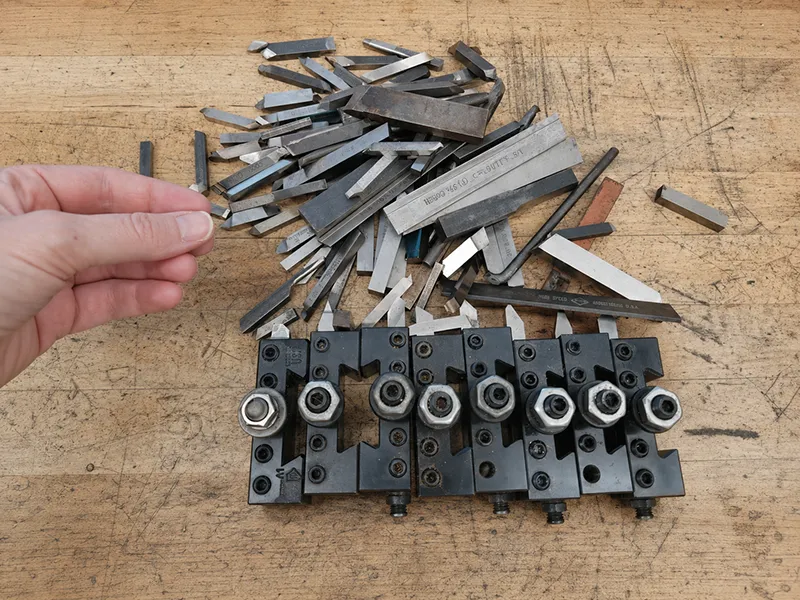
Lathe cutting tools are the working end of CNC turning. They remove material from a rotating workpiece to create diameters, faces, bores, grooves, threads, cutoffs, and textured surfaces. Because each geometry is built for a different job, the tool you choose directly affects chip control, productivity, dimensional accuracy, surface finish, tool life, and part cost.
What Are Lathe Cutting Tools?
Lathe cutting tools are tools used on manual lathes and CNC lathes to machine a rotating workpiece. In CNC turning, they are typically held in a toolholder or mounted on a turret, and they are used for operations such as external turning, facing, boring, threading, grooving, parting, drilling, and tapping.
The term lathe cutting tools is broad. It includes standard OD turning tools, internal boring bars, thread turning tools, grooving and parting tools, chamfering tools, drilling tools used on lathes, and even knurling tools for textured surfaces. In a CNC turning environment, these tools are selected not just by shape, but also by insert geometry, cutting material, rigidity, coolant access, and the feature being machined.
How Lathe Cutting Tools Work in CNC Turning
In CNC turning, the workpiece rotates in the spindle while the cutting tool moves along programmed axes, primarily X and Z, to remove material. Haas’s lathe programming documentation describes the X axis moving toward and away from spindle centerline and the Z axis moving along the spindle axis, while turning programs also use canned cycles for operations such as spot drilling, drilling, boring, tapping, roughing, and finishing.
How well a lathe tool performs depends on much more than its name. Cutting speed, feed, and depth of cut all affect tool life, while insert geometry, nose radius, and entering angle influence chip formation, cutting forces, vibration tendency, and achievable surface finish. In other words, the “right” lathe cutting tool is really a combination of tool type, insert style, tool material, and cutting conditions.
Modern CNC lathes also expand what turning centers can do. Y-axis and live-tool machines can add drilling, tapping, and secondary operations, which is why tool selection on a CNC lathe often overlaps with holemaking and finishing strategy, not just simple OD turning.
Main Types of Lathe Cutting Tools
The table below summarizes the most common lathe cutting tools used in CNC turning.
| Tool type | Main function | Typical use |
|---|---|---|
| Turning tool | Removes material from the outer diameter | Shafts, pins, steps, profiles |
| Facing tool | Machines a flat end face | Part ends, shoulders, datum faces |
| Boring tool | Enlarges or finishes an internal hole | Bushings, sleeves, housings |
| Threading tool | Produces internal or external threads | Screws, fittings, threaded parts |
| Grooving tool | Cuts narrow grooves | O-ring grooves, relief grooves, face grooves |
| Parting tool | Cuts the part off from bar stock | Cutoff operations in production turning |
| Chamfering and deburring tool | Breaks edges and prepares entrances | Safer edges, easier assembly, burr control |
| Knurling tool | Creates a patterned texture | Handles, knobs, grip surfaces |
| Drilling tool | Produces axial holes on the lathe | Pilot holes, through holes, prep for boring or tapping |
These categories match the operation groups described in turning, threading, parting-and-grooving, and lathe programming documentation.
Turning Tools
Turning tools are the most common CNC turning tools because external turning is one of the most common lathe processes, and longitudinal turning is the most common of those operations. They are used to reduce diameters, machine shoulders, and generate external profiles. In production shops, turning tools are usually split between rough turning tools for heavier cuts and finish turning tools for lower cutting forces, better dimensional control, and better surface finish.
For rough turning, insert geometries are designed for higher depth of cut and feed-rate combinations with strong edge security. For finish turning, the geometry is optimized for light cuts and low feed rates. Wiper inserts can also help maintain or improve surface finish at higher feeds, which is why they are common in precision CNC turning when cycle time still matters.
Facing Tools
Facing tools machine the end of a part by feeding radially toward the spindle center. Face turning is often one of the first operations in CNC turning because it establishes a reference face for later passes. It is also a mechanically different cut from straight OD turning because radial cutting forces are higher and can create vibration or component deflection if the setup is weak.
A good facing setup matters for more than appearance. Facing quality influences length control, shoulder accuracy, and downstream assembly. Guidance for turning component quality also recommends starting with the facing pass and using chamfers where appropriate to smooth tool entry and reduce burr formation at the edge.
Boring Tools
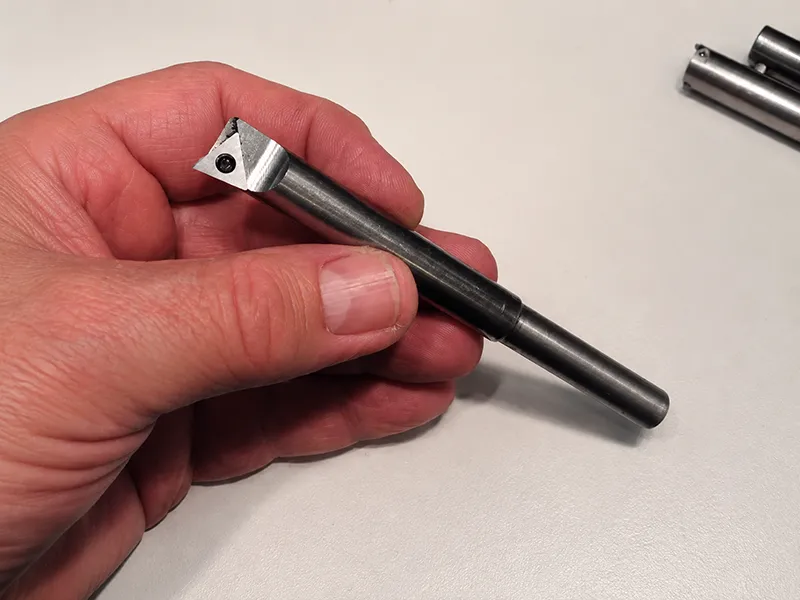
Boring tools are used for internal turning. They enlarge, straighten, or finish an existing hole, which is why boring is commonly described as the internal counterpart to external turning. Rough boring is used mainly to remove material and open up an existing hole, while finish boring is used when tighter size, better cylindricity, or improved surface finish is required.
Because boring bars usually work with longer overhangs and tighter chip-evacuation space, they are more sensitive to vibration than external tools. For that reason, internal turning guidance emphasizes large bar diameter, short overhang, positive insert geometry, and in demanding setups the use of carbide or damped boring bars to improve stability and repeatability.
Threading Tools
Threading tools generate internal and external threads on a lathe. Thread turning is demanding because the tool makes multiple passes to reach full thread depth, chip control is difficult, and internal threading is especially sensitive to poor chip evacuation and long, slender tooling. Toolmakers also note that the feed rate in thread turning must match the pitch of the thread.
A threading tool must match the thread profile and application. Full-profile inserts cut the complete thread form and require a separate insert for each pitch and profile, while V-profile inserts are more flexible across pitch ranges that share the same angle. Insert geometry, flank clearance, radial clearance, and correct shim selection all influence thread quality, wear, and tool life.
Grooving Tools
Grooving tools are used to cut narrow recesses and relief features. In CNC turning, grooving is not a single operation family but several: external grooving, internal grooving, and face grooving. That is why grooving tools come in different holder styles and insert widths depending on whether the groove is on the OD, ID, or face of the part.
Groove geometry matters. For wider shallow grooves, one strategy is plunge turning; for deep narrow grooves, multiple grooving may be better; and for groove finishing, toolmakers recommend either a turning geometry or a profiling geometry depending on the radius and feature shape. Overhang, insert width, and side-turning conditions all affect vibration and final groove quality.
Parting Tools
Parting tools, also called cut-off tools, separate the finished component from bar stock. Although the cutoff itself may take only a small portion of total cycle time, it is usually one of the last operations, which makes process security critical. If the insert breaks during parting, the workpiece is often scrapped.
A good parting tool setup usually starts with a narrow insert to reduce cutting force and save material, plus the shortest possible overhang and secure clamping for stability. Precision coolant is strongly recommended because it improves chip evacuation, reduces heat and wear, and helps surface finish. Thin inserts, incorrect center height, or feeding too aggressively toward center can all increase the risk of breakage.
Chamfering and Deburring Tools
Chamfering and deburring tools are used to break sharp edges, prepare thread starts, reduce burrs, and make parts easier to assemble. In lathe work, chamfering is often integrated into turning toolpaths rather than performed with a completely separate specialty cutter. Haas’s workbook specifically uses linear interpolation for faces and corner chamfers, which reflects how common chamfering is in everyday CNC lathe programming.
Chamfers also improve process quality. Turning guidance notes that facing is typically the first operation for setting the reference point, and that adding a chamfer or radius can reduce burr formation at the end of the cut. A chamfer also creates a smoother entry for the insert during both facing and longitudinal turning.
Knurling Tools
Knurling tools are different from standard turning tools because their job is to create a pattern rather than simply remove stock for size. In production practice, knurling is used for decorative and grip surfaces on cylindrical parts such as handles and knobs. Accu Trak’s guidance also distinguishes between roll forming knurling, which is a plastic deformation process without chips, and cut knurling, which creates a true cutting action.
Common knurl patterns include straight, spiral, diamond, and cross-type forms, depending on the holder and wheel arrangement. Setup quality matters: manufacturer guidance emphasizes center height, concentricity, proper infeed method, and strong coolant flow to wash away chips and prevent wheel seizure in cut-type knurling.
Drilling Tools Used on Lathes
Lathes do not only turn. CNC lathe controls include canned cycles for spot drilling, drilling, boring, and tapping, and modern turning centers can use live tooling for milling, drilling, and tapping operations. That means drill-related tooling is a normal part of many CNC turning jobs, especially when holes must be prepared before boring or threading.
Depending on the setup, a lathe may use standard drills, spot drills, center drills, and other types of drill bits.Center-drilled holes are especially important when a live center is used for support, and Haas explicitly notes that a proper 60-degree center drill should be used rather than a countersink, because correct tool geometry is needed for proper live-center contact and stable cutting.
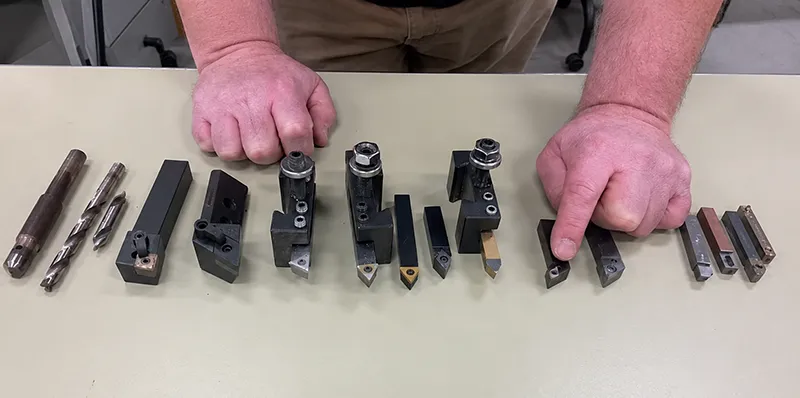
Lathe Cutting Tool Materials and Formats
Tool geometry is only half the story. The material of the tool or insert determines wear resistance, toughness, speed capability, and where the tool fits in the production mix. For CNC turning, the most important families are HSS, carbide, ceramic, CBN, and diamond-based tooling.
High-Speed Steel Tools
High-speed steel still matters, especially in lower-speed applications, simpler setups, and some holemaking and manual-tooling situations. Official guidance from Dormer Pramet notes that HSS is less hard and less wear-resistant than carbide, but offers higher toughness and is therefore suited to lower cutting speeds. Kennametal likewise notes that HSS is less expensive than carbide, but far less productive at modern cutting speeds.
In practical CNC turning, HSS is no longer the default choice for high-volume insert turning, but it remains relevant where edge toughness, easy regrinding, lower tooling cost, or low-speed work are more important than maximum productivity.
Carbide Tools
Carbide is the standard material for modern CNC turning. Sandvik states that coated cemented carbide represents roughly 80–90% of all cutting tool inserts, and that coated carbide grades are the first choice for a wide range of tools and applications because they balance wear resistance, toughness, and manufacturability.
That is why carbide dominates OD turning, threading, grooving, and most general-purpose production turning. Compared with HSS, carbide supports higher speed, stronger wear resistance, and better consistency in long production runs.
Ceramic Tools
Ceramic tools are not general-purpose tools, but they are highly valuable when the application fits. Sandvik describes ceramic cutting tools as having excellent wear resistance at high cutting speeds, with different ceramic families optimized for different materials, especially high-speed turning of difficult materials. Their main limitations are thermal shock resistance and fracture toughness.
For many shops, that means ceramic turning inserts are best reserved for stable, well-understood processes rather than stop-and-go or interruption-heavy work. They are powerful tools, but not forgiving ones.
CBN and Diamond Tools
CBN and PCD/diamond tooling sit at the high-performance end of lathe tool materials. Sandvik notes that CBN is widely used for finish turning hardened steels above 45 HRC, and above about 55 HRC it becomes the leading alternative to grinding.. PCD, by contrast, is limited mainly to non-ferrous materials because it lacks chemical stability against iron at high temperatures.
In simple terms, CBN is the specialist for hard turning, while PCD is the specialist for high-abrasion non-ferrous work such as high-silicon aluminum and other non-ferrous materials where premium surface finish and wear resistance matter.
Indexable Inserts vs Solid Lathe Tools
In most CNC turning departments, indexable insert tooling is the default. Kennametal points out that when an insert edge wears, it can be replaced in seconds without losing tool position or needing to touch off the tool again, which is a major productivity advantage in CNC machining.
By contrast, solid tools still have a place, especially for small internal features and highly precise miniature operations. Small internal turning systems, for example, often use solid carbide boring bars and ground tools to achieve precise edge position, repeatability, and stability.
| Format | Main advantages | Main limitations |
|---|---|---|
| Indexable insert tooling | Fast edge replacement, repeatable geometry, strong productivity in production CNC turning | Requires correct holder, insert, chipbreaker, and grade selection |
| Solid tools | High precision in small features, useful for specialty shapes and miniature ID work | Slower to recondition or replace, less convenient for high-volume insert-style production |
In production CNC turning, indexables usually win on uptime, repeatability, and cost per edge, while solid carbide is often the better answer for very small bores, tiny grooves, or specialized internal features.
How to Choose the Right Lathe Cutting Tool
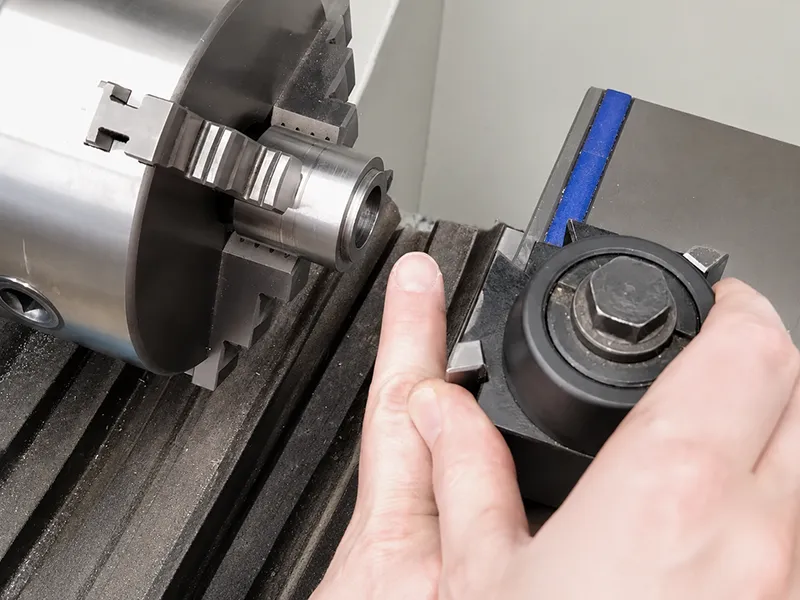
Choosing the right lathe cutting tool starts with the operation, not with the catalog. First define the feature you need to produce, then work backward into tool style, insert shape, insert grade, nose radius, holder style, and cutting data. Sandvik Coromant’s turning insert selection guidance recommends considering insert geometry, grade, shape, size, nose radius, and entering angle to achieve good chip control and machining performance.
Match the Tool to the Operation
For external roughing, you normally want a stronger geometry and a more robust setup. For finishing, lighter-cut geometries and lower cutting forces become more important. Positive inserts are often preferred for internal turning and slender components because they lower cutting forces, while negative inserts are often preferred for external turning and heavier cutting conditions because they give higher edge strength.
For boring, tool overhang and bar diameter quickly become limiting factors. For parting and grooving, insert width, blade height, and chip evacuation become more important than they are in general OD turning. And for threading, correct profile, pitch, clearance, infeed method, and chip direction can matter as much as the insert grade itself.
Match the Tool to the Workpiece Material
Workpiece material changes the entire tooling strategy. Low-carbon steels have a tendency to smear and build up on the edge, so higher cutting speeds and suitable geometries are recommended. Austenitic stainless steels benefit from coolant, sharp or positive geometries, and attention to notch wear and built-up edge. Titanium and HRSA demand sharp edges, dedicated geometries, and always-on, well-directed coolant. Aluminum and many non-ferrous materials benefit from sharp, positive tools, with uncoated carbide or PCD often preferred. Hardened steel is where ceramic and especially CBN become important.
| Workpiece material | Tooling tendency in CNC turning |
|---|---|
| Low-carbon and general steels | Use steel-oriented grades; increase speed enough to avoid built-up edge; use appropriate chipbreaking geometry |
| Stainless steel | Use coolant, sharp/positive geometry, and setups that limit notch wear and chip hammering |
| Titanium and HRSA | Use sharp edges, application-specific geometry, smaller entering-angle strategy, and strong coolant delivery |
| Aluminum and non-ferrous materials | Use sharp positive tools; uncoated carbide or PCD is often preferred; coolant mainly helps chip evacuation |
| Hardened steel | Use ceramic or CBN depending on hardness and process stability |
These are broad rules, but they are foundational. Material mismatch is one of the fastest ways to shorten tool life and damage part quality.
Match the Tool to Tolerance and Surface Finish
If your part has tight tolerances, good tool selection is inseparable from process stability. Sandvik notes that insert nose radius influences surface finish, chip breaking, and insert strength, while Haas notes that incorrect centerline position causes chatter, accuracy problems, and tool-life issues. Surface finish guidance also shows that wiper inserts can maintain or improve finish at higher feed rates when conditions are stable.
Tool wear also matters directly to precision. Flank wear is predictable, but as it progresses it changes the cutting process and can affect dimensional tolerance. If a part requires tight tolerance turning or precision CNC turning, tooling, setup rigidity, center height, tool stick-out, and insert-change discipline all become part of the tool-selection decision.
A Practical Selection Checklist
Before choosing a lathe cutting tool, define:
- the workpiece material and hardness
- whether the feature is OD, ID, face, groove, thread, cutoff, or texture
- whether the cut is roughing or finishing
- the required tolerance and surface finish
- the available rigidity, coolant delivery, and chip-evacuation space
- the production volume and whether fast insert changes matter
That short checklist captures most of what drives turning insert geometry, toolholder choice, and tool material selection in real CNC turning work.
Common Problems with Lathe Cutting Tools
Tool Wear
All lathe tools wear, but not all wear is equally destructive. Common insert-wear modes include flank wear, crater wear, built-up edge, notch wear, plastic deformation, and edge chipping. Flank wear is generally the most predictable; built-up edge is especially common in sticky materials such as low-carbon steel, stainless steel, and aluminum; crater wear and plastic deformation are tied more strongly to excessive heat and speed.
A useful rule of thumb is that cutting speed has the strongest effect on tool life, feed has a secondary effect, and depth of cut usually has the smallest effect. Too little speed can cause built-up edge and poor finish; too much can accelerate flank wear, crater wear, and plastic deformation.
Chatter and Vibration
Chatter is one of the most common lathe-tool problems, especially in boring and slender-part work. Official troubleshooting guidance highlights long tool stick-out, incorrect center height, unsuitable insert geometry, weak clamping, light chip load, excessive wear, and poor workpiece support as common causes. Longer tools are less stiff, boring bars have stick-out limits that depend on material, and reducing tool length has a major effect on stiffness.
If a cut chatters, the most common fixes are to shorten overhang, increase rigidity, use the largest practical boring-bar diameter, correct center height, adjust speed/feed, or switch to a more suitable insert geometry and nose radius. For difficult bores, damped or carbide boring bars are often the right solution.
Poor Surface Finish, Burrs, and Dimensional Drift
Poor surface finish is usually not caused by a single factor. It can come from vibration, an unsuitable nose radius, built-up edge, incorrect geometry, chip recutting, low cutting speed, unstable workholding, or excessive insert wear. Guidance for turning component quality shows that insert geometry, nose radius, cutting speed, and coolant application all influence surface finish, and that wiper inserts can improve finish without forcing a dramatic feed reduction.
Burrs often appear at tool entry or exit. Troubleshooting guidance recommends sharper edges, correct feed for the edge preparation, and using a chamfer or radius at the start or end of the cut to reduce burr formation.If the workpiece shifts in the chuck during cutting, accuracy problems, tolerance loss, and chatter are likely, which is why CNC quality control is important for turned parts.
Built-Up Edge and Chip Control Problems
Built-up edge, chip wrapping, and long stringy chips are classic turning problems. Built-up edge is caused by pressure welding of workpiece material to the insert and is more likely at low cutting speed in sticky materials. Thread-turning guidance also warns that chips can wrap around the chuck, tool, or component and cause stoppages, quality issues, and lost production time.
In practice, better chip control often comes from four changes: choosing the right insert geometry, increasing feed enough to make the insert cut properly, using proper coolant delivery, and avoiding overly light chip load. If those do not solve the issue, re-check the insert grade and whether the tool is truly matched to the workpiece material.
Conclusion
Different types of lathe cutting tools exist because CNC turning is not one single operation. OD turning, facing, boring, threading, grooving, parting, chamfering, knurling, and drilling all place different demands on the tool, holder, insert geometry, and cutting material. In modern CNC turning, carbide indexable tooling is the production standard, but solid tools, ceramics, CBN, and diamond all have important roles when the material, feature, or tolerance requires them. The right tool choice is never just about “what cuts metal.” It is about matching the operation, workpiece material, rigidity, tolerance target, and surface-finish requirement so the process runs faster, more predictably, and at lower total cost.
FAQ About Lathe Cutting Tools
What is the difference between turning tools and boring tools?
Turning tools usually machine the outer diameter or face of a workpiece, while boring tools machine the inside of an existing hole. A simple way to think about it is that boring is internal turning: both remove material with a single-point cutting edge, but one works outside the part and the other works inside it.
How do I choose the right lathe cutting tool?
Start with the feature and material. Define whether you are machining OD, ID, a face, groove, thread, or cutoff; then match the insert geometry, tool material, nose radius, and holder style to the workpiece material, rigidity level, tolerance, surface-finish target, and production volume. That sequence is more reliable than picking by tool name alone.
Why do lathe cutting tools wear out?
Lathe cutting tools wear out because cutting creates friction, pressure, heat, and repeated mechanical loading. Common wear modes include flank wear, crater wear, built-up edge, notch wear, plastic deformation, and chipping. Tool life is heavily influenced by cutting speed, feed, depth of cut, insert grade, workpiece material, and coolant application.
Are carbide tools better than HSS tools?
For most CNC turning jobs, yes. Carbide supports much higher cutting speeds and better wear resistance, which makes it the first choice for production work. HSS is still useful when toughness, low-speed cutting, low tooling cost, or easy regrinding matter more than maximum productivity, but it is no longer the default for high-output CNC turning.
What are the main types of lathe cutting tools?
The main types are turning tools, facing tools, boring tools, threading tools, grooving tools, parting tools, chamfering and deburring tools, knurling tools, and drilling tools used on lathes. Each one is designed around a specific feature family rather than one universal cutting approach.