Gold’s melting point is the temperature at which solid gold becomes liquid. Pure gold melts at about 1,064 °C (1,947–1,948 °F, or roughly 1,337 K). This high melting temperature influences how gold is processed. For example, jewelers, casters, refiners, and manufacturers must control heat precisely to shape, purify, or combine gold. In this guide we cover the exact melting-point values for pure and alloyed gold, factors that affect those values, unit conversions, practical melting methods and equipment, comparisons to other metals, and common questions and pitfalls in melting gold.
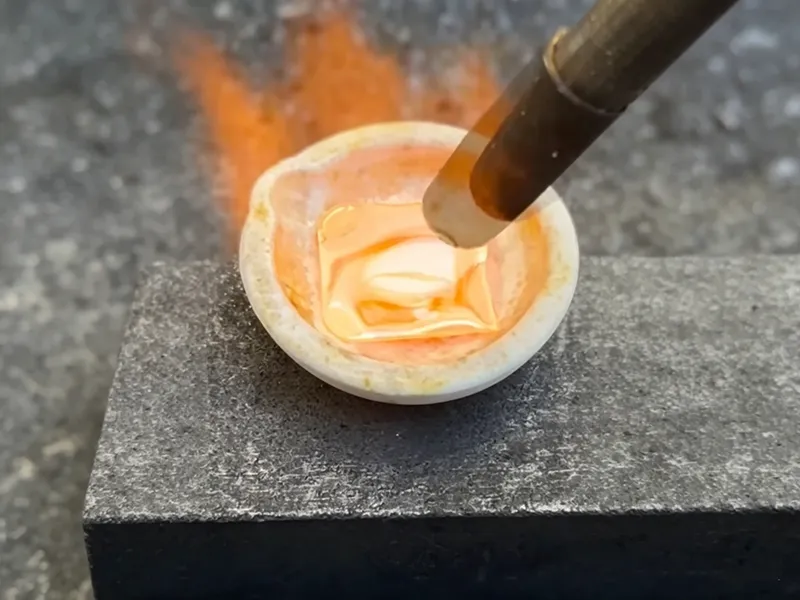
What Is the Melting Point of Gold?
Pure (24-karat) gold melts at about 1,064 °C (1,947 °F). In other units, that is roughly 2,325 °F or 1,337 K (using the conversion formulas °F = (°C×9/5)+32 and K = °C+273.15). At this precise temperature, gold transitions from solid to liquid, allowing it to be molded, cast, or alloyed. Knowing this number is critical because reaching the melting point is the first step in any gold-processing operation. (Additional heat beyond the melting point can then raise the liquid gold’s temperature toward its boiling point of about 2,856 °C, but in practice we typically work just above the melt to cast or refine it.)
Why the Melting Point of Gold Matters
Gold’s high melting point affects its use in many fields. Jewelers rely on it to cast intricate rings and designs without unintended softening. In metal refining and recycling, melting gold separates it from impurities and allows reuse, as explained in this precious metals refining process reference. Electronics manufacturers value gold’s combination of conductivity and thermal stability: circuit components and connectors must withstand soldering and operating temperatures. In industrial and aerospace applications, gold parts often face extreme heat, so the metal’s ability to remain intact at high temperatures is critical.
Understanding the melting point is key to materials and process control. For instance, a metal with too low a melting point might deform in service, while one too high can be difficult to cast. Goldsmiths employ specialized torches, furnaces, and other tools to reliably reach gold’s melting temperature without overheating. Because gold resists corrosion and retains its structure even when red-hot, it is a durable material once properly cast or formed. Its stability and high melt point also make it attractive for jewelry, coinage, and high-tech uses where long-term reliability is needed.
Melting Point of Pure Gold
Pure gold (24K, 99.95%+ Au) has a fixed melting point of about 1,064 °C (1,947 °F). This value is a standard reference: all pure gold objects, regardless of shape or maker, will melt at essentially the same temperature. Compared to other common metals, gold’s melt point is relatively high but not the highest, as shown in this gold element properties reference. For example, silver melts at about 961 °C (lower than gold), and aluminum at only 660 °C. In contrast, copper melts slightly above gold (1084 °C), and platinum requires much higher heat (~1,770 °C). Thus, gold sits near the top of the melting scale for common metals, but is far below refractory metals like tungsten.
Because pure gold is so soft, it is usually alloyed for practical use (see below). However, the melting point of 24K gold is a stable constant and is often used to verify metal purity: if an alleged 24K sample melts below 1,064 °C, it must contain other metals.
Does the Melting Point Change in Gold Alloys?
Yes. Alloying gold with other metals lowers or alters its melting point. Different karats of gold melt at different temperatures:
- 24K Gold (pure): ~1,064 °C (1,947 °F).
- 18K Gold (75% Au, 25% other metals): usually melts around 926–960 °C (1,700–1,760 °F). The exact temperature depends on the alloy metals (commonly silver, copper, zinc). Manufacturers often quote ~1,700 °F (≈926 °C) as a typical melting point for 18K gold.
- 14K Gold (58.5% Au): typically melts lower, around 879–926 °C (1,615–1,700 °F). Because it contains more alloying metals, 14K gold is harder and less expensive, but melts several tens of degrees below pure gold.
- White Gold (often Au + Ni, Pd, or Zn): melting points vary widely due to different recipes. Many white-gold alloys melt roughly between 950 °C and 1,200 °C. For example, an 18K white gold with nickel might melt near 950 °C, while palladium-based white golds can require up to ~1,150 °C.
- Rose Gold (Au + Cu): usually melts around 1,000–1,100 °C. The copper content lowers the melting point compared to pure gold, but the exact range depends on the copper fraction.
Alloying gold with silver, copper, nickel or palladium changes the metal’s overall bonding and thus its melting temperature. In general, common alloying metals like copper and silver lower gold’s melting point, which is why karat gold (less pure) melts more easily than 24K. Understanding these differences is crucial for jewelers and casters: the correct temperature must be chosen for the specific alloy being used.
Factors That Affect the Melting Point of Gold
Several factors influence how and when gold melts:
- Purity: As noted, higher purity (closer to 24K) means a higher melting point. Even small amounts of alloy or contamination can shift the melt point. Jewelers often test purity by observing melting behavior.
- Alloy Composition: The type and percentage of other metals in the alloy directly affect the melt. For instance, copper lowers the melting point more than nickel in equivalent amounts. Some rare alloying elements (like palladium) can raise the melt slightly, but the effect is usually that mixing metals broadens the melting range.
- Impurities: Non-metal impurities or residues (e.g. dirt, grease, flux) generally raise the apparent melting point, because they need to burn away before the metal itself can melt. In refining, removing trace elements is important to ensure the gold melts cleanly at its normal point.
- Atmospheric Conditions: Standard melting points assume normal atmospheric pressure. In practice, variations (like vacuum or inert gas environments) have minimal effect on the melting temperature but can affect how the metal behaves (e.g. reducing oxidation). Very high pressure can change melting slightly, but this is not common in jewelry or refining.
- Heating Method and Equipment: How you heat the gold matters. For example, induction furnaces heat metal uniformly through electromagnetic fields, often melting gold more efficiently and evenly. A torch or old furnace might create local hot spots. Equipment calibration also matters: if a furnace’s temperature gauge is off, you might under- or overshoot the true melting point. In practice, operators usually heat gold slightly above its melting point to ensure full liquidity. Indeed, casting often requires setting the melt temperature tens of degrees higher to compensate for heat loss during transfer.
Theoretical vs. Practical: The listed melting point is an ideal “liquidus” value. In real operations, gold must be heated a bit higher. For example, MatWeb notes that even pure gold (m.p. 1,064 °C) is typically cast at about 1,095–1,300 °C. The extra heat ensures the metal stays fluid long enough to pour, especially when it contacts a cooler mold.
Gold Melting Point in Celsius, Fahrenheit, and Kelvin
For reference:
- Celsius (°C): Gold melts at ~1,064 °C.
- Fahrenheit (°F): That is about 1,947 °F.
- Kelvin (K): About 1,337 K (1,064 + 273).
Gold’s melting point is usually quoted in °C by scientists and internationally, °F in North American contexts, and Kelvin in scientific fields. Jewelers may think in °C or °F depending on regional training. We can convert using °F = (°C×9/5)+32 and K = °C + 273.15.
How Gold Is Melted in Practice
Gold can be melted by several methods, each suited to different scales and needs:
- Using a Furnace: Electric or gas furnaces with crucibles (made of clay, ceramic, or graphite) are common in labs and refineries. The crucible holds the gold as it heats uniformly. Professional gold melting furnaces are designed for precision and safety. (Some furnaces have tilting features to pour liquid gold more easily.)
- Using a Torch: For small jobs (like jewelry repairs or small casts), a high-temperature torch (acetylene, propane with oxygen, or butane) can melt gold in a handheld crucible. This is very portable, but requires skill to keep the flame on the gold long enough without overheating other areas.
- Using an Induction Melter: Induction coils generate heat within the metal itself. These machines melt gold extremely quickly and cleanly, with minimal loss. They are popular in labs and industry for their efficiency. Induction heating tends to produce a very even melt, which helps avoid hot spots or “cold” regions.
In any method, temperature control is crucial. Operators will heat beyond the melting point and often stir or flux the molten gold. Flux can be added to prevent oxidation or to collect impurities. The goal is to achieve a fully liquid batch of gold at a uniform temperature before pouring. For example, cast masters often hold gold ~30–100 °C above its melting point and then pour rapidly into a preheated mold.
Tools and Equipment for Melting Gold
Common equipment in gold melting includes:
- Crucibles: Vessels (usually ceramic, graphite, or clay-graphite) that withstand high heat. Choose a crucible rated above 1,200 °C for gold. Some precious-metal crucibles have special coatings to prevent metal sticking.
- Furnaces: Benchtop electric furnaces or large industrial melters. A well-controlled furnace will have a reliable thermometer and possibly a tilting mechanism for pouring.
- Torches: High-oxygen torches for small-scale melting or soldering. Useful for spot-melting or working outdoors.
- Induction Melters: Modern machines that can rapidly melt gold with electricity. They often have programmable controls.
- Safety Gear: Heat-resistant gloves, face shield or goggles, and heavy aprons are essential. A fume hood or ventilation should be used to remove toxic gases (gold alloys sometimes emit harmful fumes when heated).
- Other Accessories: Tongs for handling hot crucibles, skimmers for slag, and molds for casting.
Different scenarios call for different tools. A small jeweler might use a handheld torch and a clay crucible, whereas a refinery uses automated induction furnaces and large graphite pots. Regardless of scale, it’s critical to use equipment rated for gold’s high melt temperature and to follow all safety protocols.
Gold Melting Point vs Other Metals
Metals vary widely in melting point. For context:
- Gold (Au): 1,064 °C (1,947 °F).
- Silver (Ag): 961 °C.
- Copper (Cu): 1,084 °C.
- Platinum (Pt): 1,770 °C.
- Aluminum (Al): 660 °C.
- Iron (Fe): ~1,538 °C (for pure iron).
- Nickel (Ni): 1,453 °C.
Compared to other precious metals, gold’s melt is intermediate: lower than platinum or tungsten, but higher than silver or copper. Compared to common nonferrous metals, gold needs more heat than aluminum or zinc, but a bit less than iron. This puts gold near the top of all metal melting temperatures, reflecting its strong atomic bonds. (For a quick reference, the table from Fractory shows gold at 1,063 °C, silver at 961 °C, copper 1,084 °C.)
| Metal | Melting Point (°C) |
|---|---|
| Aluminum | 660 |
| Silver | 961 |
| Gold | 1,064 |
| Copper | 1,084 |
| Platinum | 1,770 |
Gold’s relatively high melting point contributes to its durability, but also means it takes more energy to smelt than many metals. This comparison helps metallurgists choose suitable alloys: for instance, mixing gold with silver (961 °C melt) can ease the casting process.
Common Applications That Require Gold Melting

Gold is melted in many industries, including:
- Jewelry Making: Virtually all gold jewelry is cast or soldered in molten form. Rings, chains, and settings often start as melted gold poured into molds or worked with a torch.
- Gold Refining: Scrap gold from electronics, jewelry, or bullion is melted to purify it. Refineries melt gold with flux to separate out impurities and recover high-purity metal.
- Investment Casting/Bullion: Gold bars and coins are produced by melting pure gold and casting it into standardized molds. Even in investment grade minting, temperature control is crucial for flaw-free bars.
- Electronics and Industrial Uses: Gold is used in wires, connectors, and plating. Components that require gold are sometimes fabricated by melting and alloying gold (e.g. in precision contact tips, circuit components).
- Medical and Dental Applications: Dental crowns, fillings, and certain medical devices use gold or gold alloys. These are manufactured by casting or forming melted gold because it is biocompatible and stable.
- Aerospace & High-Tech: Specialized parts (like satellite connectors or high-temperature seals) can use gold alloys. Designers account for the melting point when selecting gold parts for extreme environments.
In each case, understanding the exact melting behavior is important. For instance, jewelry may use 14K gold for hardness (requiring ~880–900 °C melting), while aerospace parts might use 18K or higher karat for strength (requiring ~930–960 °C). Electronics plating typically involves heating gold to just above its melt to deposit thin films. In all these fields, precise temperature control ensures the gold flows and sets correctly without defects.
Common Mistakes When Melting Gold
Some frequent errors include:
- Not Reaching Sufficient Temperature: If the gold is not fully melted (or hot enough above the melt point), it may solidify too quickly or trap voids. Always verify your furnace or torch is calibrated; check that gold is fully liquid before pouring.
- Overheating: Running temperatures far above what’s needed can waste energy, damage equipment, or cause excessive oxidation. It can also lead to boiling or vaporizing alloying elements. Follow recommended casting ranges (e.g. ~1,095–1,300 °C for pure gold) rather than blasting at maximum heat.
- Wrong Crucible Material: Using a crucible that can’t withstand gold’s heat (e.g. regular pottery) can cause cracks or contamination. Use appropriate graphite or ceramic crucibles rated for 1,200 °C+.
- Incorrect Alloy Composition: Misidentifying the alloy composition can cause melting at unexpected temperatures. For example, 18K gold will freeze at ~926 °C, not 1,064 °C. Misjudging this can cause incomplete melting or overheating.
- Neglecting Oxidation and Contamination: Failing to use flux or protective gas when melting can allow oxygen to react with the gold or alloys, creating dross (oxide layer) and metal loss. Always use flux and/or an inert atmosphere if possible.
- Insufficient Safety Precautions: Hot gold can splatter. Not wearing gloves, face shield, or apron can cause severe burns. Also, neglecting ventilation can expose the operator to toxic fumes from metals like nickel or zinc in alloys.
One instructive point: if you melt gold jewelry containing other metals (like steel posts or solder), those impurities may burn off and be lost. For example, when refining scrap, steel or base metals sometimes melt away or oxidize, reducing the final gold yield. Proper preparation (removing non-gold parts) can prevent unexpected loss.
Safety Considerations When Melting Gold
Melting gold involves extreme heat, so safety is paramount. Key considerations include:
- Heat Hazards: Molten gold is extremely hot (bright orange-white). Protective clothing is a must: heat-resistant gloves, face shield or safety goggles, and flame-resistant apron or coat. Even radiant heat from a furnace can burn skin, so keep a safe distance.
- Fumes and Ventilation: Alloying metals (like nickel, zinc, cadmium) can produce toxic fumes when hot. Always work under a fume hood or in a well-ventilated area to avoid inhalation.
- Molten Metal Splatter: Liquid gold can spit if water or other contaminants contact it. Ensure all tools are dry and clean. Use crucible tongs and tools at a distance to avoid splatter injuries.
- Fire Risk: Work on fireproof surfaces. Keep flammable materials (paper, solvents) far from the furnace or torch. Have a fire extinguisher (class D for metal, or at least CO₂) on hand.
- Electrical Safety: For electric furnaces or induction units, ensure proper grounding and don’t overload circuits. Follow manufacturer’s instructions.
- Training: Only trained personnel should operate melting equipment. Understanding metal behavior under heat (e.g. recognizing when gold is truly molten vs. beginning to melt) is important to prevent mistakes.
In short, treat molten gold with the same care as molten lava. Proper PPE and ventilation are non-negotiable.
How to Choose the Right Temperature for Gold Casting
When casting gold, the pouring temperature is usually set above the theoretical melt point. This accounts for heat loss during transfer and ensures the metal flows fully into the mold. For example:
- Theoretical Melt vs. Pour Temp: Pure gold melts at ~1,064 °C, but castings are often done near 1,100–1,300 °C. The exact “casting range” depends on alloy and mold. A guide from MatWeb lists 1,095–1,300 °C for pure gold casting.
- Alloy-Specific Casting: Each alloy has its own recommended casting temp. As a rule of thumb, jewelers often cast ~50–150 °F above the melting point. For example, sterling silver (m.p. ~893 °F) is cast around 1,950–2,100 °F (about 100–150 °F above melt). Similarly, 18K gold (~1,700 °F) might be poured at ~1,750–1,850 °F, depending on detail.
- Avoiding Mold Damage: Note that molds (investment or graphite) have their own limits. Do not heat the mold above its safe range (often <800–900 °C for gypsum-based investments). Instead, adjust the metal hotter if needed.
- Minimizing Defects: Adequate temperature helps prevent defects like porosity or cold shuts. However, overheating can cause grain growth or unwanted reactions. The goal is to find the “sweet spot” where metal is fully liquid but not excessively hot. This usually requires practice and sometimes a pyrometer for precision.
In practice, one chooses a casting temperature after testing: pour a small sample ingot and inspect for shrinkage or porosity. Experienced casters typically start 30–50 °C above the melt point and adjust from there for best results.
Melting Point of Gold in Jewelry and Manufacturing
In jewelry and manufacturing, accurately knowing gold’s melting point improves quality and efficiency. For example, when casting wedding rings or intricate settings, using the correct temperature ensures the metal fills the mold completely without burning. During repairs or remelting scraps, understanding that gold may burn off alloy metals (like zinc in “white” solders) is important. Manufacturers rely on consistent melting behavior to automate production lines (e.g. in stamping or plating lines that use molten gold).
Precise temperature control also affects the mechanical properties of the final product. If gold is overheated, its grain structure can coarsen, making it more brittle. If underheated, the casting may have voids. By keeping melts at just the right temperature and using proper cooling, jewelers and engineers achieve higher yields and stronger parts.
For instance, a bullion minter using 24K gold for coins will use a furnace with PID controls to hold 1,100 °C exactly, ensuring each gold bar is defect-free. In aerospace manufacturing, gold-plated components may be annealed by briefly heating above gold’s melt point in controlled furnaces, relying on the known melting behavior to ensure uniform coating adhesion.

Common Misunderstandings About Gold’s Melting Point
- “24K and 18K gold melt the same way.” False. Pure gold (24K) melts at ~1,064 °C, but 18K (75% Au) melts around 925–960 °C. The alloy composition changes the melt dramatically.
- “Once you hit the melting point, you can pour immediately.” Not exactly. As noted, practical casting often requires heating a bit above the melt point to keep gold fluid. Achieving the theoretical melting point is just the first step.
- “A higher melting point means a better quality gold.” No – melting point is a material property, not a quality metric. 24K gold does have a higher melt point than 14K, but “quality” depends on application. Jewelry often uses 14K for strength even though it melts lower.
- “All gold alloys behave the same.” Different alloys melt over different temperature ranges and can behave differently when liquid. For example, some white-gold alloys require special flux to prevent oxidation. It’s not one-size-fits-all.
- “Impurities don’t matter much for melting.” Actually, impurities can significantly affect the melt and final result. Even trace contaminants can cause alloying issues or loss during melting.
Summary
Gold’s melting point is about 1,064 °C (1,947 °F), a fundamental property that underpins all gold processing. Pure gold (24K) always melts at this temperature, making it a fixed reference. Alloying gold with silver, copper, nickel or other metals lowers its melting point, so 18K and 14K gold melt at roughly 926–960 °C and 879–926 °C, respectively. Key factors affecting gold’s melting behavior include its purity, alloy composition, and how it is heated.
In practice, controlling the melt is critical in jewelry, casting, refining, and manufacturing. Using the right equipment (furnaces, torches, induction) and safety measures (gloves, goggles, ventilation) ensures that gold can be melted cleanly and safely. By understanding gold’s melting characteristics and applying proper temperature control, craftsmen and engineers can improve product quality, reduce waste, and avoid common mistakes.
Whether you’re casting a gold pendant, refining scrap, or designing a microchip with gold contacts, knowing gold’s melting point and how to work with it is essential.
FAQ
What is the melting point of gold in Celsius?
Pure gold melts at about 1,064 °C.
Does 18K gold melt at the same temperature as pure gold?
No. 18K gold (75% Au) melts significantly lower, typically around 926–960 °C (about 1,700–1,760 °F), because the other metals in the alloy reduce the melt point.
Why does alloyed gold melt at a lower temperature?
Adding other metals (silver, copper, etc.) disrupts gold’s atomic structure and lowers its melting point. Each alloy has its own melting range depending on composition.
What equipment is used to melt gold?
Gold is often melted in furnaces (clay/ceramic crucibles heated by gas or electricity), or with a high-temperature torch for small batches. Industrial settings may use induction melting machines for fast, uniform melting. Crucibles, tongs, flux, and protective gear are common accessories.
Can you melt gold with a torch?
Yes – jewelers frequently melt gold with a torch. A strong flame (acetylene or propane with oxygen) directed at a crucible of gold can reach gold’s melting point. However, it requires care to heat evenly and not overheat surrounding components. Always use safety gear when torch-melting gold.
Why is casting temperature higher than the melting point?
Because gold will lose some heat as it’s transferred to the mold, casters typically set the furnace ~30–100 °C above the melt point. For example, pure gold (m.p. 1,064 °C) is often cast at around 1,095–1,300 °C to ensure the metal fully flows before solidifying. The exact overheat depends on the mold material and detail of the piece.