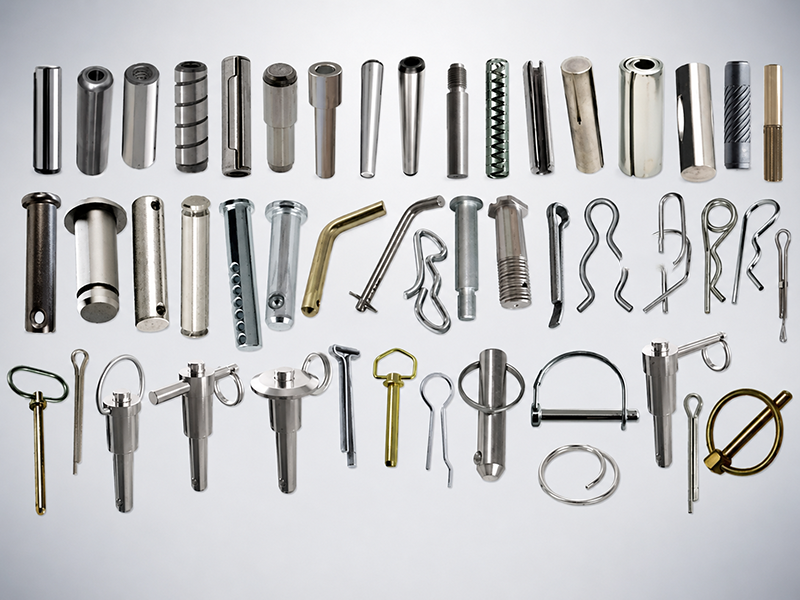
Pins are among the most common mechanical components in engineered assemblies. They are used to align, fasten, locate, lock, join, and sometimes allow controlled movement between parts. Unlike threaded fasteners that principally clamp parts together, many pins work through shear strength, friction, radial tension, taper lock, or a secondary retaining device such as a cotter or keeper clip.
In practical design, the right type of pin is chosen by balancing load direction, assembly method, removability, positional accuracy, corrosion exposure, material, and manufacturing cost. That is why a precision dowel pin, a self-retaining spring pin, a clevis pin for pivoting, and a hitch pin for quick field connection all solve different problems even though they are all “pins.”
What Are Mechanical Pins?
Mechanical pins are cylindrical or specially shaped components used to join, align, secure, or position two or more parts. In machine design they are often selected when the joint must carry shear, maintain repeatable alignment, permit pivoting, or provide a compact retention feature without the bulk of a threaded fastener system.
They are widely used in machinery, tooling, fixtures, molds, automotive assemblies, aerospace hardware, medical equipment, electronics, and custom CNC machined products. Depending on the design, a pin may be semi-permanent, press-fit, or quickly removable; some are intended for repeated service, while others are effectively one-time locking devices.
Common Types of Pins
Most common pin families are defined in ISO, DIN, or ASME standards. Examples include ISO 8734 and ISO 2338 for dowel or parallel pins, ISO 2339 for taper pins, ISO 8752 for slotted spring pins, and ASME B18.8.1 and B18.8.2 for common imperial clevis, cotter, and machine dowel pin forms.
| Pin Type | Main Function | Removable? | Typical Applications | Manufacturing Notes |
|---|---|---|---|---|
| Dowel pin | Accurate alignment and positioning | Often yes, depending on fit | Fixtures, molds, machine assemblies, precision CNC parts | Tight diameter tolerance; commonly hardened and/or ground; reamed holes often used |
| Taper pin | Secure positioning with self-locking taper | Yes | Shafts, gears, pulleys, tooling, machinery | Requires tapered hole; metric taper is commonly 1:50 |
| Spring pin / roll pin | Self-retaining fastening with radial tension | Usually removable with tools | Shock- or vibration-prone joints, assemblies, housings | Slotted or coiled form; easier hole prep than precision solid pins |
| Clevis pin | Pivoting connection | Yes | Linkages, brackets, agricultural and industrial joints | Used with clips or cotter pins for retention |
| Cotter pin / split pin | Secondary locking and retention | Technically removable, but often replaced after use | Locking nuts, shafts, clevis pins | Wire-formed part, usually bent in assembly |
| Grooved pin | High-retention locking in a straight drilled hole | Semi-permanent | Hinges, latches, shafts, panels, locating features | Grooves expand for locking force; straight holes can be used |
| Hitch pin | Quick connection and removal | Yes | Trailers, tow bars, implements, agricultural equipment | Keeper or clip is critical to safe retention |
| Locating pin | Precise part positioning | Varies by design | Jigs, fixtures, molds, assembly systems | Often hardened; may be press-fit, threaded, or bushing-mounted |
| Threaded pin | Retention, extraction, or adjustment | Yes | One-side access assemblies, fixtures, repeated disassembly | Internal or external threads; often custom turned |
The table above synthesizes guidance from engineering and manufacturer references on dowel, taper, spring, clevis, cotter, grooved, hitch, locating, and threaded pins.
Dowel pins are the classic choice for accurate alignment. Precision dowels are solid cylindrical pins with ground or tightly controlled diameters, and they are widely used to align and secure two or more components in fixtures, tooling, and precision mechanical assemblies. ISO 8734 and ASME B18.8.2 families are common references for hardened or precision machine dowel pins.
Taper pins use a slight taper to create a secure, self-locking fit. They are widely used to locate and secure gears, pulleys, couplings, and machine components, and they are valued when accurate positioning and later removal are both required; the trade-off is that the mating hole usually must be taper-reamed.
Spring pins, also called roll pins, are hollow or coiled pins that retain themselves by radial spring force against the hole wall. SPIROL notes that spring pins are especially useful where shock, vibration, and simpler installation are important, and they are often easier to install than precision solid pins because they tolerate wider hole variation.
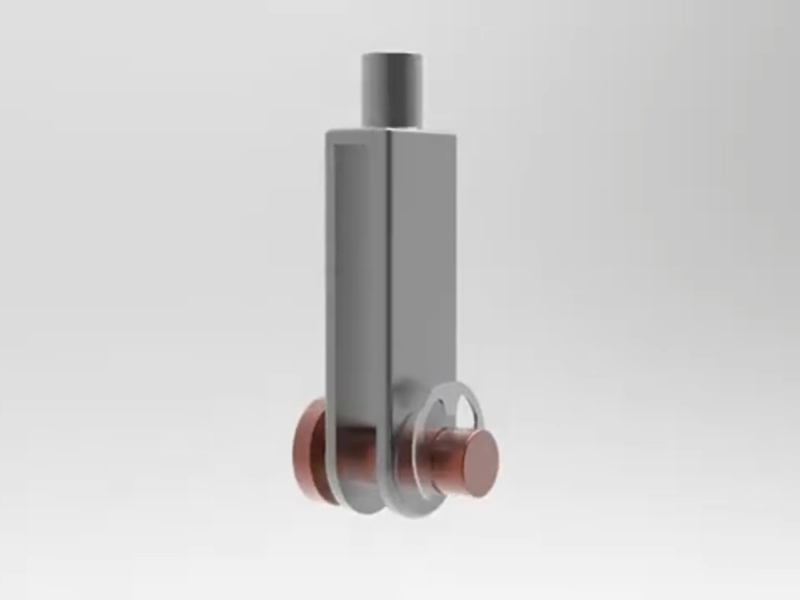
Clevis pins are designed for pivoting joints. They usually have a head on one end and a cross-hole or retainer on the other, allowing them to connect two linked parts while still permitting rotation; they are common in agricultural machinery, turnbuckles, brackets, and industrial linkages.
Cotter pins, also called split pins, are secondary locking devices rather than primary load-carrying alignment pins. They are widely used to stop nuts, shafts, and clevis pins from backing out, and because they are bent during installation, they are often treated as single-use parts in service work.
Grooved pins add locking force through longitudinal grooves that compress during installation and then press against the hole wall. Manufacturer guides emphasize that they can work in straight drilled holes, resist shock and vibration well, and may offer higher shear strength than spring pins of the same diameter, which is why they are common in hinges, latches, shafts, and compact retention features.
Hitch pins are field-friendly retaining pins used where fast connection and removal matter more than micron-level alignment. Purdue Extension’s hitch pin guidance shows how important pin diameter, grade, usable length, and especially a proper keeper are in trailer and implement service, since hitch pins can fail in shear or bounce out if they are undersized or poorly retained.
Locating pins are used to position workpieces or mating components accurately in fixtures, jigs, molds, and assembly systems. Carr Lane and norelem both note that locating pins are precision components intended to guide and hold parts in a predetermined position, and many are hardened, ground, press-fit, or mounted in bushings to provide repeatable, low-wear location.
Threaded pins add a thread for fastening, extraction, or repeat disassembly. Internally or externally threaded taper pins are especially useful when only one side of the hole is accessible or when a precision locating pin needs to be removed more easily during maintenance.
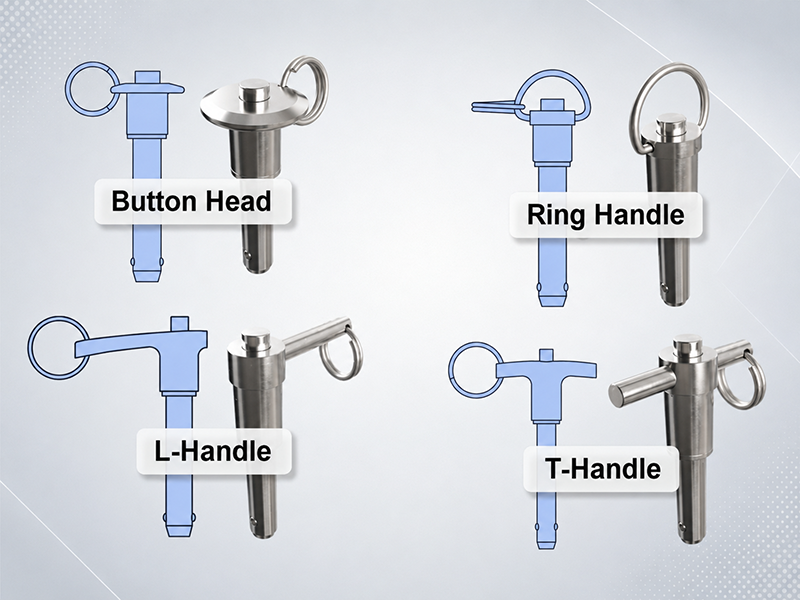
Pin Materials and Surface Treatments
Material selection determines whether a pin is economical, corrosion resistant, hard enough, strong enough, or suitable for a particular environment. Across industrial fastening practice, carbon steel, alloy steel, stainless steel, brass, aluminum, titanium, and engineering plastics are all used, but each one changes the joint’s performance envelope in a meaningful way.
| Material | Main Advantages | Main Limitations | Typical Uses |
|---|---|---|---|
| Carbon steel | Low cost, common, good baseline strength | Needs coating for corrosion resistance | General-purpose mechanical pins |
| Stainless steel | Strong corrosion resistance; good for wet, medical, food, and outdoor use | Higher cost; some grades are not heat-treat hardenable | Medical, marine, food, exposed hardware |
| Alloy steel | Higher strength and heat-treat response | Usually needs coating against corrosion | High-load dowel, grooved, and specialty pins |
| Brass | Corrosion resistant, conductive, non-magnetic, attractive | Softer than steels | Electrical, marine, decorative, light-duty pins |
| Aluminum | Lightweight, corrosion resistant, conductive | Lower stiffness and strength than steel families in many applications | Weight-sensitive custom pins, light-duty hardware |
| Titanium | High strength-to-weight ratio and strong corrosion resistance | Expensive; harder to justify for commodity hardware | Aerospace, medical, premium custom pins |
| Plastic / nylon | Lightweight, insulating, non-conductive, corrosion resistant | Best only for low-load service; can absorb moisture or degrade under UV | Electronics, insulation, light-duty retention |
This material summary is based on engineering and fastener references from NASA, Fastenal, GlobalSpec, Güldner, KD Fasteners, and Accu.
Surface treatment matters almost as much as the base alloy because it changes corrosion behavior, wear behavior, appearance, and service life. In practice, zinc plating is widely used on steel fasteners for economical corrosion protection; electroless nickel is valued for wear and corrosion resistance plus uniform coverage on complex shapes; black oxide is extremely thin and attractive but offers only limited corrosion resistance; stainless passivation removes free iron and improves corrosion resistance; anodizing creates a protective aluminum oxide layer; and heat treatment increases strength, hardness, wear resistance, and temperature capability.
For precision pins, finishing can also be a dimensional decision. Dowel pins are often specified as hardened and ground parts because grinding and centerless finishing can deliver the diameter control and surface condition needed for predictable press fits or slip fits, while polishing is more often reserved for cosmetic surfaces or specialized sealing and surface-quality requirements.
How Pins Are Manufactured
Custom and standard pins are produced by several different manufacturing routes. For cylindrical, stepped, threaded, or shouldered pin designs, machining on a lathe or CNC turning center is the most direct process; if the pin also needs flats, grooves, slots, cross-holes, or other non-round geometry, CNC milling or secondary machining is added. SPIROL notes that machining is typically done from rod stock, while custom dowel suppliers explicitly offer additional features such as milled flats, internal threads, and external threads.
When a pin needs tight tolerances and reliable repeatable fits, grinding becomes important. DRIV-LOK describes precision dowels as solid cylindrical pins with a centerless ground finish and precision tolerances, and emphasizes that they are sensitive to hole variation and often require reamed holes. That is why ground dowels remain the benchmark for high-accuracy locating work.
For higher production volumes, some solid pins are manufactured by cold heading rather than machining. SPIROL’s engineering paper explains that cold heading forms raw wire in dies, while machining cuts geometry from rod stock; the manufacturing method directly affects available tolerances, geometry, material options, and overall cost, so the right choice depends on function and volume rather than on habit alone.
Wire-form pins are different again. MW Components states that cotter pins and related wire forms may be produced with CNC wire bending, CNC wire forming, multi-slide, or four-slide processes, which is why split pins, hairpin cotters, and similar retainers are usually not machined like dowels or locating pins.
For bespoke or non-standard parts, custom manufacturers can build pins from drawings, CAD files, known standards, or application requirements. Common custom requests include non-standard diameters or lengths, special alloys, Rockwell hardness targets, internal or external threads, additional grooves, flats, and finish requirements.
Design, Tolerances, and Fit Requirements
Good pin design starts with a few fundamentals: diameter, usable length, hole tolerance, fit class, load direction, shear requirement, wear requirement, corrosion environment, installation method, removability, and quantity. WM Berg’s dowel guidance and Purdue’s hitch-pin safety guide both show that getting even one of these basics wrong can lead to poor fit, difficult assembly, deformation, or outright failure in service.
The fit between the pin and the hole is usually the most important design decision. A clearance or slip fit gives easier assembly and removal; a transition fit balances location with serviceability; and an interference or press fit increases retention but also raises insertion force and hole-preparation demands. Precision dowel systems commonly rely on reamed holes and close tolerances, while grooved pins and spring pins are deliberately more forgiving and can reduce hole-preparation cost.
Inspection requirements scale with application risk. For precision pins, manufacturers commonly control diameter, length, hardness, and finish, and may also verify straightness, roundness, or fit-critical features. Grooved-pin references specifically call out tools such as micrometers, calipers, and ring gages, while hitch-pin guidance emphasizes that grade, diameter, keeper condition, and visible bending or notch damage are central inspection concerns in field service.
Applications and How to Choose the Right Pin
Pins are used throughout automotive, aerospace, medical, industrial, electronic, and tooling applications. Dowel and locating pins are common in fixtures, machine assemblies, and precision components; clevis and hitch pins dominate pivoting or field-service joints; spring and grooved pins are practical in vibration-prone assemblies; and threaded or custom pins appear when removal, one-side access, or unusual geometry must be built into the joint itself.
A simple rule works well in early design. Use dowel pins for precise alignment, spring pins for flexible retention and vibration resistance, clevis pins for pivoting joints, cotter pins for secondary locking, taper pins for secure positioning with disassembly, grooved pins when you want more retention in a straight drilled hole, hitch pins for quick field connection, and locating or threaded pins when fixture repeatability or easier extraction matters.
Custom pin manufacturing becomes necessary when standard catalog hardware cannot meet the application. Typical triggers include non-standard diameters or lengths, special grooves or shoulders, internal or external threads, unusual materials, tight tolerance requirements, or prototype quantities. In those cases, CNC machining is usually the practical route for low-volume custom pins, while cold heading or wire forming becomes more economical when the design stabilizes and volume increases.
Conclusion
Pins are simple parts, but they solve very different mechanical problems. Dowel pins provide alignment, taper pins provide secure location, spring pins deliver compliant retention, clevis pins enable pivoting, cotter pins lock, grooved pins increase holding power, hitch pins speed field connection, and locating or threaded pins add precision and serviceability where standard hardware falls short. Material, fit, finishing, and manufacturing method all shape real-world performance, especially when corrosion, vibration, shear load, or repeated maintenance are part of the application. For precision assemblies, the best results usually come from choosing the pin type first by function, then matching the alloy, tolerance, finish, and production method to the environment and quantity. That approach reduces assembly problems, lowers total cost, and makes the finished joint far more reliable.
FAQs About Types of Pins
What are the most common types of pins?
The most common mechanical pin types are dowel pins, taper pins, spring pins or roll pins, clevis pins, cotter pins, grooved pins, hitch pins, locating pins, and threaded pins. Each one is optimized for a different combination of alignment, retention, removability, or motion control.
What is the difference between a dowel pin and a spring pin?
A dowel pin is a solid precision pin primarily used for accurate positioning and repeatable alignment, often in reamed or tightly controlled holes. A spring pin is a slotted or coiled self-retaining pin that uses radial tension to stay in place and is usually preferred when easier installation, vibration resistance, or more tolerant hole preparation is needed.
What materials are used for mechanical pins?
Common pin materials include carbon steel, alloy steel, stainless steel, brass, aluminum, titanium, and plastic such as nylon. The best choice depends on strength, corrosion resistance, electrical conductivity, weight, cost, and whether the application is precision, decorative, outdoor, medical, or high load.
How are precision pins manufactured?
Precision pins are commonly produced by CNC turning or other machining, followed by grinding when tight diameter control and surface finish are required. Depending on design and volume, manufacturers may also use cold heading, heat treatment, wire forming, and secondary finishing or coatings.
What affects the cost of custom pins?
The main CNC machining cost drivers are material, heat treatment, finish, diameter and length, fit tolerance, feature complexity such as grooves or threads, inspection level, and order quantity. In general, a simple standard steel pin is far cheaper than a custom ground alloy or titanium pin with tight tolerances and special coatings.
Can pins be custom manufactured?
Yes. Custom pins can be made to drawings, CAD files, standard references, or samples, and manufacturers commonly offer custom diameters, lengths, material grades, hardness levels, grooves, flats, shoulders, internal or external threads, and special finishes.