Rivets are mechanical fasteners used to permanently join metal parts and structural components by deforming a shaft to hold materials together securely, widely used in modern custom CNC machining. They are widely used in industries such as aerospace, automotive, and construction due to their strength and reliability. This guide explains what rivets are, the different types available, their common uses, and how to choose the right rivet for your application.

What Is a Rivet?
Rivet Definition
A rivet is a type of mechanical fastener used to permanently join two or more materials, most commonly metal components. It consists of a smooth cylindrical shaft (also called the shank) and a head on one end. During installation, the tail end of the rivet is deformed to create a second head, which holds the materials tightly together.
The basic structure of a rivet includes two main parts:
- Head: The pre-formed top portion that remains visible after installation
- Shank: The cylindrical body that passes through the materials being joined
Because of its simple design and strong holding capability, a rivet is widely used in structural applications where durability and reliability are essential. This makes it a key component in understanding what is a rivet and how it functions in industrial fastening.
How Rivets Work
Rivets work based on the principle of plastic deformation, a concept widely explained in engineering resources such as Engineering Toolbox. When a rivet is inserted into a pre-drilled hole, force is applied to the tail end using a hammer, rivet gun, or specialized tool. This force causes the material of the rivet to deform and expand, forming a second head on the opposite side.
Once deformed, the rivet tightly clamps the materials together, creating a permanent and secure joint. Unlike screws or bolts, rivets do not rely on threads and cannot be easily removed without damaging the fastener.
This permanent fastening method provides excellent resistance to vibration and shear forces, which is why rivets are commonly used in industries such as aerospace, automotive, and construction.
Main Types of Rivets
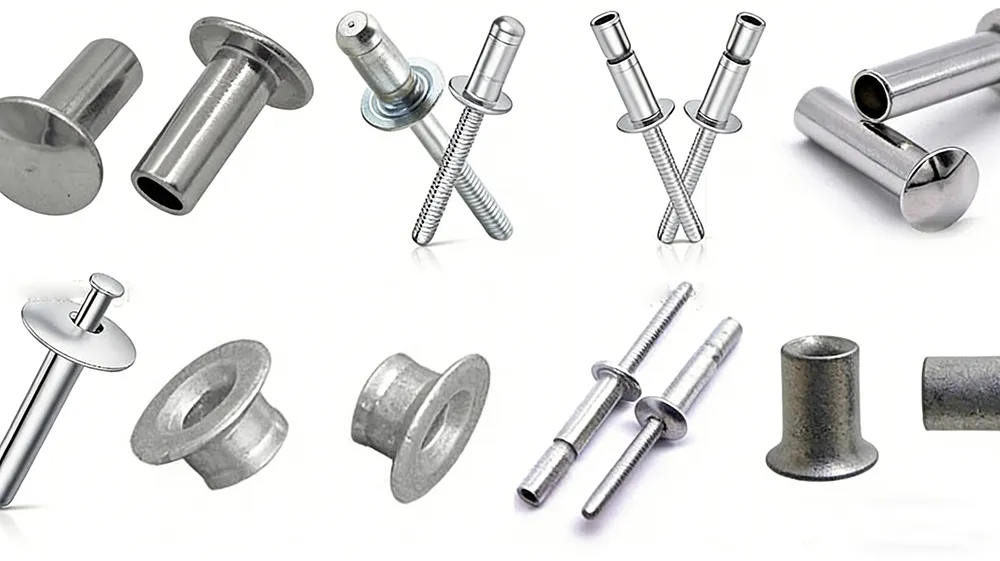
Understanding the different types of rivets is essential when selecting the right fastener for your application. Each type is designed for specific use cases, materials, and installation conditions.
Solid Rivets
Solid rivets are the most traditional and widely used type of rivet. They consist of a solid shaft and require access to both sides of the material for installation. During installation, the tail end is deformed using a hammer or rivet gun to form a second head.
Because of their simple structure and high strength, solid rivets are commonly used in applications that require maximum durability and reliability.
Typical applications include:
- Aerospace structures (aircraft frames)
- Heavy machinery
- Structural steel connections
Blind Rivets (Pop Rivets)
Blind rivets, also known as pop rivets, are designed for situations where only one side of the workpiece is accessible. They are installed using a rivet gun that pulls a mandrel through the rivet body, expanding it and securing the materials.
These rivets are extremely popular due to their ease of use and versatility.
Typical applications include:
- Automotive panels
- Sheet metal assemblies
- Electronics enclosures
Semi-Tubular Rivets
Semi-tubular rivets have a partially hollow shaft, which reduces the force required for installation. This makes them easier and faster to install compared to solid rivets.
They are ideal for applications where moderate strength is sufficient and efficiency is important.
Typical applications include:
- Hinges
- Brackets
- Light mechanical assemblies
Tubular Rivets
Tubular rivets feature a fully hollow shaft, making them lightweight and suitable for applications that do not require high strength. They are often used where materials are softer or where weight reduction is important.
Typical applications include:
- Leather goods
- Fabric assemblies
- Light-duty consumer products
Drive Rivets
Drive rivets are designed for quick and simple installation. They feature a pre-installed pin that is driven into the rivet body, causing it to expand and secure the materials.
These rivets are commonly used when speed and convenience are more important than maximum strength.
Typical applications include:
- Signage installation
- Nameplates
- Light structural fastening
Each type of rivet serves a specific purpose, and choosing the right one depends on factors such as material, strength requirements, and installation accessibility.
Common Materials Used for Rivets
The material of a rivet plays a critical role in its performance, durability, and suitability for different applications, as explained in material engineering resources such as MatWeb material database.Choosing the right material affects not only the strength of the joint but also its resistance to corrosion, weight, and overall lifespan. Below are the most commonly used materials for rivets.
Aluminum Rivets
Aluminum rivets are lightweight and easy to install, making them one of the most widely used options in many industries. They offer good corrosion resistance and are ideal for applications where weight reduction is important.
However, aluminum rivets are not as strong as steel-based rivets, so they are typically used in light to medium-duty applications.
Typical applications include:
- Electronics enclosures
- Automotive panels
- General sheet metal work
Steel Rivets
Steel rivets provide high strength and durability, making them suitable for heavy-duty applications. They can withstand significant loads and are often used in structural and industrial environments.
One drawback is that standard steel rivets are more prone to corrosion unless they are coated or treated.
Typical applications include:
- Structural steel assemblies
- Heavy machinery
- Construction projects
Stainless Steel Rivets
Stainless steel rivets combine strength with excellent corrosion resistance. They are ideal for environments exposed to moisture, chemicals, or extreme conditions.
Although they are more expensive and harder to install than aluminum rivets, they offer superior performance in demanding applications.
Typical applications include:
- Marine environments
- Food processing equipment
- Outdoor structures
Copper Rivets
Copper rivets are known for their excellent corrosion resistance and attractive appearance. They are softer than steel rivets, making them easier to form and install.
They are often used in applications where aesthetics and resistance to corrosion are important.
Typical applications include:
- Decorative metalwork
- Roofing and gutters
- Leather goods
Selecting the right rivet material is essential for ensuring optimal performance. Factors such as load requirements, environmental conditions, and compatibility with the base materials should always be considered when choosing rivets.
Common Uses of Rivets
Rivets are widely used across various industries due to their strength, reliability, and ability to create permanent joints. They are especially suitable for applications where vibration resistance and long-term durability are required.
Aerospace Industry
Rivets play a critical role in the aerospace industry, where structural integrity and safety are essential. Aircraft structures such as fuselages, wings, and frames rely heavily on rivets to securely join metal components.
In many aerospace applications, solid rivets are preferred because they provide high strength and excellent resistance to fatigue and vibration.
Typical uses include:
- Aircraft fuselage assembly
- Wing structures
- Structural reinforcement components
Automotive Manufacturing
In automotive manufacturing, rivets are commonly used to join metal panels and structural parts. They are particularly useful for lightweight vehicle designs where welding may not be suitable.
Rivets also help improve vibration resistance and maintain structural integrity over time.
Typical uses include:
- Body panels and frames
- Interior components
- Chassis and structural parts
Construction and Steel Structures
Rivets have long been used in construction and structural engineering for joining steel components. Although welding is now more common, rivets are still used in specific applications where durability and reliability are critical.
They are especially valuable in heavy structures that must withstand high loads and environmental stress.
Typical uses include:
- Bridges and steel frameworks
- Structural beams and supports
- Heavy-duty metal assemblies
Electronics and Appliances
In the electronics and appliance industry, rivets are used for assembling components where precision and clean fastening are required. Blind rivets are particularly popular because they allow installation from one side.
These rivets provide a neat finish and are suitable for thin materials.
Typical uses include:
- Electronic enclosures
- Household appliances
- Control panels and housings
Rivets remain an essential fastening solution across industries due to their versatility and reliability. Choosing the right type of rivet for each application ensures strong, durable, and long-lasting connections.
Advantages of Rivets
Rivets offer several advantages that make them a preferred fastening solution in many industrial and structural applications.
- Permanent connection
Rivets create a permanent joint that cannot loosen over time, unlike screws or bolts. This makes them ideal for applications where long-term stability is required. - Vibration resistance
Riveted joints perform exceptionally well under vibration and dynamic loads. They do not rely on threads, so they are less likely to fail in environments with constant movement. - High reliability
Rivets provide consistent and uniform fastening, ensuring dependable performance across multiple parts and assemblies supported by strict quality control processes. This is especially important in safety-critical industries. - Ideal for metal structures
Rivets are widely used in metal fabrication because they create strong and durable connections between metal components without causing thermal distortion, as welding might.
Rivets vs Bolts vs Welding
Different fastening methods are used depending on the application, material, and strength requirements. Below is a comparison of rivets, bolts, and welding.
| Method | Advantages | Disadvantages |
|---|---|---|
| Rivets | Permanent, vibration-resistant, reliable | Cannot be easily removed |
| Bolts | Removable, adjustable | Can loosen under vibration |
| Welding | Strong, seamless joints | Requires heat, may cause distortion |
Rivets are best suited for applications requiring permanent and vibration-resistant joints, while bolts are preferred for assemblies that need disassembly. Welding is ideal for creating seamless structures but may not be suitable for all materials or environments.
How to Install a Rivet
Installing a rivet is a straightforward process, but it requires the right tools and proper technique to ensure a secure connection.
Tools Required
- Rivet gun or hammer
- Drill (to create holes)
- Rivets (appropriate size and material)
- Safety equipment (gloves, goggles)
Step-by-Step Process
- Drill a hole through the materials to be joined, ensuring the diameter matches the rivet size.
- Insert the rivet into the hole so that the head sits flush against the surface.
- Use a rivet gun or hammer to apply force to the tail end of the rivet.
- The rivet deforms and expands, forming a second head that locks the materials together.
- Check the joint to ensure it is tight and secure.
This process creates a strong, permanent connection suitable for a wide range of applications.
How to Choose the Right Rivet
Selecting the correct rivet is essential for achieving optimal performance and durability.
- Material compatibility
Choose a rivet material that matches or is compatible with the base materials to prevent corrosion and ensure strength. - Strength requirements
Consider the load and stress the joint will experience. High-strength applications may require steel or stainless steel rivets. - Environment
Evaluate environmental conditions such as moisture, temperature, and exposure to chemicals. Corrosion-resistant materials are important in harsh environments. - Size selection
Select the correct diameter and length based on the thickness of the materials being joined.
Choosing the right rivet ensures long-lasting performance and reduces the risk of failure in critical applications.
Rivet Applications in Metal Manufacturing
Rivets play an important role in modern metal manufacturing, especially in processes that involve assembling precision components.
- Metal structural connections
Rivets are widely used to join structural metal parts in frames, supports, and heavy-duty assemblies. - CNC machined parts assembly
In CNC machining, rivets are often used to assemble precision metal components where welding is not suitable or where a clean finish is required. - Custom metal products
Rivets are commonly used in custom metal fabrication to create durable and reliable products, especially in CNC machining solutions.
Their versatility makes rivets an essential solution for many metalworking and manufacturing applications.
FAQ About What Is a Rivet?
What is a rivet used for?
A rivet is used to permanently join two or more materials, typically metal components. It is commonly used in industries such as aerospace, automotive, construction, and manufacturing where strong and durable connections are required.
Are rivets stronger than screws?
Rivets are generally stronger than screws in applications involving shear loads and vibration. Unlike screws, rivets do not loosen over time, making them more reliable for permanent connections in demanding environments.
What materials are rivets made from?
Rivets are commonly made from aluminum, steel, stainless steel, and copper. The choice of material depends on the required strength, corrosion resistance, and application conditions.
How do you install a rivet?
To install a rivet, a hole is drilled through the materials, the rivet is inserted, and force is applied to deform the tail end. This creates a second head that secures the materials together permanently.
When should you use rivets instead of welding?
Rivets should be used when heat from welding may damage materials, when joining dissimilar metals, or when vibration resistance is required. They are also ideal for applications where a clean and consistent finish is needed.