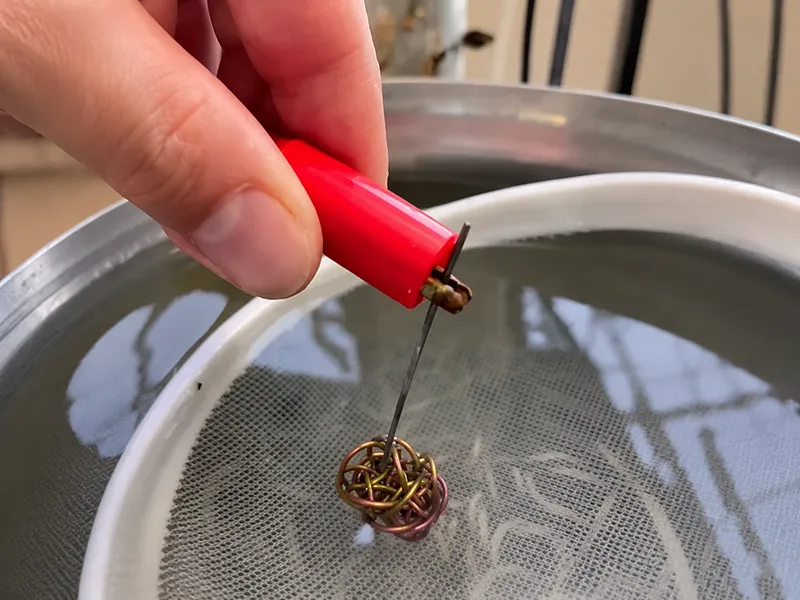
Anodizing is an electrochemical surface finishing process that converts a metal’s surface into a tough, protective oxide layer. It is most commonly applied to aluminum parts (Al naturally forms a stable oxide), though nonferrous metals like titanium and magnesium can also be anodized. In an anodized finish, the metal itself becomes the source of the coating – the aluminum surface grows a controlled aluminum oxide film that is integral to the part. This oxide layer is hard, durable and corrosion-resistant. It significantly improves corrosion resistance, wear resistance, surface hardness, and fatigue strength, and creates a porous, dye-absorbing structure for lasting color. Unlike paint or plating, the anodized film will not peel or flake off, since it is bonded to the base metal. Anodized aluminum parts (such as housings, brackets, heat sinks, aerospace and automotive components) benefit from both enhanced function and attractive appearance. This article will explain the anodizing process, review the main Type I/II/III anodizing options, highlight benefits and limitations, survey common applications, and discuss design and selection considerations for anodized finishes.
What Is Anodizing?
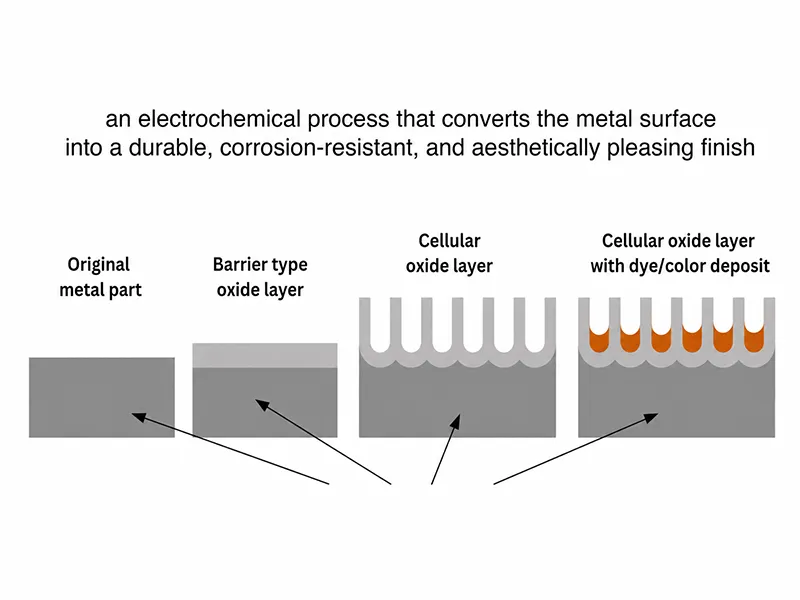
The Aluminum Anodizers Council explains that anodizing is an electrochemical process that converts the metal surface into a decorative, durable, corrosion-resistant anodic oxide finish. During anodizing, the metal part (usually aluminum) is made the anode in an electrolytic cell and immersed in an acid bath. When DC current is applied, oxygen ions from the electrolyte react with the aluminum at the surface to form an Al₂O₃ (aluminum oxide) film. This film is very tightly bound to the substrate – it grows from the metal itself. In practice this means the oxide layer cannot chip off like a paint layer; it is integral with the part. Anodizing therefore enhances the metal’s surface properties: the oxide layer is hard and ceramic-like, providing greatly improved corrosion resistance and abrasion resistance compared to bare aluminum. Importantly, the porous nature of anodized aluminum allows dyes or sealants to enter the coating, so anodizing can also produce vibrant, fade-resistant colors.Anodizing is commonly used on CNC-machined aluminum components, electronics enclosures, aerospace parts, automotive trim, consumer products and other applications where a durable, decorative finish is desired. (Steel and other ferrous metals generally are not anodized – they form rust instead – so anodizing is typically limited to aluminum and certain nonferrous alloys.)
How Does the Anodizing Process Work?
The anodizing workflow involves several controlled steps. First, the metal part undergoes thorough surface preparation. This includes cleaning (degreasing, rinsing) and usually etching (for example in a caustic bath) to remove the natural oxide and any machining residues. Etching also smooths or blasts the surface for an even finish. Next, anodizing itself takes place: the cleaned aluminum part is submerged in an acidic electrolyte (commonly sulfuric acid for Type II/III processes) and connected as the positive electrode (anode). An inert conductor (cathode) is also placed in the bath. When DC current is applied, water in the electrolyte dissociates and oxygen ions react with the aluminum surface to build up the oxide layer. The oxide layer grows both outward and inward into the metal; its final thickness is controlled by the composition of the electrolyte, the current density, temperature, and process time.
After anodizing, the part is rinsed, and any dyes or colors can be applied while the pores are still open. Coloring is optional: the anodized film is naturally translucent or “clear” (silver) if left undyed, but it can absorb organic or inorganic dyes to yield many vibrant colors. For example, Type II sulfuric acid anodize is prized for its excellent dyeability, giving a spectrum of durable colors. Finally, the coating is sealed to close the pores and lock in the finish. A typical sealing method is boiling deionized water, which hydrates the oxide into a form called boehmite that swells to seal the film. Proper sealing significantly boosts corrosion resistance and color stability. In summary, the basic flow is: Cleaning → (Etching/Desmut) → Anodizing (electrolysis) → Rinse → Dyeing (if desired) → Sealing. Each step must be carefully controlled to ensure a uniform, high-quality anodized finish.
Main Types of Anodizing
The aerospace/military specification MIL-A-8625 (and similar industry standards) defines the main anodizing classes for aluminum. In general, there are three principal types of anodizing:
- Type I (Chromic Acid Anodize): Uses chromic acid electrolyte; produces a very thin oxide film (on the order of only 0.5–2.5 μm). The thin film has minimal dimensional impact, excellent corrosion resistance, and good adhesion for paints and adhesives. (It is often used in aerospace applications where tight tolerance and bonding are critical.)
- Type II (Sulfuric Acid Anodize): Uses sulfuric acid electrolyte; produces a moderate-thickness oxide layer (typically a few μm up to ~25 μm). This is by far the most common anodizing process. Type II anodize offers a good balance of corrosion protection and durability, and its porous structure makes it ideal for dyeing bright colors. It is widely used on general aluminum parts and housings for decorative and protective purposes.
- Type III (Hardcoat or Hard Anodize): Also typically a sulfuric acid process (at low temperature and high current) that produces a very thick and dense oxide layer. Hardcoat anodizing yields an extremely hard, wear-resistant surface (often exceeding the hardness of tool steel). It is intended for heavy-duty applications where abrasion resistance is crucial. Because the film is so thick, Type III coatings are usually gray or dark in appearance and require design allowances for the added thickness.
Additional variants include colored anodizing (typically using Type II or III followed by organic or metal ion dyes) and clear (natural) anodizing (where no dye is added, leaving the bare aluminum look). The table below summarizes the key differences:
| Type | Common Name | Main Feature | Typical Use |
|---|---|---|---|
| Type I | Chromic Acid Anodize | Very thin coating (≈0.5–2.5 μm); excellent corrosion resistance; minimal dimensional change | Aerospace, defense, precision machined parts, adhesives/bonding |
| Type II | Sulfuric Acid Anodize | Moderate thickness (2.5–25 μm); good corrosion protection; highly dyeable | Decorative/protective finish on aluminum housings, panels, consumer and industrial parts |
| Type III | Hardcoat (Hard Anodize) | Very thick coating (up to tens of μm); exceptionally hard and wear-resistant | Industrial and aerospace mechanical parts, sliding surfaces, high-wear components |
| Colored Anodizing | Dyed Anodizing | Porous anodic film holding dye; wide range of fade-resistant colors | Consumer electronics, outdoor hardware, decorative products |
| Clear Anodizing | Natural Anodizing | Undyed oxide (silver appearance); retains metallic look with enhanced hardness | CNC-machined aluminum parts, architectural and industrial parts |
Type I Anodizing
Type I Chromic Acid Anodizing uses a chromic acid electrolyte to build a very thin oxide film. Typical film thicknesses are only about 0.00002–0.0001 inches (0.5–2.5 μm). Despite its thinness, a properly sealed Type I finish provides corrosion protection comparable to thicker Type II/III coatings. Because the coating is so thin, there is effectively no change in part dimensions, making Type I ideal for precision components. Type I anodize exhibits a gray to clear appearance and does not readily take dyes (it can accept black dye if processed hot, but that is seldom used). It is most commonly specified for high-reliability applications – for example, aerospace and defense hardware, landing gear, and parts that require excellent fatigue strength and paint adhesion. (Note: due to environmental and handling concerns with hexavalent chromium, chromic acid anodizing is now less common and sometimes replaced by alternative processes, but it remains important where minimal coating thickness and precise tolerances are required.)
Type II Anodizing
Type II Sulfuric Acid Anodizing is the most commonly used anodizing process. It uses a dilute sulfuric acid bath to grow a moderately thick oxide layer (typically a few to a couple dozen microns). This process produces a durable aluminum oxide surface that is harder and more corrosion-resistant than bare aluminum, yet still suitable for painting or adhesive bonding. A key advantage of Type II is its excellent dyeability: the porous microstructure of the film easily absorbs organic dyes or metal salts, enabling a wide spectrum of decorative colors. Sealed Type II coatings offer good protection against weather and corrosion. Because of its balance of performance and economy, Type II anodizing is used on a huge variety of aluminum parts – from architectural profiles and electronics housings to consumer products and automotive trim. For example, many building façade panels, laptop cases, and machined brackets are Type II anodized in clear (silver) or colored finishes. (Type II is often designated under MIL-A-8625 Class 1 for clear or Class 2 for dyed coatings, according to military specs.)
Type III Hard Anodizing
Type III Hard Anodizing (also called Hardcoat) is a specialized sulfuric acid process run at low temperature and high current to yield a very thick, dense oxide layer. The resulting coating is extremely hard and wear-resistant – in fact Type III anodized surfaces can surpass the hardness of many tool steels. This makes hard anodizing ideal for parts subjected to heavy abrasion or mechanical loads (such as sliding guides, pistons, gears, and industrial machinery components). The Type III layer is typically much darker (gray to brown) and has a matte finish. Because the film growth is substantial, hard anodizing will noticeably increase part dimensions (approximately half the coating grows outward on each surface); as a result, tight tolerances may require allowance. Also, masking of threads or precision holes is often needed to maintain fit. Hard anodized parts are found in applications like aerospace landing gear bushings, engine valves, automobile fuel injection parts, and rugged outdoor equipment. In summary, Type III produces a very thick, hard, abrasion-resistant oxide coating, sacrificing some color options and dimensional subtlety in exchange for maximum durability.
Benefits of Anodizing
Anodizing offers many key advantages for aluminum components:
- Enhanced Corrosion Resistance: The anodic oxide layer provides a long-lasting barrier against oxidation and corrosion. Unlike uncoated aluminum, anodized surfaces can survive thousands of hours in salt spray when properly sealed.
- Improved Wear and Hardness: The aluminum oxide layer is significantly harder than the base alloy (surface hardness can reach ~70 Rockwell C). This boosts abrasion resistance and durability, especially under hard anodizing.
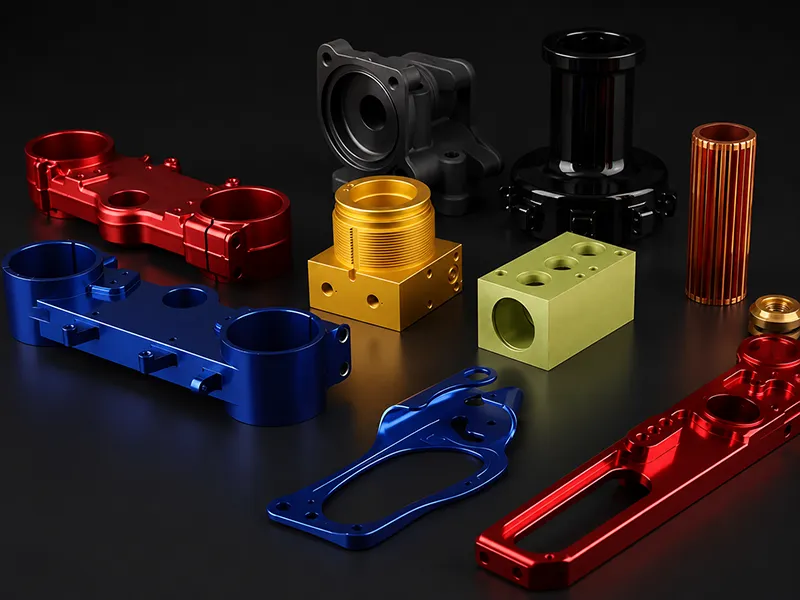
- Decorative Finishes: Anodized coatings can be left clear for a bright metallic sheen, or dyed in a spectrum of fade-resistant colors. The color is integrated into the surface rather than sitting on top, so it doesn’t chip off like paint. Many consumer goods (bicycle parts, hardware, water bottles, etc.) use dyed anodizing for its rich aesthetic and durability.
- Better Adhesion and Cleanliness: The porous anodic film provides excellent adhesion for subsequent paints or sealants. Anodized parts do not require oils or solvents for corrosion protection, making them cleaner and more environmentally friendly. (The process itself has no VOCs and produces few hazardous byproducts.)
- Stable, Long-Lasting Finish: The oxide layer is inert and does not peel, flake or swell. It maintains its appearance over time (especially in clear or metallic finishes) and improves overall part longevity. In short, anodizing enhances both the functional performance (hardness, corrosion resistance) and the visual quality of aluminum parts.
Limitations of Anodizing
Anodizing is very useful, but has some limitations to consider:
- Material Restrictions: True anodizing (with sulfuric or chromic acid) works best on aluminum and certain other nonferrous metals. Ferrous and steel alloys cannot be anodized by these methods – they rust instead. (There are other finishes like black oxide for steel, but these are not “anodizing.”)
- Alloy Sensitivity: Different aluminum alloys anodize differently. High-silicon or certain high-copper alloys can yield uneven colors or “smut” in the finish. (For example, some bike levers made of high-zinc or high-silicon alloy can turn dark gray and resist coloring.) Cast aluminum often contains silicon that can produce a blotchy or non-uniform appearance under anodizing, so understanding billet vs cast vs forged aluminum helps when choosing parts for anodized finishes.
- Thickness and Tolerance: Hard anodizing (Type III) deposits thick oxide that can be a few mils (tens of microns) thick. This increases part dimensions by roughly 40–50% of the coating thickness per surface. Designers must account for this in tolerances, or machine critical fits after anodizing. (Type I anodize, by contrast, adds almost no dimension.)
- Geometry Challenges: Deep holes, blind cavities or complex internal features may not receive uniform coating due to limited acid circulation. Masking may be needed for areas like fine threads or bores.
- Chemical Resistance: Anodic oxide is very corrosion-resistant in neutral and mild environments, but it can still be attacked by strong bases or acids. Unsealed anodize may turn sticky or white if exposed to harsh conditions.
- Outdoor Fading: Dyed anodized colors are durable, but prolonged UV exposure can cause slight fading over many years (though still better than most organic paints). White and light colors are especially prone to yellowing.
- Brittleness: The anodic layer is essentially ceramic and is more brittle than the aluminum. It won’t peel, but a sufficiently high impact or thermal shock can crack the oxide.
What Materials Can Be Anodized?
Among common CNC machining materials, aluminum is by far the ideal material for anodizing. Aluminum alloys naturally form an oxide film, so an oxidizing treatment easily converts the surface into a much thicker, controlled oxide layer. Other nonferrous metals can also be anodized in specialized processes: for example, titanium, magnesium, zinc, niobium, and tantalum all form anodic oxides. (Titanium anodizing is used in aerospace and medical applications, producing decorative colors; magnesium can be anodized for weight-critical parts.) By contrast, steel and iron generally cannot be anodized in the aluminum sense – immersion in acid and current will simply produce rust (iron oxide) and damage the part. In practice, most anodizing shops focus on aluminum alloys, with occasional work on titanium or magnesium.
Anodizing Aluminum Alloys
Within aluminum, some alloys anodize better than others. The best results generally come from the 5xxx and 6xxx series:
- Aluminum 5xxx series (e.g. 5052): Magnesium alloys like 5052 anodize to a strong, transparent oxide layer. These alloys are very corrosion-resistant (often used in marine or fuel tanks) and yield a uniform clear finish.
- Aluminum 6xxx series (e.g. 6061, 6063): These extrudable, heat-treatable alloys anodize exceptionally well. The oxide is clear and bright, providing good corrosion protection. 6061 is a general-purpose structural alloy, while 6063 is common in extrusions and architectural components. Both give consistent, attractive anodized surfaces.
- Aluminum 7xxx series (e.g. 7075): High-strength zinc alloys can also be anodized, and according to industry sources they produce clear, protective films. (However, anodized 7xxx finishes may be slightly darker and can vary with alloy composition – in some cases a fine pre-treatment is used.)
- Cast aluminum: Alloys like A356 or A413 (used in castings) often contain a lot of silicon, which can create a gray or patchy appearance when anodized. Such cast parts are prone to “mottling” because the silicon-rich phases don’t anodize well. In precision parts, engineers usually prefer wrought alloys; if castings must be anodized, extra attention is needed in preparation.
- High-copper alloys (2xxx series): Alloys containing more copper or iron (like 2024 or 2017) tend to give off-color grays under anodizing, and often require “de-smutting” (acid cleaning) to remove copper smears before coating.
In summary, 6061, 6063 and 5052 are among the most anodizable and commonly used for CNC parts; 7075/7xxx can be anodized but may not dye as uniformly. Cast alloys and high-alloy steels are generally poor choices for anodizing.
Anodizing vs Other Surface Finishes
Anodizing is a conversion coating – it transforms the metal surface itself. By contrast, many other finishes simply add material on top. For example, painting or powder coating apply polymer films, and plating deposits another metal. Each finish has its own use case:
- Anodizing: Forms a hard oxide layer within the aluminum. It has excellent UV and heat stability (the oxide is essentially ceramic), so colors won’t fade and the coating won’t burn off under heat. Anodizing adds only a few microns, so it preserves tight tolerances. It provides very durable corrosion protection and is highly durable (Type III can be harder than steel). However, because it’s not an opaque film, color matching can be variable.
- Powder Coating: An applied polymer film (50–150 μm thick) that can be formulated in any RAL color with various textures. It offers very uniform coverage and impact resistance. It is great for outdoors and enclosures because the paint layer can be thick and weather-proof. On the downside, powder coating can chip or scratch off (exposing metal beneath) and adds significant thickness that can hide fine details. It also has finite UV/temperature limits (can start to degrade above ~200 °C).
- Painting: Like powder coat but typically thinner and with solvents. Offers infinite color choices and ease of field repair, but lower durability (paint can peel, chip, or fade).
- Plating: Electroplating (nickel, chrome, zinc, etc.) deposits a secondary metal onto the surface. Plating is used when specific properties are needed (conductivity, very hard coatings, decorative chrome, etc.). It’s widely used on steel, brass, copper parts, or where a metallic finish is needed. Plating can add significant weight and thickness, and compatibility depends on base metal.
- Polishing: Mechanical polishing simply smooths and brightens the metal surface – it does not add protection. It yields a reflective finish for show parts, but polished aluminum will still corrode unless it is sealed or painted afterwards.
- Black Oxide (for steel): This is a chemical blackening of steel (iron oxide magnetite) that provides a dark appearance with minimal corrosion resistance. It adds only ~1 μm of thickness, so no dimension change, but it must usually be oil-sealed to resist rust. It’s used mainly for small steel parts to give a uniform black finish. (Unlike anodize, black oxide is not durable in salt or moisture unless oiled.)
The table above further contrasts these finishes by purpose and material. In choosing a finish, consider that anodizing integrates into aluminum to give a thin but very durable layer. For applications needing thick colorful coatings and impact resistance on any metal, powder coat or paint may be more suitable. For electrical or highly decorative metal layers, plating is chosen. The decision depends on the substrate, required corrosion/wear protection, desired appearance, and budget.
Common Applications of Anodizing
Anodizing is used in a vast array of products and industries. Its combination of durability and appearance makes it suitable for both demanding engineering components and consumer goods. Common anodized aluminum applications include:
- Aerospace and Defense: Aircraft structural parts, rocket motor cases, satellite components and missiles often use anodized aluminum for corrosion protection and to enhance fatigue life. Anodized parts are found in fighter jets, military optics, and missile housings.
- Automotive: Engine parts, pistons, valve guides, wheels, and trim pieces. Hard anodizing is used on high-wear components (e.g. camshafts, brake rotors, wear plates). Also, decorative trim and interior controls are anodized or painted after anodizing.
- Electronics and Consumer Products: Heat sinks, enclosures, camera bodies, laptop casings, phone frames, and appliance panels. Many gadgets use colored anodized aluminum for a premium look. Anodized finishes are common on consumer electronics (“aluminum unibodies”), cookware, and sporting goods (bike frames, poles).
- CNC Machined Hardware: Precision machined brackets, fixtures, gears, and fasteners made of aluminum are frequently anodized for wear and corrosion resistance. This includes aerospace brackets, instrumentation covers, hand tools, and robotics parts.
- Architectural & Marine: Exterior cladding, window frames, door frames, and other building materials. Anodized profiles resist weathering (common on skyscrapers and stadiums). Boating hardware, railings and maritime fittings (e.g. for yachts) also use marine-grade anodized aluminum (5052, 6061) for saltwater protection.
- Medical & Optics: Surgical instruments and medical device housings often use Type II or Type III anodized aluminum (titanium is also anodized for implants, but that’s beyond our scope). Optical mounts and lens housings are sometimes black anodized to reduce reflections.
- Industrial Equipment: Machinery frames, control panels, pumps and valves in factories – any part requiring a tough finish. Conveyor components, machine tool parts, and measurement equipment often use clear or hard anodize.
Anodizing’s versatility is why it’s used from home hardware to high-tech fields. For example, the Aluminum Anodizers Council notes that anodized aluminum protects satellites, forms durable building exteriors (e.g. Chicago’s Willis Tower), and appears in everyday products like laptops and appliances. In short, if an aluminum part needs improved corrosion resistance and an attractive surface, anodizing is likely a candidate.
Anodizing for CNC Machined Parts
Anodizing is especially popular for CNC-machined aluminum components. Machined parts such as housings, brackets, covers, knobs, heat sinks, fixtures, and fasteners often receive an anodized finish. The process brings several benefits to machined parts: it hides tool marks less readily than coatings (so proper surface prep is key) and improves performance. For precision parts, anodizing adds hardness and a protective layer without significantly altering dimensions. In fact, one of anodizing’s strengths is that it can be performed on tight-tolerance parts: the oxide film grows controllably and is very thin compared to the part size. This makes anodizing ideal when maintaining fit is crucial.
In practice, a machined part destined for anodizing should be finished (polished or bead-blasted) as needed beforehand, since scratches or surface irregularities will remain visible. Critical holes and threads should be masked or machined after anodizing because even slight oxide build-up can affect fits. For example, adding a 0.001″ anodize layer could widen a hole on each side by ~0.0003–0.0005″. Therefore, engineers usually either oversize holes or plan final machining after coating. Overall, anodizing CNC parts greatly enhances their durability and appearance, but it must be considered during design – not just as an afterthought.
Design Considerations Before Anodizing
When specifying anodizing for a part, consider these key design factors:
- Alloy Selection: Use an alloy known to anodize well (e.g. 6061, 6063, 5052). Avoid mixing different aluminum alloys in one assembly, as colors may mismatch.
- Anodizing Type & Color: Decide on Type I/II/III and whether the part will be dyed. (Type II clear or colored is most common; Type III is chosen for wear.) Communicate specific color or appearance requirements clearly to the finisher. Remember that anodized colors can vary slightly between batches.
- Coating Thickness: Determine required coating thickness (which varies by type and purpose). Remember that roughly 33% of a Type II layer builds outwards per side, while 45% of a Type III layer builds up. Tight-tolerance features should allow for this growth (or be machined afterward).
- Masking & Critical Areas: Plan to protect or mask threads, press-fit pins, or contact surfaces. Threads can be plug-plugged with silicone or wax. Any area that must remain conductive or precise should be masked.
- Edge Geometry: Sharp edges tend to discharge faster during anodizing, causing uneven film thickness. Slightly chamfered or rounded edges give a more uniform anodic coating.
- Surface Finish: The pre-anodize finish will strongly affect the final look. Polished or super-finished parts will appear shiny after clear anodizing. Brushed, bead-blasted, or anodized matte surfaces will diffuse light differently. Specify surface roughness targets if needed.
- Mechanical Tolerances: As noted, account for the build-up of coating when dimensioning critical fits. For example, if a shaft is 10.00 mm and will be hard anodized to 0.005″ (≈0.13 mm) thickness, the shaft end might grow ~0.03 mm on each end.
- Batch Consistency: For assemblies with multiple anodized parts, try to order them in one batch to minimize color variation.
- Post-Anodize Operations: Keep in mind that anodized parts cannot be welded. Any bending or forming should be done before coating. Also, threaded holes that will be assembled after anodizing may need slight tapping to clear oxide.
In general, involve the anodizing supplier early. They can help set tolerances and advise on fixture/handling. Proper planning will ensure the anodized finish meets both functional and cosmetic requirements.
Common Problems in Anodizing
Even with care, various issues can occur in anodizing. Some common defects include:
- Uneven or Grainy Color: Non-uniform coating thickness or alloy inconsistencies can cause blotchy appearance. This often happens on high-silicon or copper-bearing alloys, where those elements can turn dark spots.
- White Stains or Blotches: If rinsing is insufficient or water contains impurities, white streaks (titanium oxide bloom) can appear on dyed parts. Proper cleaning between steps is crucial.
- Scratches and Handling Marks: Since anodize does not cover blemishes, any scratch on raw aluminum will show through. Protective handling and careful cleaning are needed.
- Burn Marks (Hard Anodize): Excessive current density or poor agitation in hardcoat can create localized overheating, leaving brown or black burn marks.
- Poor Sealing: If the final sealing step is inadequate (for example, insufficient hot water seal), the anodic pores remain open. This can lead to future corrosion or dye leaching. A telltale sign is a chalky white surface after a humidity test.
- Color Mismatch: When multiple parts or runs are involved, slight shifts in dye batch or alloy lot can cause inconsistent shades. Always specify color tolerance and perform test panels if exact matching is required.
- Dimensional Errors: Inexperienced finisher might over-etch or under-anodize, leading to parts out of tolerance. (Checking coating thickness with an X-Ray Fluorescence meter can verify proper layer build.)
- Poor Adhesion/Debonding: Though rare, severely contaminated surfaces or improper process control can result in spalling of the anodic film (especially on large, flat panels).
- Rough or Pitted Surface: Incomplete acid etching or desmutting can leave a rough finish. Also, cast parts may anodize with a rougher texture.
Most of these problems are preventable with proper process control, cleaning, and alloy selection. A reputable anodizer will typically provide an inspection report and even sample approval before full production.
How to Choose the Right Anodizing Finish
Selecting the optimal anodize finish involves weighing multiple factors:
- Material/Alloy: Use a known anodize-friendly alloy. If you need higher strength (like 7075), be prepared for potential color variation.
- Corrosion vs. Wear: If the main goal is corrosion protection and appearance, Type II is usually sufficient. If heavy wear resistance is needed (e.g. bearings, moulds, sliding surfaces), Type III hardcoat is the better choice.
- Appearance/Color: For bright, consistent colors, Type II with dyes is preferred. If the part will be left natural or black, either Type II clear or Type I black-dye can work (Type III anodize is generally very dark and not used for vivid coloring).
- Thickness/Tolerance: For very thin or precision requirements, lean toward Type I or a light Type II. Avoid unexpected dimension changes. For thick protective layers, use Type III.
- Environment: Outdoors or marine environments may call for thicker anodize and hard sealing. Indoor parts with mild exposure can use thinner clear anodizing.
- Batch Size and Cost: Smaller quantities and short lead times might favor Type II (easier & cheaper). Large industrial components may justify the expense of hardcoat if it eliminates replacement costs.
- Specification Requirements: If your part must meet a Mil-Spec (e.g. MIL-A-8625) or ISO standard, ensure the chosen type and class (e.g. Class 1 vs Class 2) meet it.
- Finishing Steps: Consider if any post-coating processes (painting, bonding) are needed. Chromic (Type I) is often chosen as a paint base in aerospace for improved adhesion.
Checklist: As a rule of thumb, specify Type II (sulfuric) for standard decorative and protective needs, and specify Type III (hardcoat) when maximum hardness and wear resistance are critical. Always communicate your color and finish needs clearly. Finally, make sure to involve your anodizing shop in design reviews so that tolerances, masking, and material choices align with the coating plan.
Conclusion
Anodizing is an electrochemical surface treatment that creates a tightly bonded oxide coating on metal parts, most commonly on aluminum. By converting the metal surface into aluminum oxide, anodizing yields a finish that is durable, corrosion-resistant, and hard, often outperforming painted or plated surfaces. This makes anodizing ideal for aluminum CNC parts, aerospace components, electronics housings and many other applications. Type II (sulfuric anodize) is the workhorse of anodizing, providing a moderately thick, protective, dyeable coating. Type III (hard anodize) produces a very thick, extremely hard layer for high-wear parts. When specifying anodizing, engineers should consider the base alloy, part geometry and tolerances, required thickness and color, and sealing requirements. In a well-planned design, an anodized finish will enhance both the performance and the appearance of aluminum components, increasing their lifespan and value.
FAQ About Anodizing
- What is anodizing? Answer: Anodizing is an electrochemical surface treatment in which the metal part (usually aluminum) is made the anode in an acid bath. This causes a controlled oxidation of the surface that builds an aluminum oxide coating. The anodized film is hard and corrosion-resistant, and it can be dyed for color. In short, anodizing forms a durable oxide layer on the metal to improve corrosion resistance, wear resistance and appearance.
- What metals can be anodized? Answer: Aluminum and its alloys are by far the most common materials for anodizing. Other nonferrous metals can also form anodic oxides: for example, titanium and magnesium can be anodized for special purposes. Zinc, niobium and others are occasionally anodized in niche processes. Steel and iron, however, do not produce a stable anodic film – attempts to anodize ferrous metals simply create rust. (Steel usually uses black oxide or plating instead.) In practice, when someone says “anodizing,” it almost always refers to aluminum anodizing.
- What is the difference between Type II and Type III anodizing? Answer: Type II (sulfuric acid) anodizing produces a moderate-thickness oxide layer and is the standard decorative/protective finish. It is easily dyed and gives a range of colors with good corrosion resistance. Type III (hardcoat) anodizing runs the process at low temperature and high current to produce a much thicker, denser oxide. This yields a very hard, wear-resistant surface. Type III parts are darker (often gray or black) and are used in applications requiring high abrasion resistance, whereas Type II parts are often lighter in color and used when appearance and corrosion protection are priorities.
- Does anodizing change part dimensions? Answer: Yes – because anodizing converts metal into oxide, part dimensions increase slightly. The growth is roughly proportional to thickness. For typical Type II coatings, about 33% of the oxide thickness is deposited outward (with 67% penetrating inward). For example, a 0.001″ (25 µm) Type II coating would grow the part by about 0.00033″ on each surface. Type III hard anodizing has a similar percent buildup (about 45% outward). In contrast, Type I chromic anodizing is so thin that the dimensional change is usually negligible. When tight tolerances are critical, designers should allow for the expected coating thickness or plan to machine critical dimensions after anodizing.
- Is anodizing good for CNC machined aluminum parts? Answer: Absolutely. Anodizing is commonly applied to CNC-machined aluminum parts to improve their surface durability and finish. It increases corrosion and wear resistance without hiding sharp features or fine details, because the coating is very thin relative to part size. Anodized surfaces have a nice metallic luster or color, which is often desirable on machined components. Note that any machining marks will still show through the anodize, so parts are typically polished or bead-blasted before coating for best appearance. Also, threads and tight-fit holes should be masked or drilled oversize, since even a small oxide buildup can affect assembly. In summary, yes – anodizing is an excellent choice for aluminum CNC parts when you need a hard, corrosion-resistant finish and good aesthetics.
Sources: Authoritative machining and finishing guides, including industry standards and technical articles. These references describe the anodizing process, film properties, types, and applications in detail, and have been cited above.