Aluminum 6061 is a precipitation-hardened alloy with magnesium and silicon as its primary alloying elements. It offers a good combination of strength, corrosion resistance, and weldability, which makes it one of the most versatile and widely used aluminum alloys for general applications. In fact, the Aluminum Association notes that “Alloy 6061 is the most widely used alloy in [the 6xxx] series” and is often found in structural components like truck and marine frames. Common uses of 6061 include structural frames, vehicle and marine parts, bicycle frames, and aerospace or precision machined components. It is available in various forms (sheet, plate, extrusions, bars) and tempers to suit different applications. Overall, 6061’s popularity stems from its high strength-to-weight ratio, good workability, and excellent weldability.
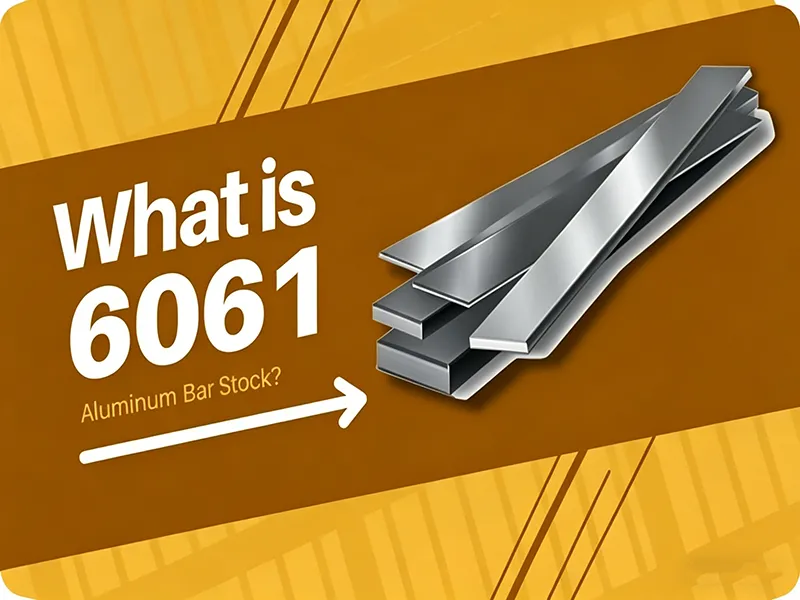
What Is Aluminum 6061?
Aluminum 6061 (UNS A96061) is a heat-treatable wrought alloy in the 6000 series. Its composition typically includes about 0.8–1.2% magnesium and 0.4–0.8% silicon, which form Mg₂Si precipitates during aging. This microstructure gives 6061 good strength and toughness. It also has excellent corrosion resistance and good joining characteristics (welding, brazing), making it useful across many industries.
Common applications for 6061 include:
- Aerospace and automotive parts: Aircraft fittings, drone components, automotive frames and mounts.
- Marine and structural: Boat fittings, marine hardware, truck and rail vehicle frames.
- Consumer and precision products: Bicycle frames, sports equipment, medical instrument housings, optical mounts.
- Machined components: Camera lens mounts, hydraulic pistons, valve parts, fixtures, tooling blocks.
- Construction and extrusions: Architectural extrusions (window frames, panels), general fabrication.
These diverse uses are possible because 6061 combines good machinability with relatively high strength and good fatigue resistance. As one data sheet puts it, 6061 features “relatively high strength, good workability, and high resistance to corrosion; widely available”. Its versatility is why 6061 is often called the “standard structural alloy” of the 6xxx series, and why it is so commonly specified in engineering designs.
What Do T6 and T651 Mean?
The designations T6 and T651 refer to specific temper treatments applied to 6061 alloy. These indicate how the material has been heat-treated and mechanically processed after solution heat treatment.
What Is T6 Temper?
“T6” is a heat-treatment temper for 6061 alloy. In 6061-T6, the material has undergone solution heat treatment followed by artificial aging. The process is: heat the aluminum to dissolve alloying elements into a solid solution, quench it (rapidly cool it), and then age it at elevated temperature to form fine precipitates that harden the metal. This yields the maximum strength from 6061’s composition. Typical properties of 6061-T6 are quite strong: the ultimate tensile strength is at least about 290–310 MPa (42–45 ksi) and the 0.2% offset yield strength is around 240–276 MPa (35–40 ksi). For thin sections, 6061-T6 often has around 12% elongation; for thicker sections it can reach 17% or more. In summary, 6061-T6 offers high strength and hardness, good fatigue resistance, and good overall machinability, making it a popular choice for many general-purpose parts.
What Is T651 Temper?
“T651” is another 6061 temper. It includes all the same heat-treatment steps as T6 (solution treatment plus aging), plus an additional step of stress-relief stretching. In practice, 6061-T651 is made by solution-heat-treating and quenching the metal just like T6, then mechanically stretching (around 1–3%) to relieve internal stresses. Finally the alloy is aged to achieve full hardness. The net effect is nearly the same hardness and strength as T6, but with much lower residual stress. In fact, 6061-T651 is described as “solutionized, stress-relieved (stretched) and artificially aged”.
This extra stretching step is particularly useful for large, thick parts (like plates) or any component that will be heavily machined. It reduces warping and distortion during subsequent processing. For these reasons, 6061-T651 is often used in plate and heavy sections of 6061. The “T651” designation literally indicates a T6 temper plus this stress-relief (“5” indicates a stretching step, and “1” indicates the exact control of that stretch). Overall, the T651 temper retains the high strength of T6 but adds better dimensional stability for demanding applications.
Aluminum 6061-T6 vs. 6061-T651: Main Differences
When comparing 6061-T6 and 6061-T651, the alloy composition is identical – the difference lies entirely in the final processing (tempering) and resulting internal stress state. The main distinctions can be summarized as follows:
- Stress Relief: 6061-T651 has undergone a stretching stress-relief step that 6061-T6 has not. During T6 processing, internal stresses can build up from quenching. T651’s stretching step deliberately introduces a small permanent elongation (1–3%) to relax those stresses. In contrast, T6 parts retain higher residual stress locked in from the quench.
- Dimensional Stability: Because of its stress relief, 6061-T651 exhibits greater dimensional stability than 6061-T6. In practice, this means that T651 stock (especially in thick plates or bars) will stay flatter and hold closer to its intended shape during and after machining. T6 stock, while still strong, may “spring back” or warp slightly as remaining stresses equilibrate under cutting forces. One source notes that “6061 T651 aluminum stays more stable in shape than T6… [T651] is easier to machine without warping the part”.
- Machining Performance: For many machining tasks, 6061-T651 is generally preferred because its low-stress condition resists distortion. The stress-relief step means tools can cut deeper or remove more material before the part shifts. By contrast, 6061-T6 may require more fixturing or allowances to counteract its higher stored stress. In the machine shop, this often translates to fewer scrapped parts and tighter tolerances when using T651. Tests and guides frequently observe that T651 is actually easier to machine, giving smoother surface finish and lighter burrs.
- Flatness and Distortion Risk: 6061-T6 stock, especially in large flat plates or long bars, is more prone to bowing or distortion under its own internal stress. In contrast, a T651 plate will stay flatter under identical conditions. This is critical for components like plates or optical mounts where flatness is crucial. In essence, T651 lowers the risk that a part will bend, twist, or curl during machining or stress relief. One author emphasizes that T651’s “low residual stress provides dimensional stability and reduced warp risks over broad, flat part designs”.
- Typical Product Forms: The temper correlates with how the material is supplied. 6061-T6 is most commonly found in sheet, small plate, and extruded shapes (typically up to 0.25″ thick). It is also used for thinner bars and general-purpose tubing. On the other hand, 6061-T651 is prevalent in thick plates and heavy bars. For example, structural 6061 plate stock is usually T651 (since 0.25″ and thicker sheet often must be T651). Cold-finished bars are also often certified T651. In summary, T6 appears more in thin sections and extrusions, while T651 is favored for thicker, load-bearing forms where stability matters.
Mechanical Properties Comparison
Mechanically, 6061-T6 and 6061-T651 have nearly the same strength and hardness, since the chemical makeup is identical and the stretch in T651 does not significantly alter the alloy’s inherent strength. Typical values (from data sheets) are:
- Tensile Strength (Ultimate): ≈310 MPa (45 ksi) for both T6 and T651.
- Yield Strength (0.2% offset): ≈276 MPa (40 ksi) for both.
- Hardness (Brinell): ~95 HB (500 g load) for both.
- Elongation: ~12% (for thin gauges, ~1.6 mm) and ~17% (for thicker sections ~12.7 mm), generally similar for T6 and T651.
These values are summarized below:
| Property | 6061-T6 | 6061-T651 |
|---|---|---|
| Tensile Strength (UTS) | ~310 MPa | ~310 MPa |
| Yield Strength (0.2% off.) | ~276 MPa | ~276 MPa |
| Hardness (Brinell) | ~95 HB | ~95 HB |
| Elongation (at break) | 12–17% (thickness-dependent) | 12–17% (similar) |
For example, an AA data sheet lists 310 MPa for UTS and 276 MPa for yield as typical values for both T6 and T651 (with elongation of 12% in 0.062″ thickness and 17% in 0.5″ thickness).
It’s worth noting that some sources observe very slight differences: one industry guide found T6 had marginally higher UTS (~310 vs 290 MPa) and yield (~275 vs 240 MPa) than T651. However, other references (including major datasheets) report the values as essentially identical. In practice, any such differences are small compared to the benefits of stress relief. Thus, for design purposes, 6061-T6 and T651 can be assumed to have the same mechanical strength limits, with the main difference being the stress state, not the alloy strength.
Machining Differences Between 6061-T6 and 6061-T651
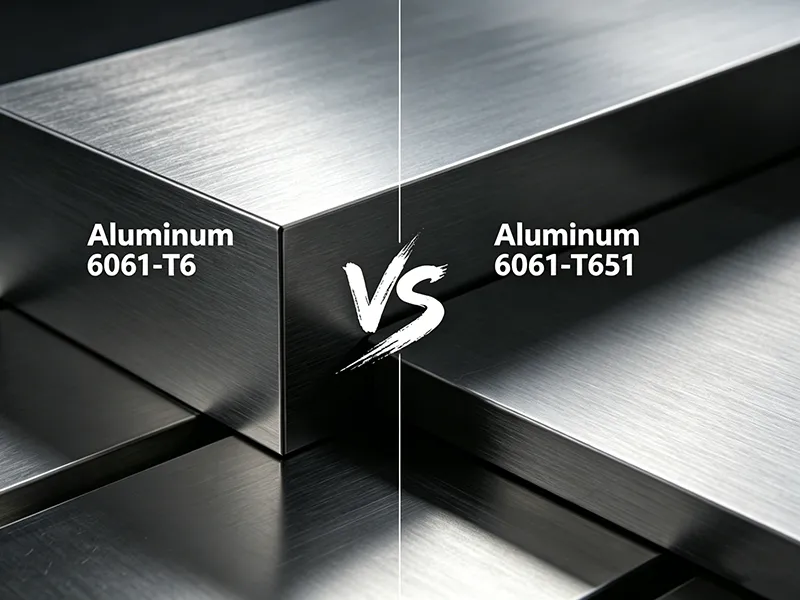
When planning a CNC machining operation, material choice can impact cost, yield, and ease of achieving tight tolerances. Key machining-related differences include:
- Dimensional Stability: Because 6061-T651 is stress-relieved, it exhibits far less springback or distortion during cutting. This means after heavy cuts or deep cavity milling, a T651 part will hold its dimensions better. For 6061-T6, extra care (like skim passes or stress-relief annealing) might be needed to prevent warping.
- Tolerance Capability: For very tight tolerances or complex geometries, 6061-T651 is typically preferred. Its low residual stress lets shops hold fine tolerances more easily. If a CNC part demands precision flatness, straightness, or concentricity, specifying T651 stock can save rework. Conversely, for looser tolerance parts or simpler shapes, T6 often works fine and can be more economical.
- Machining Quality: Tests have shown that 6061-T651 can machine as easily or even more easily than T6. Surface finishes are often smoother and burr formation is lighter with T651. One report found that T651 cutting forces and tool life were essentially the same (or slightly better) than T6, with slightly lower tendency to burr. In practical terms, T651’s stability can reduce chatter and result in a cleaner cut.
- Cycle Time and Cost: In high-volume CNC production, the reduced scrap rate with T651 (due to fewer distortion issues) can offset its higher material cost. For one-off or simple jobs, a manufacturer might accept using the cheaper T6 alloy and just account for any extra machining steps. The typical advice is to use T651 for high-value, precision parts (e.g. aerospace fixtures, optical frames) and use T6 when the part is rugged and budget is a concern.
In summary, 6061-T651 is usually the safer choice for challenging CNC jobs. Its controlled stress state means the finished part is more likely to meet dimensional requirements on the first try. 6061-T6, while strong, may require compensating machining strategies to achieve the same accuracy.
Aluminum 6061-T6 vs. 6061-T651 in Plate, Bar, and Extrusions
The form of the material often dictates which temper is used:
- Plate (Sheet): Thick plates of 6061 almost always use the T651 temper. By standards, 6061-T6 is generally not produced above about 0.25″ thickness. In practice, any plate stock (say 0.5″ and thicker) will be T651. This is because the stretching step in T651 is crucial for large flat surfaces to stay flat. The Xometry guide notes that “6061-T651 aluminum alloy is a frequently used structural aluminum in plate form…stretched after the solution heat treatment. This stress relieves the metal to mitigate warp and distortion during machining”. In short, T651 plate is industry standard for aluminum plate stock to ensure flatness.
- Bar Stock: Round or square bar stock may come as T6, T651, or T6511 (the extruded-bar variant). Smaller-diameter bars (like up to an inch or two) are often simply T6 (extruded then quenched/aged). However, many precision or certified bars are supplied T651/T6511. The Xometry guide mentions that “Plate stock is typical. Cold-finished bars are also classified as T651.”. In other words, cold-drawn or machined bar stock (especially for larger sizes) is frequently stress-relieved as T651 to provide uniformity. If an extruded bar is labeled T651, it has gone through the stretch step too.
- Extruded Profiles: Most extruded aluminum profiles (like tubing, angles, channels) are available in T5 or T6 tempers. 6061 extrusions up to medium sizes are commonly T6, which offers good strength and is more formable. For very large extrusions, such as wide cross-sections or thick walls, manufacturers might supply T6511 (a stress-relieved extruded rod) or T651 to guarantee straightness. In practice, many contractors simply use the available temper. For example, 6061-T6 extrusions (sheet, angles, T-slot profiles, etc.) are abundant and inexpensive. But if a part is machined from a large extrusion and requires tight flatness, one may specify T6511 or T651 material.
In summary: Thicker plate and large-section bars: usually T651. Thin sheets, small extrusions: typically T6 (or even T5). The choice is driven by practicality (thick stock being stress-relieved) and by the intended use (flat precision parts get T651).
Which Is Better for CNC Machining?
When choosing between 6061-T6 and 6061-T651 for specific machining scenarios, consider the part type:
- Thin-Walled Parts: Parts with thin walls or high aspect ratios are susceptible to distortion. T651 is strongly recommended here. Its low residual stress means the thin walls stay straight. Using T6 in such cases runs a high risk of the walls flexing under tool pressure. Many machinists follow the rule that if wall thickness is very small or the part is like a large thin panel, use T651.
- High-Precision Parts: For components requiring tight geometric tolerances (±0.01″ or so), T651 is the better option. As noted earlier, T651 remains stable, making it easier to meet tight tolerance. For example, an aerospace optical bracket or precision jig would typically be made from T651 material.
- Large Plates: By definition, large aluminum plates are T651. If a CNC job involves cutting from plate stock, you’ll almost certainly be using T651 (since plate is usually over 0.25″ thick). Thus for large flat panels or plates, T651 is de facto.
- General Structural or Simple Parts: If the part is a solid, thick bracket, base, or fixture (where minor warping won’t spoil functionality), 6061-T6 can be suitable. For such “general-purpose” parts that are heavy and not extremely tight in tolerance, the cost savings of T6 can make it appealing. In fact, T6 is often chosen for structural supports, base plates, or equipment frames where ultimate strength is needed and precise flatness is less critical.
- Welded Assemblies: If the part will be welded as well as machined, it’s important to note that welding usually destroys any previous temper in the heat-affected zone. In welded structures, some shops choose T6 simply because post-weld stress relieve will be needed anyway. (On that note, in many welding situations the difference between starting with T6 or T651 becomes moot after welding.)
In practice, 6061-T651 is generally the safer choice for CNC machining when tight tolerances, thin sections, or large material removal are involved. 6061-T6 can be used effectively for less critical parts or when budget is a constraint. For any given project, one might run a quick check: if the design involves >50% material removal or tolerance of ±0.15 mm or finer, the machining guides strongly advise using T651.
How to Choose Between 6061-T6 and 6061-T651
Engineers and purchasers should consider several factors when deciding on T6 vs. T651:
- Part Geometry: Large, flat geometries or long thin walls benefit from T651’s stability. Complex pockets or deep cavitations likewise. Small, simple blocks or thick sections can often use T6.
- Tolerance Requirements: High-precision tolerances (a few mils or microns) favor T651. If the design tolerances are loose (e.g. ±0.3 mm or more), T6 is usually fine. Always ask: will deformation ruin the part? If yes, lean T651.
- Material Form: As noted, available stock matters. If you need a 1″ plate, it’s T651 by default. If the drawing specifies a 0.125″ sheet, that will be T6. Also consider machining allowances: if sourcing bar, you might choose T6511 if certifying to T6 temper is needed.
- Machining Volume: For small prototype runs, the ease of using either may outweigh cost differences. For large production runs, the reduced scrap with T651 can justify its higher price. Conversely, if budget is extremely tight and the parts are not precision-critical, T6 may be chosen to save about 10-20%.
- End-Use Environment: If the final part will see high cyclic loading or critical flatness over time, T651 is beneficial. In aerospace or medical applications with stringent certification, T651 is often mandated. For parts simply subjected to static loads or outdoor exposure, both tempers perform similarly. If welding is required after machining, plan for post-weld stress relief anyway – sometimes that equalizes the playing field between T6 and T651.
By evaluating the combination of geometry, tolerances, form, and usage, engineers can select the temper that best balances performance and cost. In general:
- Use 6061-T651 when high flatness and stability are paramount (precision fixtures, aerodynamic parts, optical equipment).
- Use 6061-T6 when strength and economy are priorities and minor distortion is acceptable (brackets, general structures, consumer goods).
Common Misunderstandings About 6061-T6 and 6061-T651
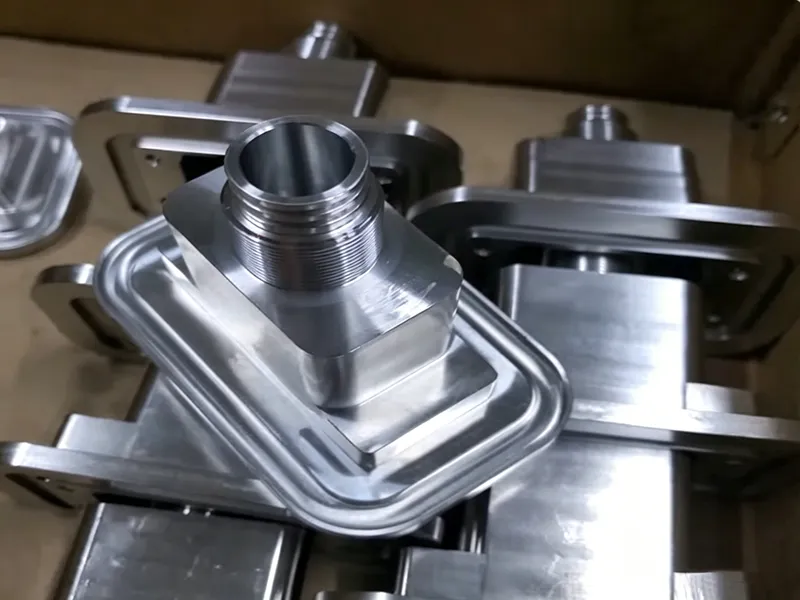
Several misconceptions can confuse engineers choosing between T6 and T651:
- “They’re the same material.” Not exactly. Chemically they’re the same, but T651 includes an extra stress-relief stretch step. This means their internal stress states differ, even though their composition and nominal strengths are identical.
- “T651 is always stronger than T6.” Actually, no. Stretching in T651 can slightly reduce measured yield strength. Some data even show 6061-T6 having a marginally higher yield (e.g. ~276 vs 240 MPa in one source). In practice, their tensile strengths are essentially the same. So T651 isn’t chosen for “strength,” but for stability. If strength alone were the only criterion, T6 would be fine.
- “T6 can’t be machined because it’s full of stress.” This is false. 6061-T6 is extensively machined in industry; it just requires awareness of its higher residual stress. Many CNC parts are made from T6 without issue. The difference is that T6 may warp more during aggressive cutting, so machinists might use back-machining or stress-relief passes on T6 parts. Nonetheless, T6 is completely machinable.
- “You can pick temper by strength alone.” Not really. Since T6 and T651 have nearly identical strength, choosing based only on strength is misguided. Instead, consider how much distortion can be tolerated. That’s why guides emphasize stability over strength in selection.
- “T6 and T651 can’t be interchanged.” They can be substituted in some contexts because their composition and chemistry are identical. However, one must respect form and certification. For example, ordering a T6-certified plate when only T651 is available (because of thickness) might cause confusion. Engineers should specify the temper correctly. Often a mill will certify thick plate as T651 and sheet as T6.
- “T651 is only for special alloys.” No – T651 is specifically a temper of 6061 (and similar alloys) used widely for plates. It’s not exotic; it’s simply 6061 processed differently. If T6 material is unsuitable for an application due to warping, switching to T651 (or to a more stable alloy or temper) solves the problem.
By clearing up these points, specifiers can focus on the real issues: residual stress, machining stability, and cost, rather than get hung up on the temper names.
Summary
In summary, Aluminum 6061 is a highly versatile, heat-treatable alloy prized for its strength, corrosion resistance, and workability. The designations T6 and T651 refer to how 6061 is heat-treated. Both tempers yield a strong, hard material – the primary difference is that T651 undergoes an additional stretching stress-relief after quenching.
The core differences are:
- Stress Relief: T651 has it, T6 does not.
- Dimensional Stability: T651 is more stable, T6 can warp more.
- Machinability: T651 machines with less distortion and often slightly better surface finish.
- Flatness: Large T651 plates stay flatter than T6 plates.
- Product Forms: T6 is common in thin stock and extrusions; T651 is used for thicker plate/bar.
Key factors for selection include part geometry (large/flat parts → T651), tolerance requirements (tight → T651), material form (thick plate → T651), and production volume/cost. If minimizing warpage and scrap is crucial (for thin walls, heavy cutting, aerospace parts, etc.), 6061-T651 is usually the better choice. If cost is tight and the part is relatively simple or robust (like a bracket or base), 6061-T6 often suffices.
For buyers and engineers: specify the temper that matches your needs. Don’t assume T6 and T651 are identical – T651’s extra processing makes it superior for high-precision, flatness-critical parts, while T6 remains the standard for general structural and machined components. Reviewing the part’s dimensional and tolerance requirements alongside material availability will guide you to the optimal choice.
FAQ
Is 6061-T651 stronger than 6061-T6?
No – their strengths are essentially the same. Both have typical tensile strengths around 310 MPa. In fact, stress-relief in T651 can make its yield strength slightly lower than T6. So T651 isn’t stronger; it’s just more dimensionally stable.
What is the main difference between 6061-T6 and 6061-T651?
The main difference is the stress-relief step. 6061-T651 is processed just like T6 plus a stretching procedure after quenching, which relieves internal stresses. As a result, T651 alloy stays flatter during machining, whereas T6 stops at aging without that extra stretch.
Which is better for CNC machining?
Generally, 6061-T651 is better if you need very tight tolerances or complex milling, because it resists warping under the cutter. 6061-T6 can still be machined and is fine for many parts, especially simpler or thicker ones, but you may need to allow for some stress relief.
Is 6061-T651 more stable than 6061-T6?
Yes. 6061-T651 has much lower residual stress, so it maintains its shape much better during and after machining. This means plate or bar stock in T651 will stay flatter and require less correction than T6.
Can 6061-T6 and 6061-T651 be used interchangeably?
Sometimes they can be swapped in general use, since the alloy is the same. However, be aware of thickness and certification. For example, plate above 0.25″ is usually T651 by standard, so you can’t call that “T6”. Always specify the temper you need. In many cases, T651 can serve in place of T6 if better stability is needed, but not vice versa unless the part can tolerate distortions.
Why is 6061-T651 commonly used for aluminum plate?
Because plate stock is often thicker than the standard limit for T6. In practice, any 6061 plate over about 0.25″ is made T651. The stretching process ensures large flat plates don’t bow or warp, which is why T651 is the industry norm for plate.