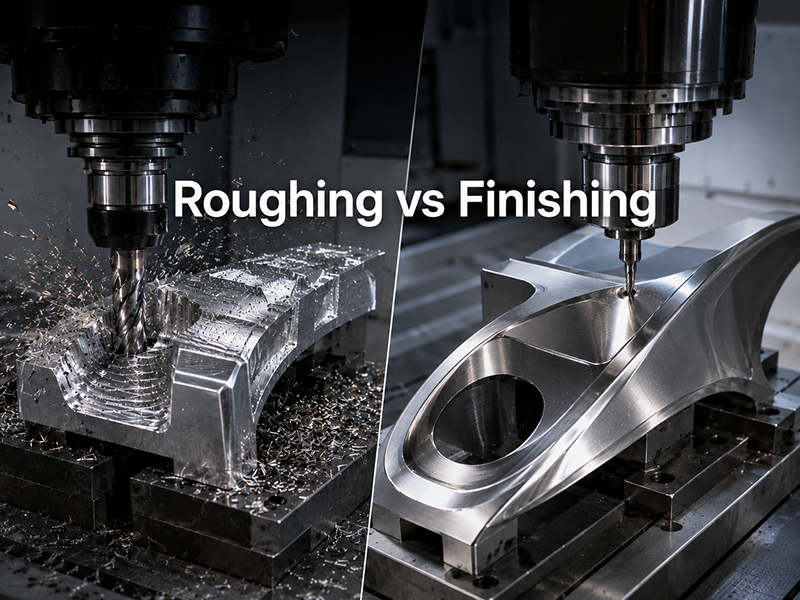
In CNC machining, roughing and finishing are two related but very different process stages. Roughing is designed to remove as much excess material as possible through stable, productive roughing cuts while leaving a controlled allowance for later finishing cuts. Finishing is the precision stage that brings the part to its final geometry, tolerance, and surface quality with lighter cuts, tighter toolpath control, and more refined tooling.
What Is Roughing in Machining?
Roughing is the early material-removal stage of a machining process. Its job is not to create the final cosmetic or dimensional result; its job is to use efficient roughing cuts to remove bulk stock and move the workpiece closer to near-net shape. Tooling guidance for rough boring describes roughing as being primarily focused on metal removal and preparation for finishing, while CAM documentation classifies common pocket-clearing operations as roughing operations that can later be followed by finish passes.
In practical terms, CNC roughing is about material removal rate, process stability, and controlled stock left behind. Metal removal rate is driven by cutting depth, cutting width, and feed, so roughing cuts often use larger engagement and multiple depth cuts to move material quickly. CAM systems also typically leave a small amount of stock after roughing so that later finishing passes can remove it under more controlled conditions.
That is why roughing machining is usually associated with deeper cuts, heavier tool loads, more aggressive toolpaths, and tools built for high chip volume rather than final appearance. The surface left after a roughing operation is normally acceptable only as an intermediate result, not as the final production surface.
What Is Finishing in Machining?
Finishing is the precision stage that follows roughing or semi-finishing. Its purpose is to bring the part to final size, final geometry, final position, and final surface finish. In boring and hole-making guidance, finishing is explicitly defined as machining with small cutting depths to achieve close tolerances and high-quality surface finish, while reaming is described as a finishing operation for high-precision holes with close dimensional tolerance.
Compared with roughing, finishing machining uses lighter engagement, finer toolpaths, and more controlled parameters. CAM documentation notes that smaller stepdown and stepover create smoother surface finish, and that tighter toolpath tolerance is more appropriate for finishing because it improves surface quality. Finishing passes may also be repeated to remove slight stock left by tool deflection.
This is why CNC finishing matters most on tight-tolerance features and quality-critical surfaces such as precision bores, sealing faces, mating diameters, and visible contoured surfaces. If a part must meet close dimensional requirements or leave the machine with a smoother, cleaner appearance, the finishing operation is usually what makes that possible.
Roughing vs Finishing in Machining: Main Differences
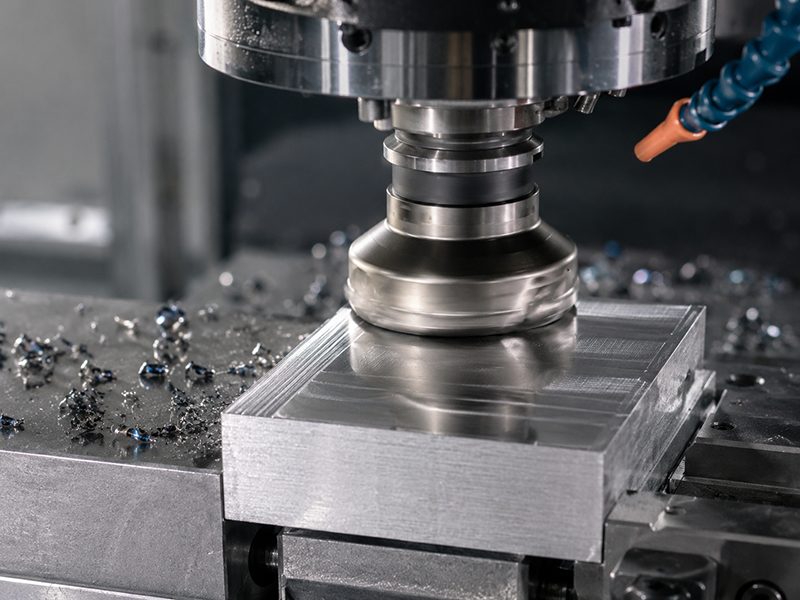
The difference between roughing and finishing is easiest to understand by looking at what each stage is trying to optimize. Roughing prioritizes productivity and bulk stock removal. Finishing prioritizes accuracy, lower deflection, and final surface quality. That distinction appears consistently in CAM documentation, tooling guidance, and manufacturing research.
| Factor | Roughing | Finishing |
|---|---|---|
| Main goal | Remove large amounts of material | Achieve final size and surface quality |
| Cutting depth | Typically deeper or more aggressive engagement | Light cuts |
| Feed strategy | Optimized for high material removal | Optimized for control and final quality |
| Speed and toolpath | Usually productivity-focused | Usually accuracy- and finish-focused |
| Surface quality | Rougher intermediate surface | Smoother final surface |
| Tolerance | Less precise | More precise |
| Tool load | Higher | Lower and more controlled |
| Common stage | Early machining stage | Final machining stage |
This comparison reflects how machining guidance separates roughing from finishing: roughing is for metal removal and allowance management, while finishing is for tight tolerance, fine geometry, and better surface finish.
Roughing usually comes before finishing because finishing is inefficient at bulk stock removal. Roughing creates the basic shape and leaves a controlled working allowance; finishing removes that remaining stock in a more stable and precise way. CAM systems and lathe canned cycles explicitly support this sequence by leaving stock during roughing and consuming it with later finish passes, and profile-milling guidance emphasizes that best finishing quality comes when previous operations leave a small, constant amount of stock.
Tools and Cutting Parameters for Roughing and Finishing
Roughing tools are selected for strength, chip flow, and high material removal. Typical examples include roughing end mills with serrated cutting edges, round-insert or radius-style cutters for profile milling, long-edge cutters for heavier shoulder milling, and carbide-based tools designed for high wear resistance and heavy loading. Manufacturer guidance also associates rough milling with larger, more robust cutters that can run at high feed rates and high metal removal rates in stable setups.
Finishing tools are selected for accuracy, lower cutting forces, and surface quality. Common examples include ball nose end mills for finishing and super-finishing 3D surfaces, reamers for high-precision holes, fine boring tools for close hole tolerance, and turning inserts with sharper, ground, or more positive geometries to reduce tool deflection. In other words, roughing tools are built to survive heavy cutting, while finishing tools are built to leave better geometry and better surfaces.
The cutting parameters also separate the two stages. Roughing usually pushes material removal rate through larger depth steps, more aggressive engagement, adaptive clearing, and multiple depth cuts. Finishing usually reduces stepdown and stepover, applies a dedicated finish feedrate, tightens toolpath tolerance, and may add repeated or multiple finishing passes to improve the final result. Smaller finishing stepovers and stepdowns directly improve surface finish, while tighter toolpath tolerance is generally recommended for finishing rather than roughing.
Coolant use and chip evacuation matter in both stages, but they affect them differently. Cutting fluid is used for chip evacuation, cooling, and lubrication, and good chip control is essential because poor chip formation or chip jamming can damage tools and degrade surface quality. Guidance for turning also recommends precision coolant for finishing applications, while medium and roughing applications often use under-coolant arrangements.
From a quality standpoint, the surface and tolerance gap between roughing and finishing is large. Sandvik Coromant’s reaming guidance positions reaming as a finishing method for high-precision holes, high surface finish, superb hole quality, and close dimensional tolerance. That is why tight-tolerance machining and precision CNC machining almost always rely on a finishing pass rather than roughing alone.
Roughing and Finishing in CNC Milling and CNC Turning
In CNC milling, roughing is commonly used to clear pockets, open cavities, remove stock around bosses, and bring complex shapes close to final form. CAM documentation explicitly classifies 2D Pocket as a roughing operation with optional finish passes, while profile-milling guidance separates multi-axis work into roughing, semi-finishing, and finishing stages. The same guidance also notes that standard face, shoulder, and slot milling can run on 3-axis machines, whereas 3D profiles typically require 4-axis or 5-axis capability.
Finishing in CNC milling then takes over for walls, floors, contours, corner blends, sculpted surfaces, and free-form geometry. Ball nose end mills are widely used because they are well suited to smooth 3D finishing, and multi-axis finishing strategies are specifically intended to improve surface quality on complex surfaces. On mold, die, and aerospace-style parts, shops often use several roughing and finishing toolpaths rather than a single all-purpose pass.
In CNC turning, the same separation exists. CAM systems provide separate toolpaths for turning profile roughing and turning profile finishing, and lathe stock-removal cycles leave explicit roughing and finishing allowances before a final finishing cycle is called. In other words, turning roughing gets the diameter or face close, while turning finishing refines the profile, removes the remaining allowance, and improves final size and surface quality.
That matters on shafts, sleeves, bushings, bores, and other rotational parts because roundness, size control, bore quality, and surface finish do not come only from fast stock removal. They come from a finishing pass with lighter engagement and better geometry control, sometimes followed by fine boring or reaming when the tolerance target is especially tight.
Machining Cost, Common Mistakes, and Strategy Selection
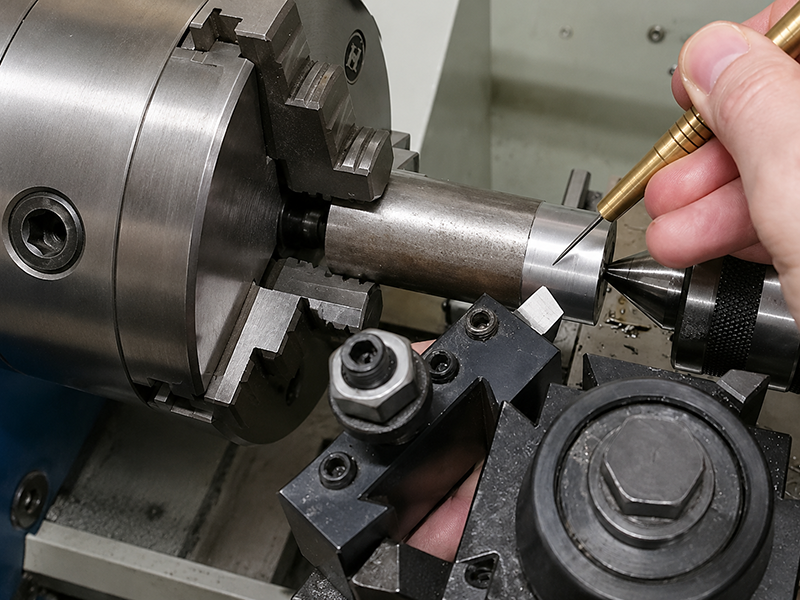
Roughing and finishing affect machining cost in different ways. Roughing drives productivity because machining time and material removal are closely tied to feed, cutting depth, and cutting width. Finishing, by contrast, often increases cycle time because better surfaces require smaller stepovers and stepdowns, tighter toolpath tolerance, dedicated finish feedrates, and sometimes multiple finishing passes. In practice, over-specifying finish quality on non-critical surfaces usually raises cost without adding functional value.
Many roughing-versus-finishing problems come from allowance control and stability. CAM guidance shows that roughing should leave stock for later operations, while profile-milling guidance warns that uneven stock left by prior passes can hurt final geometrical accuracy. Finishing also suffers when the tool is forced into sharp internal corners, when thin walls deflect, or when chips are not evacuated cleanly, because chatter, deflection, and chip jamming all hurt surface finish and process security.
Before choosing a roughing and finishing strategy, use a simple checklist:
- Material behavior and chip formation matter because sticky or long-chipping materials may need sharper geometries, better coolant direction, and stronger chip evacuation control.
- Part geometry and overhang matter because deep cavities, thin walls, and long tool extensions increase vibration and deflection risk.
- Tolerance and surface-finish requirements by feature matter because not every face needs the same finishing intensity, but precision holes and mating features usually do.
- Machine capability matters because 3-axis, 4-axis, and 5-axis systems do not handle the same geometry in the same way, and rigidity plus toolholding strongly affect results.
- Allowance planning matters because roughing should leave a small, consistent stock for one or more finishing operations rather than an irregular or excessive load.
Neither stage is “more important” in absolute terms. Roughing determines how efficiently a shop removes stock and controls cycle time. Finishing determines whether the part actually meets final dimensional, functional, and cosmetic requirements. High-quality CNC parts depend on both, and the best results usually come from matching the allowance, tooling, and toolpath strategy to the exact feature being machined.
Conclusion
The core difference between roughing and finishing in machining is the goal of the cut. Roughing is built for fast, stable material removal and for creating a near-net shape with a controlled allowance left behind. Finishing is built for final dimensions, tighter tolerances, better geometry, and smoother surface finish through lighter cuts and more controlled toolpaths. When those two stages are planned together instead of treated as interchangeable, CNC machining becomes more efficient, more predictable, and more cost-effective. In short, roughing creates the basic shape, while finishing creates the final quality.
FAQ About Roughing vs Finishing in Machining
What is roughing in machining?
Roughing is the initial machining stage used to remove most of the excess material from a workpiece as efficiently as possible. It focuses on material removal and near-net shape rather than final dimensions or final surface finish, and it usually leaves a small allowance for later finishing passes.
What is finishing in machining?
Finishing is the precision stage that brings the part to its final size, geometry, and surface quality. It typically uses smaller cutting depths, more refined toolpaths, and tighter control so the part can meet closer dimensional tolerance and better surface-finish requirements.
What is the main difference between roughing and finishing?
The main difference is the objective. Roughing prioritizes fast stock removal and productivity, while finishing prioritizes final tolerance, geometry, and smooth surface finish. Roughing is about efficiency first; finishing is about quality first.
Does roughing always come before finishing?
Usually, yes. Roughing removes bulk stock and leaves a controlled allowance, then finishing removes that remaining material more precisely. CAM systems and lathe canned cycles are built around this sequence, which is why finish passes usually follow roughing rather than replace it.
How much material should be left for finishing?
There is no single universal number. The right finishing allowance depends on material, part geometry, tool diameter, rigidity, and the required tolerance or surface finish. The consistent rule in CAM and tooling guidance is that roughing should leave a small, controlled, and as-even-as-possible stock for later finishing passes.
Can the same tool be used for roughing and finishing?
Yes, in some simple cases. CAM documentation explicitly allows finishing passes when roughing and finishing are done with the same tool. However, separate tools are usually better when the part needs higher accuracy, better surface finish, or more efficient stock removal.
Does finishing increase machining cost?
Usually, yes. Better finish quality often requires smaller stepovers, smaller stepdowns, finish-specific feedrates, multiple finishing passes, and tighter toolpath tolerance. Those choices improve quality, but they also add toolpath length, cycle time, and overall machining effort.
Why is finishing important for precision CNC parts?
Finishing is what allows a precision CNC part to reach its final dimensional tolerance, bore quality, geometry, and surface finish. Operations such as fine boring and reaming are specifically intended for close tolerance and high-quality surfaces, which roughing alone usually cannot deliver.