Die casting is a metal casting process in which molten metal is forced under high pressure into a mold cavity (called a die) and allowed to solidify. The mold itself is made of hardened tool steel, similar to an injection mold for plastic, and is designed to produce complex shapes with tight tolerances. Most die castings use non-ferrous metals (for example, zinc, copper, aluminum, and magnesium) because of their fluidity and lower melting points. Die casting is distinguished from other casting methods by its use of reusable metal dies and high-pressure injection, enabling very fast cycles, high dimensional accuracy, and smooth surface finishes. Because of the large capital cost of the casting equipment and steel dies, die casting is mainly used for high-volume production of relatively small to medium parts.
What Is Die Casting?
In simple terms, die casting is a high-pressure metal casting process. Molten metal is poured or injected into a steel mold (the “die”) under pressures often ranging from 10 to 175 MPa. The molten metal completely fills the die cavity, then solidifies. The die is opened and the finished part is ejected. This is similar in concept to plastic injection molding, but uses metal and much higher temperatures and pressures. A typical die casting machine has two halves of a mold that are clamped together; a plunger or piston injects the metal, and after solidification the halves are separated to remove the casting. Die casting parts are usually small or medium in size, and most commercial die-castings are made from non-ferrous alloys like aluminum, zinc, and magnesium.
The high-pressure injection and steel dies give die casting parts excellent repeatability and surface quality. Die castings have smooth, near-machined surfaces and very good dimensional accuracy (on the order of 0.1 mm for the first 25 mm of length). This contrasts with processes like sand casting (where molds are sand-based and surfaces are rough). Because the metal is forced into the die quickly under pressure, even thin-walled or intricate shapes can be filled completely. However, the flip side is that the tooling (the steel dies and machine) is very expensive, so die casting is usually only economical when making large quantities of parts.
In manufacturing, die casting plays the role of a high-volume precision casting method. It is widely used to mass-produce components that require tight tolerances and smooth finishes. Compared to other metal forming or casting methods, die casting’s advantages include its speed, repeatability, and low per-part cost at scale. For example, a single die can produce thousands of identical parts with virtually no mold degradation. This makes die casting ideal for consumer electronics, automotive parts, hardware, and many other applications where thousands of units are needed.
When comparing die casting to other metal forming processes (such as forging, sand casting, or CNC machining), the key differences are the use of pressure, mold material, and volume economics. Unlike sand casting or investment casting, die casting uses permanent steel dies and high pressure to inject the metal, resulting in very fast cycle times and excellent detail. Compared to CNC machining, die casting is not a subtractive process – instead of cutting away metal, it forms the near-net shape of the part directly in the mold. As a result, die casting can produce complex geometries in high volumes much faster and cheaper per piece than CNC milling, though CNC offers greater flexibility for low-volume or highly custom parts.
How Does Die Casting Work?
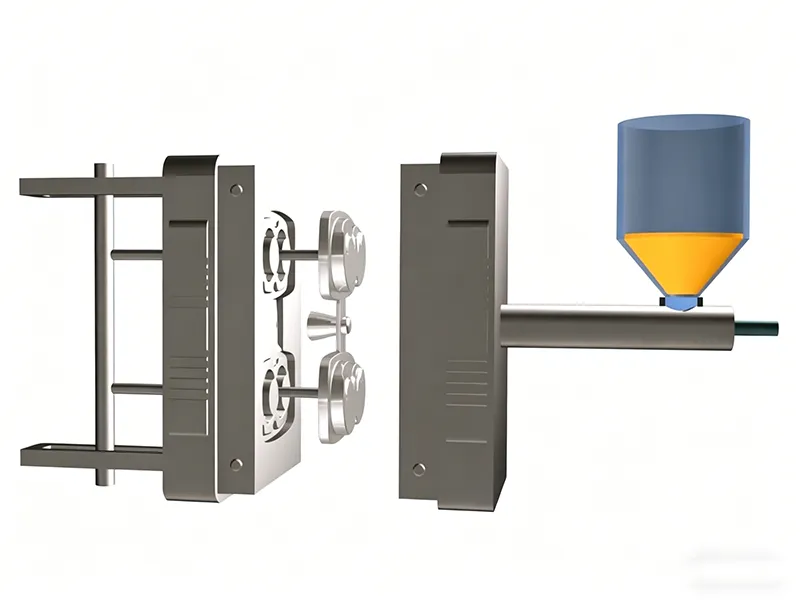
In a die casting machine, the process begins by closing and clamping the die halves together. The cavities in the die are cleaned and sprayed with a lubricant or release agent (often water-based) to control temperature and aid part ejection. Once the die is closed and locked, molten metal is prepared in a holding furnace. The melted alloy (such as aluminum, zinc, or magnesium) is then introduced into the machine: in a cold-chamber machine, the metal is ladled or transferred into an injection chamber; in a hot-chamber machine, the chamber itself is dipped into the molten metal.
The key step is the injection or shot. A hydraulic or mechanical plunger drives the molten metal at very high pressure into the die cavity. Because of the high pressure, the metal flows rapidly to fill every detail of the cavity – even thin sections are filled before any solidification begins. Typical injection pressures range from a few thousand psi to tens of thousands of psi. Once the cavity is filled, the machine holds pressure on the metal until it solidifies. This holding pressure compensates for shrinkage and ensures the metal stays in contact with all parts of the die as it cools.
After the metal has cooled and solidified, the die is opened. Ejector pins in the die then push the newly-formed part out of the mold. At this point the part is free of the die, but it typically still has excess material attached (such as runners, gates, or flash from the parting line). In the final trimming/finishing step, these excess sections are removed (often by shearing or machining) and recycled. After trimming, the part is ready for any additional finishing operations (such as machining, plating, or painting).
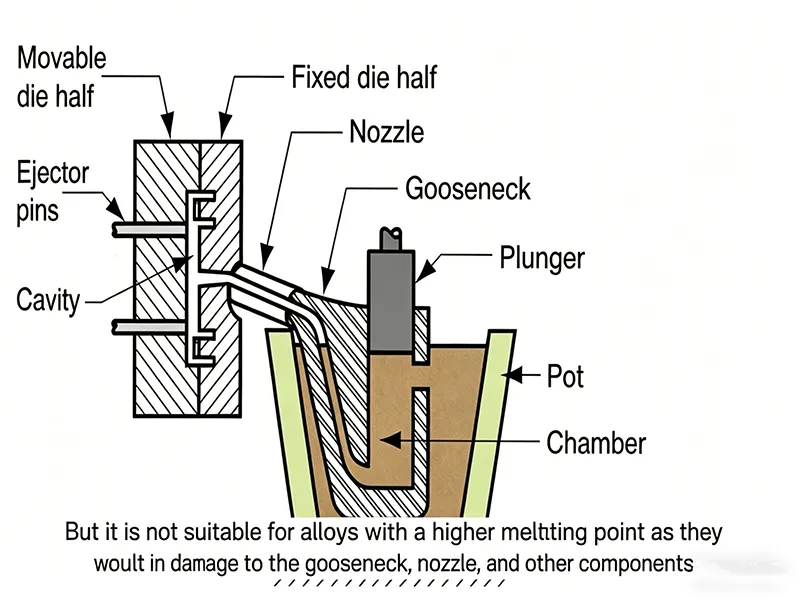
In hot-chamber die casting (see diagram above), the injection cylinder is submerged directly in the molten metal, so metal is drawn into the chamber and then pressed into the die. In cold-chamber die casting, the metal is melted in a separate furnace and poured into the injection chamber just before each shot. In both cases, once the die is clamped, the molten metal is injected under high pressure, then cooled, opened, and ejected. The entire cycle (closing mold, injecting, cooling, ejecting, trimming) is often only a few seconds long, allowing die casting to achieve very high production rates.
Main Steps in the Die Casting Process
The traditional high-pressure die casting process consists of six main steps:
Step 1 – Preparing the Die
First, the die halves are cleaned and sprayed with a release agent or lubricant. This spray controls die temperature and helps the part release later. Then the two halves of the steel die are closed together and tightly clamped (or “locked”) by the machine so that they form a sealed cavity.
Step 2 – Melting the Metal
In parallel, the casting alloy is melted in a furnace. For cold-chamber machines, the metal is melted outside the machine in a separate furnace. The alloy is typically heated above its melting point (for example, >660 °C for aluminum alloys) until fully liquid.
Step 3 – Injecting the Molten Metal
Next, a measured shot of molten metal is moved into the injection chamber (or in hot-chamber machines, the chamber is already filled). A hydraulic or mechanical plunger then forces the molten metal into the closed die cavity at high pressure. Pressures often range from 1,500 to 25,000 psi (10–175 MPa). The metal rushes into the die and completely fills the cavity, replicating the part geometry in an instant.
Step 4 – Cooling and Solidification
Once the die is filled, the pressure is maintained until the metal cools and solidifies into the part shape. The cooling time depends on the alloy and thickness of the part, but is usually just a few seconds. During this time, the mold remains locked.
Step 5 – Ejecting the Part
After solidification, the die halves are separated. Ejector pins push the newly cast part out of the die. Because the die may contain multiple cavities, each shot can produce several identical parts at once (each called a “shot”).
Step 6 – Trimming and Finishing
The raw die-cast parts still have excess metal attached — runners, gates, and flash from the parting line. These are removed in a trimming operation. Workers or secondary machines cut off the flash and gating material. The scrap metal from these features is recycled by remelting. Finally, the cleaned-up cast parts may undergo further finishing, such as machining critical features, polishing, or surface coating, as needed.
Types of Die Casting Processes
There are two main variants of high-pressure die casting: hot-chamber and cold-chamber. The difference lies in how the metal is injected.
Hot Chamber Die Casting
In the hot-chamber process, the injection cylinder (gooseneck system) is immersed in the molten metal bath. The furnace is built into the machine, so metal is drawn directly into the chamber and then immediately injected into the die. This makes the cycle very fast and efficient for low-melting alloys. Hot-chamber casting is typically used for zinc, magnesium, tin, and lead alloys (all low melting-point, high-fluidity metals). These processes can produce parts with very high precision and excellent surface finish, and are well-suited for small to medium-sized components with detailed features. The drawback is that the metal is in contact with the machine, so hot-chamber machines corrode easily and cannot be used with high-melting-point or highly corrosive alloys.
Cold Chamber Die Casting
In cold-chamber casting, the metal is melted in a separate furnace outside the machine and then poured (ladled) into the cold chamber for each shot. A plunger then injects the metal into the die. Because the hot parts of the machine are not continually immersed, this method avoids corrosion issues and allows the use of higher-temperature alloys. Cold-chamber casting is commonly used for aluminum, copper, and other high-melting alloys that would damage a hot-chamber system. It typically has a slower cycle time than hot-chamber (since each shot requires new metal ladling) and is suitable for larger parts. However, cold-chamber machines handle the strongest alloys and produce very durable castings for demanding applications.
Hot Chamber vs Cold Chamber (Comparison Table)
Below is a summary comparison of hot-chamber and cold-chamber die casting processes:
| Feature | Hot-Chamber Die Casting | Cold-Chamber Die Casting |
|---|---|---|
| Melting Location | Inside the machine (plunger immersed in metal) | Outside machine (metal ladled into cold chamber) |
| Injection Pressure | Lower (≈1,000–5,000 psi) | Higher (≈1,500–25,000 psi) |
| Injection Axis | Typically horizontal | Horizontal or vertical |
| Suitable Metals | Low-melting alloys (Zn, Mg, some Al) | High-melting alloys (Al, Cu, Mg alloys) |
| Cycle Speed | Very fast (built-in furnace allows rapid cycling) | Slower (requires metal ladling each shot) |
| Typical Part Size | Small to medium with intricate features | Medium to large, thicker sections |
| Machine Wear | High (constant exposure to molten metal) | Lower (melting kept separate) |
| Production Volume | Best for very high volumes of small parts | Good for high volumes, especially larger parts |
This summary shows the trade-offs: hot-chamber is limited by alloy choice but yields the fastest cycle times, while cold-chamber is more flexible with materials (at the expense of speed).
Common Materials Used in Die Casting
Die casting can use a variety of non-ferrous metals and alloys. The choice depends on required strength, weight, corrosion resistance, and cost. The most common die casting materials are:
- Aluminum Alloys (e.g. A380, A360) – Aluminum die casting is popular for its good strength-to-weight ratio. Alloys like A380 offer moderate tensile strength (~310–320 MPa) with low density. Aluminum castings are lightweight, corrosion-resistant, and electrically conductive. They are widely used for automotive and aerospace parts (engine blocks, housings, brackets) and consumer products where reduced weight is important.
- Zinc Alloys (e.g. Zamak 3, ZA-8) – Zinc is the easiest metal to cast by die casting and has excellent flow characteristics. Zinc alloys provide high strength and hardness, and produce very fine surface detail with thin walls. They are ideal for high-precision, small parts such as connectors, gears, and complex housings. Zinc’s low melting point means long die life. Zinc die castings generally have tight dimensional tolerances and excellent surface finish. The disadvantage is that zinc parts are heavier than aluminum and are prone to corrosion (requiring plating or coating).
- Magnesium Alloys (e.g. AZ91D, AM60) – Magnesium is the lightest die casting alloy (density ~1.8 g/cm³). Magnesium die cast parts are ultra-lightweight yet strong, making them ideal for aerospace components and portable electronics. For example, AZ91D is widely used; it has a high strength-to-weight ratio and good castability. Magnesium parts have excellent dimensional stability and surface finish. However, magnesium alloys are more expensive than aluminum and can be highly corrosive, so protective coatings are often used.
- Copper and Brass Alloys – Less common, but used when high strength, thermal or electrical conductivity is needed. Copper-based alloys (including brass and bronzes) can be die cast but require high temperatures and robust machines. These parts are heavier and usually more expensive. Typical uses include plumbing fixtures, hardware with high wear resistance, and electrical connectors. (For example, the Xometry guide notes copper alloys for “electrical terminals” and wear parts.)
Choosing the right material depends on the part’s function and requirements. Lightweight, corrosion-resistant applications (like aerospace housings) often use aluminum or magnesium. Thin, high-precision parts (like connectors or consumer electronics) often use zinc alloys. Where conductivity or strength is needed (plumbing fixtures, terminal pins), copper/brass alloys may be used. Cost is also a factor: zinc has the lowest melting point and cheapest dies, but aluminum and magnesium may give weight savings.
Advantages of Die Casting
Die casting offers many advantages for manufacturing:
- High dimensional accuracy and consistency. Die cast parts have very tight tolerances – on the order of 0.04–0.10 mm over the first centimeter. This precision comes from the rigid steel dies and high-pressure injection, which produce consistent parts every cycle.
- Excellent surface finish. Because the metal is forced into a smooth steel die under pressure, die cast parts have smooth, nearly polished surfaces (typical roughness Ra 1–2.5 µm). This often eliminates the need for post-machining of cosmetic surfaces.
- Thin walls and complex shapes. Die casting can reliably produce thinner walls (down to ~0.75 mm) and more intricate geometries than sand or permanent mold casting. Features like bosses, ribs, and hollow sections can be cast in one step. Inserts (like threaded bushings) can also be placed in the die before casting, allowing them to become integral to the part during the cast process.
- High production rate. The automated die casting cycle is very fast (seconds per part), enabling large quantities. Die castings can be produced at rates of 3–4 shots per minute or more in conventional machines. This makes die casting ideal for mass production.
- Reduced secondary operations. Because of the good accuracy and surface quality, many die cast parts require minimal machining after casting. This saves time and cost downstream.
- Strength. Die cast parts often have good mechanical properties. For example, aluminum die castings can reach tensile strengths up to 415 MPa, which is high compared to sand casting. The high-pressure process also produces dense, uniform microstructures (except for some porosity), giving parts good strength-to-weight.
Overall, die casting can produce complex metal parts quickly, accurately, and in large volumes, which leads to low per-part costs in high-volume runs.
Limitations of Die Casting
Despite its advantages, die casting has some important limitations:
- High tooling and equipment cost. The steel dies and high-pressure machines are very expensive. A single die can cost tens of thousands of dollars or more. This means die casting is only economical if the mold will be used for many parts. For short runs or prototypes, the cost is prohibitive.
- Limited to certain materials. The process requires alloys with high fluidity and low melting points. Very high-melting metals or extremely high-strength alloys cannot be die cast. Alloys like stainless steel or high-carbon steels are out of the question. Even aluminum has limits on silicon content (higher silicon alloys are harder to machine). In practice, only non-ferrous alloys (Al, Zn, Mg, some Cu alloys) are used.
- Limited part size and thickness. Die casting machines and dies impose size limits. Very large or very heavy parts (above ~10 kg, though modern machines can handle larger) are impractical. Extremely thick sections also solidify slowly, making uniform cooling difficult. Typically, design guidelines limit sections to just a few millimeters of thickness to avoid shrinkage voids.
- Porosity. A small amount of gas porosity is virtually unavoidable in die casting because the fast fill traps air. This means die cast parts are not fully dense. Consequently, parts generally cannot be fully heat-treated or welded (the trapped gas will expand). Special vacuum or pore-free casting variants exist to reduce porosity, but standard die castings will have some porosity.
- Rigidity on shape features. While die casting allows complex shapes, features must be designed to allow part ejection (draft angles) and avoid undercuts. Very intricate internal cavities may be impossible without cores or later machining.
In summary, die casting shines for large-volume, relatively small, precise parts of castable alloys. It is not the method of choice for one-off parts, very large castings, or ferrous/high-melting alloys.
Die Casting vs Other Manufacturing Processes
Die Casting vs Sand Casting
Die casting and sand casting are both metal casting methods, but they use very different molds and machinery. Sand casting uses expendable sand molds formed around patterns, then gravity-pours metal. Die casting uses permanent steel molds and pressure-injects metal. Key differences include:
- Mold Material: Sand molds are quick and cheap to make (using compacted sand) but only last one shot. Die casting molds are steel and expensive, but are reusable for millions of cycles.
- Startup Time and Cost: A sand mold can be made rapidly if you have the pattern, so initial lead time and cost are low. In contrast, designing and machining steel dies for die casting is time-consuming and costly. Therefore, die casting makes sense only when you need a lot of parts; sand casting is more flexible for short runs or large, one-off castings.
- Surface Finish: Die cast parts have very smooth surfaces, because of the smooth steel die and high-pressure filling. Sand cast parts come out much rougher (sand grain texture) and almost always require machining for tolerances.
- Dimensional Accuracy: Die casting yields much tighter tolerances than sand casting. Die cast parts are often ready to assemble, whereas sand castings need a lot of machining. The pressure injection also means die casting can fill thin sections that sand casting cannot handle. For these reasons, die casting is preferred for small-to-medium parts requiring high precision.
- Complexity of Parts: Both can make complex shapes, but die casting often handles very thin walls and fine details better (thanks to pressure). Sand casting is better for extremely large parts (like engine blocks) or very complex internal passages (via sand cores).
In brief, die casting is faster and yields higher quality surfaces and accuracy but at higher upfront cost. Sand casting is slower and less precise but has low tooling cost and can handle larger sizes. The choice depends on budget, volume, and part requirements.
Die Casting vs Investment Casting
Investment casting (lost-wax) uses disposable ceramic molds formed around wax patterns. Key differences:
- Tooling and Cycles: Investment molds are broken each time, whereas die casting uses a reusable steel die. Die casting has very short cycle times (often several shots per minute), whereas investment casting is much slower (wax pattern making, ceramic coating steps). Thus, die casting can produce parts more rapidly.
- Volume and Cost: The ceramic molds in investment casting are relatively cheap per mold, so investment casting is economical for low to medium volume runs. The high cost of die casting dies makes die casting economical only at high volumes. The Dynacast guide notes that investment casting tooling is cheaper and suited to lower volumes, while die casting is ideal for high-volume production.
- Material Capability: Investment casting can produce parts in alloys that die casting cannot, including stainless steels and high-temperature alloys. Die casting is typically limited to non-ferrous alloys (aluminum, zinc, magnesium). So if you need a part in stainless steel, you would use investment casting.
- Tolerances: Die casting generally achieves tighter tolerances than standard investment casting. For comparable part sizes, die casting can hit finer tolerances (see Dynacast’s tolerance comparison table).
- Complexity: Both methods can create intricate geometries. Investment casting can capture very complex shapes with undercuts (since the ceramic shell is destroyed to remove the part), whereas die casting requires draft angles for ejection.
In summary, investment casting is preferred for lower volumes, exotic or ferrous alloys, and extremely intricate one-off parts. Die casting is preferred for large volumes of non-ferrous parts where cycle time and per-part cost must be minimized.
Die Casting vs CNC Machining
Die casting and CNC (computer-controlled machining) are fundamentally different. Die casting is a casting process (form metal by solidification in a mold), while CNC is subtractive (cutting away material from a solid block). Some contrasts:
- Volume Flexibility: CNC machining requires no specialized tooling beyond cutting tools and fixtures, so it’s cost-effective even for low-volume production or prototypes. Die casting requires expensive molds, so it only pays off at high volumes.
- Geometry and Precision: CNC can achieve very tight tolerances and complex shapes (including undercuts and features not possible in casting) simply by programming different tool paths. Die casting also achieves high precision, but it is constrained by the need for draft angles. For large parts runs, die casting yields very consistent dimensions, while CNC for very high volumes can be slower.
- Material Waste: CNC machining often has significant material waste (the “swarf” or chips cut away from the block). Die casting uses almost all the metal (except for gate/flash scrap) and leftover gates can be remelted. Thus, die casting is more material-efficient for high-volume runs.
- Production Speed: For producing many identical parts, die casting can be far faster, since each shot yields complete parts quickly with little human intervention. CNC machining each part individually (with multiple axes moves) will be slower on a per-part basis for large quantities.
- Economics: Die casting has high upfront cost but very low marginal cost per part; it “wins” on unit cost when making thousands of parts. CNC has no mold cost, so its per-part cost is constant with volume and can be higher for complex parts.
In practice, CNC and die casting are often used together: one might prototype a part in CNC to refine the design, then switch to die casting for the production run. A CNC machine can also be used for finishing operations on a die-cast part.
(Compare Table) Die Casting vs Other Processes
| Process | Die Casting | Sand Casting | Investment Casting | CNC Machining |
|---|---|---|---|---|
| Tooling | High-cost steel dies, reusable | Low-cost sand molds, disposable | Low-cost ceramic molds, disposable | No special molds (cutting tools only) |
| Materials | Limited to high-fluidity metals (Al, Zn, Mg) | Virtually any metal/ferrous or non-ferrous | Most alloys (including steels) | Any machineable material |
| Initial Cost | Very high (designing dies) | Low | Low | Low (but complex CNC setups cost) |
| Part Cost | Low for large volumes | Moderate | High for any volume (labor-intensive) | High (includes waste and time) |
| Surface Finish | Excellent (smooth) | Rough (sand texture) | Very smooth (good detail) | Very smooth (milled finish) |
| Accuracy | High (tight tolerances) | Lower (needs machining) | Moderate (better than sand) | Very high (precision machines) |
| Production Rate | Very high (fast cycle times) | Low (slow pour & clean) | Low (slow multi-step) | Low for large runs, high for simple parts |
| Part Complexity | Complex shapes with draft; inserts cast-in | Very large parts possible; cores | Very complex details possible | Undercuts & channels possible |
| Typical Use | High-volume consumer auto, electronics parts | One-off heavy castings (engine blocks) | Complex aerospace/medical parts | Prototypes, low-volume production |
This table (summarized from industry sources) highlights that die casting excels when you need large quantities of medium-complex metal parts with fine detail and finish. Other processes each have their niches depending on volume, materials, and geometry.
Key Applications of Die Casting
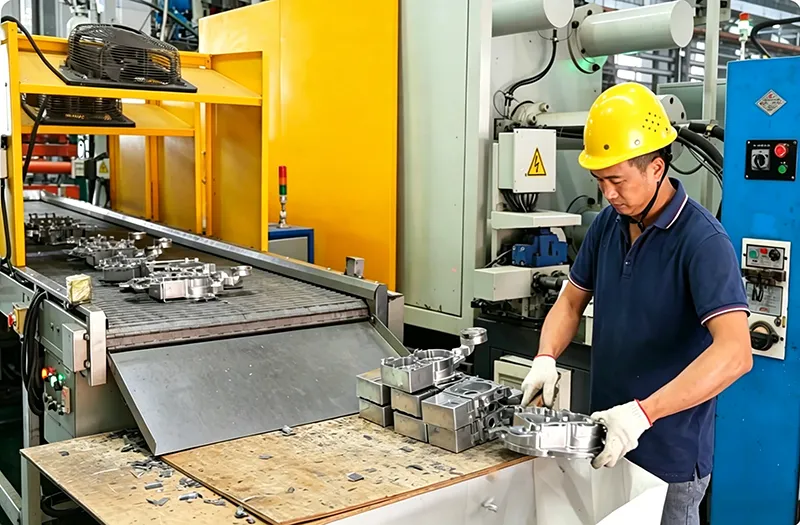
Die casting is used across many industries. Some key application areas include:
- Automotive Parts – Die casting is critical in the auto industry. Engine blocks, transmission cases, cylinder heads, brackets, housings, and chassis components are commonly die cast. For example, thin-walled aluminum engine covers and structural parts are often die cast for strength and precision.
- Electronics Housings and Components – Consumer electronics often use die-cast housings (such as for smartphones, computers, and cameras) due to their high precision and thin walls. Heat sinks and other thermal components are also die cast (e.g. as aluminum or copper parts).
- Industrial Machinery – Pumps, valve bodies, gearbox housings, motor frames, and other machine components are frequently die cast. The accuracy and durability of die-cast parts make them suitable for demanding industrial applications.
- Consumer Products – Many consumer goods contain die-cast metal parts. Examples include hardware (door handles, hinges, knobs), tools (power tool bodies), appliance parts, and decorative items. Die casting provides a balance of quality and cost for large production runs of these items.
- Aerospace and Lightweight Parts – Die casting (especially using aluminum and magnesium) is used in aerospace for lightweight structural components, brackets, and housings. The combination of strength and light weight is vital for aviation. Magnesium die castings, in particular, help reduce the weight of electronics and aerospace parts.
- Electronics and Housings – Die-cast aluminum or zinc enclosures are used extensively in electrical connectors, switch boxes, LED lighting housings, and even smartphones. They provide electromagnetic shielding and ruggedness for sensitive electronic components.
Overall, any industry that needs precision, durable metal parts in large numbers can benefit from die casting. Automotive and electronics lead the way, but medical devices, telecommunications, and infrastructure also use die-cast parts for their complex shape and performance needs.
Design Considerations for Die Casting Parts
When designing a part to be die cast, engineers must account for the capabilities and constraints of the process by following die casting design standards. Key considerations include:
- Wall Thickness – Aim for uniform wall thickness. Varying wall thicknesses cause uneven cooling and shrinkage, leading to defects like sink marks or warping. Gradual transitions between thick and thin sections are critical. Thick sections should be “cored” to hollow them out if possible, which speeds cooling and prevents porosity. Recommended typical wall thicknesses (depending on alloy) are around 1–3 mm (e.g. 1.5–3.0 mm for Al, 0.75–2.5 mm for Zn, 1.25–2.0 mm for Mg).
- Draft Angle – Any vertical walls or recesses must include a draft (taper) to allow the part to be ejected from the die. Without draft, the casting would stick or damage the die. Typical draft is 0.5°–1.0° per side for aluminum, and around 0.25°–0.5° for zinc (aluminum can tolerate more). Deep or textured features may require more draft.
- Fillets and Radii – Sharp internal corners should be avoided, as they create stress concentrations and are difficult for molten metal to fill without turbulence. Xometry recommends internal fillets of at least 0.5–1.0 mm radius to avoid cracking. Generous fillets also prolong die life and improve flow. As a rule, eliminate any corners sharper than about 0.25 mm radius.
- Parting Line – The die’s split-line determines where the two halves separate. Designers should plan the part geometry so the parting line can be located on non-critical surfaces. Overhangs or undercuts relative to the parting line require side-action cores, which add complexity. Avoid having the parting line bisect critical details if possible.
- Tolerances – Die casting can hold tight tolerances, but specify realistic ones. Dimensional tolerances of ±0.1–0.2 mm are often achievable for cast features, with secondary machining used for critical dimensions. Xometry notes zinc die castings can hold about ±0.025–0.050 mm for small features, and aluminum ±0.050–0.100 mm depending on size. Overly tight tolerances or no draft will drive up cost with little benefit.
- Surface Finish – Die cast parts come out smooth, but surface textures or plating can be added. If a specific finish is required (e.g. matte, polished, painted), it should be specified in the design. Keep in mind that fine textures require additional draft (e.g. +0.5° per 0.05 mm of texture depth).
- Ribs, Bosses, and Cores – Features like ribs and bosses must be supported by adequate wall thickness and draft. If a long boss is needed, consider coring it. Also avoid tall, thin bosses that can bend. At Dynacast, engineers often add ribs inside thick sections to strengthen them when cored out.
In general, good die casting design focuses on uniform thickness, proper draft, smooth transitions, and adequate fillets. Following these guidelines minimizes defects and machining needs.
How to Choose the Right Die Casting Material and Process
Selecting the optimal alloy and casting method depends on factors such as part function, production volume, strength/weight requirements, and cost:
- Based on Part Function: If the part needs to be lightweight, choose an alloy with a high strength-to-weight ratio (e.g. magnesium or aluminum). For example, magnesium alloys (AZ91D, AM60) are the best for ultra-light parts like aerospace or portable electronics. If corrosion resistance is important (like outdoor equipment), aluminum alloys (with anodizing) or zinc with plating are common. For electrical conductivity or wear resistance (e.g. in electrical or plumbing parts), copper/brass alloys may be selected. In general, match the alloy’s properties (tensile strength, ductility, corrosion) to the part’s requirements.
- Based on Production Volume: Die casting’s high tooling cost means it is most economical when amortized over many parts. If you only need a few dozen pieces, processes like CNC machining or even 3D printing may be more cost-effective. However, if you expect tens of thousands or more, die casting usually wins. As noted earlier, die casting per-unit cost drops dramatically at high volumes. CNC machining has no tooling cost, so it is flexible for low-volume or custom parts; but for thousands of parts, die casting’s speed makes it cheaper per part.
- Based on Strength and Weight: For applications where weight matters (e.g. automotive or aerospace), lean toward aluminum or magnesium die casting, as these metals are much lighter than zinc or copper. If the highest strength or stiffness is needed, certain zinc-aluminum alloys or magnesium can be chosen (for instance, the zinc-aluminum alloy ZA-8 offers high strength for load-bearing parts). The Xometry alloy chart above shows typical strengths: zinc alloys can reach up to ~380 MPa UTS (for ZA-8), while aluminum alloys like A380 hit ~320 MPa. Consider the part’s required mechanical properties when picking the alloy.
- Based on Cost and Finish: Zinc die casting often gives the highest precision and smoothest finish at the lowest per-cast cost, but zinc is heavy. Aluminum is lightweight but alloy prices are higher. Magnesium is mid-weight, expensive, and has good vibration damping. Also, secondary finishing (painting, plating) affects choice: some alloys take certain finishes better. For example, Xometry notes that AZ91D magnesium must be coated due to poor corrosion resistance. Always evaluate the trade-offs of material cost vs. performance.
In summary, match the alloy to the part’s function and the expected volume. Use zinc for fine-detail, lower-strength parts; aluminum for general lightness and good corrosion resistance; magnesium for ultra-lightweight needs; and copper alloys for specialty uses. Choose hot- or cold-chamber process based on alloy (low-melting vs high-melting). When uncertain, consult the data (like ultimate strengths, minimum wall thickness, and corrosion notes above) to guide the selection.
Common Defects in Die Casting
Even though die casting is highly reliable, defects can occur. The most common casting defects include:
- Porosity (Gas Pockets): Entrapped air or gas in the melt can form tiny voids in the casting. Rapid high-pressure injection often traps some air, leading to porosity mostly in the core of thick sections. This is mitigated by vents in the die, vacuum casting, or using low-porosity alloys. However, some porosity usually remains.
- Cold Shuts (Misruns): If the metal front flows around an internal corner and meets itself before fully fusing, a cold shut (a seam) can form. This can happen if die temperature is low or the flow is too slow. Poor venting or dirty metal can also contribute. Cold shuts appear as lines on the surface.
- Flash: Flash is excess thin metal that leaks out at the parting line between the die halves. It appears as a thin fin along the edges of the casting. Flash is caused by imperfect die clamp or excessive injection pressure. Flash is usually removed during the trimming step.
- Shrinkage (Sink Marks): Thicker sections of a casting contract more as they cool, which can leave small depressions or sink marks on the surface. These defects result from metal solidification without enough feed (often seen on large bosses or ribs). Proper gating and “chasing” pressure can reduce shrinkage defects.
- Surface Imperfections: Surface dings, roughness, or flow lines can result from mold roughness, excessive lubricant, or metal contaminants. Flow marks (smooth lines on the surface) can be left by poor gate design or sharp corners. Careful process control and die maintenance are needed to minimize these.
According to industry sources, most of these defects arise from process issues. For example, the Wikipedia article notes that misruns and cold shuts can be caused by “cold dies, low metal temperature, dirty metal, lack of venting, or too much lubricant”. Designers help avoid defects by keeping uniform wall thickness, adequate draft, and proper venting. Quality control often finds defects like porosity or cold shuts immediately after casting so corrective action can be taken.
Summary
Die casting (also called pressure die casting) is a high-pressure metal casting process for producing precision, large-quantity metal parts. In this process, molten non-ferrous metal (commonly aluminum, zinc, or magnesium alloys) is injected under high pressure into a reusable steel die. The metal solidifies quickly under pressure, and the finished parts are ejected, trimmed, and finished. Key steps include die preparation (lubrication, closing), injection of molten metal, controlled cooling, and part ejection.
There are two main die casting methods: hot-chamber (where the injection mechanism is in the molten metal) and cold-chamber (where metal is ladled into the machine). Hot-chamber is fast and suited to low-melting alloys (like zinc and magnesium), while cold-chamber can handle high-melting alloys (like aluminum).
Common die casting materials include aluminum alloys (lightweight, moderate strength), zinc alloys (high precision, thin walls), magnesium alloys (ultra-light), and copper/brass (high conductivity or wear resistance). The choice depends on part function – e.g. aluminum for structural strength and corrosion resistance, zinc for fine detail and finish, magnesium for weight-critical parts.
Die casting’s main advantages are high dimensional accuracy, excellent surface finish, rapid production, and ability to cast complex shapes with thin walls. Its limitations include very high tooling cost, restriction to high-fluidity alloys, part size/weight constraints, and inherent porosity.
Die casting is often compared with other processes: it gives smoother, more accurate parts than sand casting, and is more cost-effective at scale than machining. Investment casting allows ferrous alloys and extremely intricate shapes but is slower, whereas die casting is best for high volumes. CNC machining is more flexible for small runs, but die casting produces parts much faster and cheaper per unit at high volumes.
In practice, die cast parts are used for automotive engine and transmission components, electronics housings, consumer products, industrial machinery, and more. When designing for die casting, engineers must ensure uniform wall thickness, include proper draft angles, and avoid sharp corners. Material selection should consider the part’s function, required strength/weight, and production volume. Ultimately, die casting is chosen when the combination of low per-part cost, high precision, and fast production outweighs its high initial investment.
FAQ
What is die casting used for?
Die casting is used to produce large quantities of metal parts that require precision and good surface finish. Common uses include automotive components (like engine blocks, brackets, housing), electronics enclosures, industrial machinery parts, appliance parts, and aerospace structural pieces.
What materials are commonly used in die casting?
The most common die casting alloys are non-ferrous: aluminum (for lightweight strength), zinc (for fine detail and smooth finish), magnesium (for ultra-light parts), and copper/brass (for high conductivity or wear resistance). Each alloy family has trade-offs in strength, weight, and cost, so material is chosen based on part requirements.
What is the difference between hot chamber and cold chamber die casting?
In hot-chamber die casting, the injection chamber is submerged in the molten metal, so metal is drawn directly into the machine; this is fast but only works with low-melting alloys like zinc and magnesium. In cold-chamber casting, the metal is melted in a separate furnace and ladled into the machine before each shot; this handles higher-melting alloys (e.g. aluminum, copper) but has a slower cycle.
Is die casting good for high-volume production?
Yes. Die casting is especially well-suited for high-volume production. Although the molds are expensive, once the die is made, each part can be produced very quickly (seconds per cycle), and the consistent quality makes the per-part cost very low. Industry sources note that die casting is ideal for large production runs, whereas other methods (like CNC or investment casting) are better for low volumes.
What are the main advantages of die casting?
The main advantages include high dimensional accuracy, excellent surface finish, ability to cast thin walls and complex shapes, high production speed, and low per-unit cost in large runs. Die castings come out of the mold very close to final form, reducing machining needs.
How is die casting different from CNC machining?
Die casting and CNC machining are very different. Die casting forms a part in a mold by injecting metal; CNC machining cuts a part from a solid block. Die casting requires expensive dies but is very fast for making thousands of parts, and generates less waste. CNC machining has no die cost (good for prototypes or small batches) but is slower and wastes material as chips. Die casting can produce complex metal parts with fine detail repeatedly, whereas CNC can achieve even finer detail but at a higher cost per part.
Sources: Authoritative industry resources and guides have been used throughout this article to ensure accuracy, including machine manufacturer insights and technical references on die casting processes and materials.