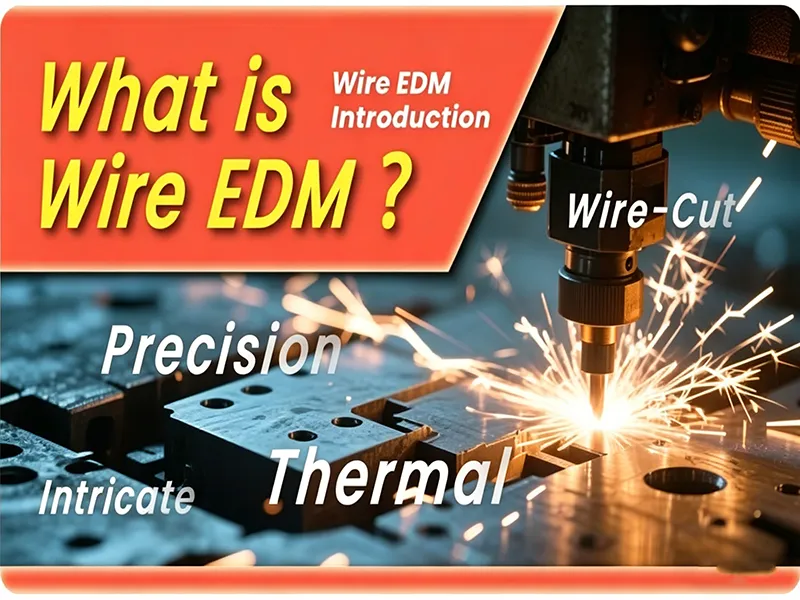
What Is Wire EDM?
Wire EDM (Wire Electrical Discharge Machining) is a precision metal cutting process that uses a thin, electrically charged wire as the cutting electrode,as explained in this Wire EDM tutorial. The wire is fed along a programmed path and produces rapid electrical sparks that melt or vaporize material from a conductive workpiece. Because the wire and workpiece are submerged in a dielectric fluid (usually deionized water) during cutting, there is no direct mechanical contact – only spark erosion. This non-contact machining causes no cutting force or tool deflection, enabling very tight tolerances and intricate features in hard or delicate parts. In contrast to conventional milling or turning, Wire EDM can cut extremely hard metals (such as hardened steel or carbide) and produce burr-free, complex contours that would be difficult or impossible with a mechanical tool.
How Wire EDM Cutting Works:
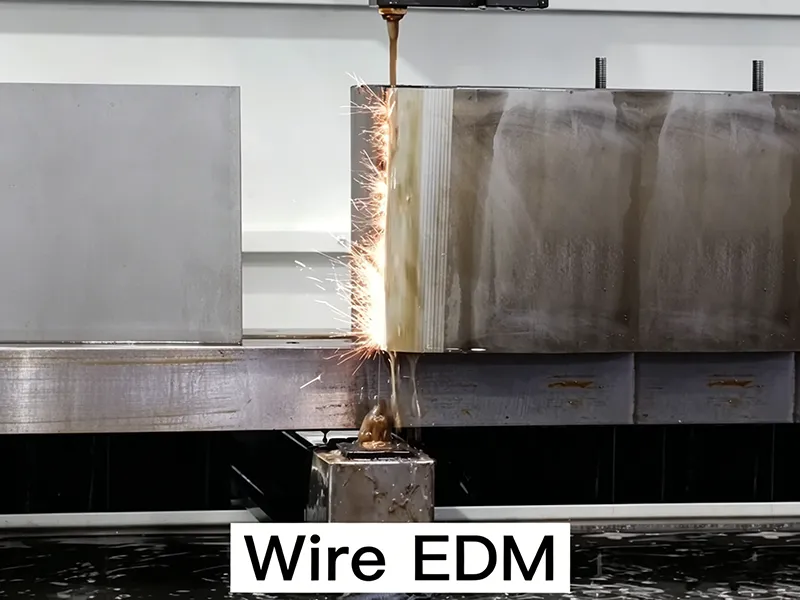
Wire EDM relies on controlled electrical discharges between the wire electrode and the workpiece. The workpiece and wire are both submerged in a dielectric fluid, which acts as an insulator until the voltage is high enough to break down the gap and create a spark. When the pulse generator applies a high-frequency pulse, a spark jumps the tiny gap between the wire and metal surface, generating intense heat that melts and vaporizes a microscopic bit of the workpiece. After each discharge, the dielectric fluid flushes away the molten particles, cooling the area. This cycle of spark-and-flush repeats many thousands of times per second as the CNC system slowly moves the wire along the programmed contour. Because the spark gap is maintained, the wire never touches the part – hence no physical cutting or forces occur during machining.
Electrical Discharge Process
During cutting, the power supply delivers pulses of electricity to the wire electrode, creating a high voltage difference between the wire and the workpiece. When the dielectric strength is overcome, a plasma channel forms and a spark discharges across the gap. This localized discharge heats a tiny spot of metal to its melting or vaporization point. The molten material is then carried off by the dielectric fluid, leaving behind a small cavity. Over many pulses, the wire erodes a continuous cut. Since this is a thermal erosion process, no mechanical force is used – the material is removed by heat alone.
Role of the Wire Electrode
The wire itself (typically brass, copper, or coated variants) serves as the cathode of the spark discharge. It is very thin (often 0.1–0.3 mm diameter) and is continuously fed from a spool to present fresh wire during cutting. The wire’s conductivity allows the electrical pulses to pass through it, and its strength lets it remain taut under high tension. Brass or zinc-coated brass wires are common because they balance cutting speed, precision, and cost. Because the wire is always moving, it does not wear down appreciably like a traditional tool; instead, each spark simply erodes the workpiece. Maintaining the correct wire tension and alignment via precise guides is crucial for accuracy and to prevent wire breakage.
CNC Control in Wire EDM Machining
A CNC (Computer Numeric Control) system guides the wire along the exact programmed path to form the desired profile. The CNC controller translates the CAD model of the part into precise, multi-axis motion instructions for the wire head. It also dynamically adjusts machining parameters – such as wire feed rate, pulse frequency, and gap control – based on feedback. This tight integration of computer control allows Wire EDM to produce complex geometries and accurate contours that would be extremely difficult with manual methods. Multi-axis Wire EDM machines can even taper the wire or cut angled features by coordinating multiple movements simultaneously.
Main Components of a Wire EDM Machine
Wire EDM machines consist of several key elements working together to cut the part. The main components are:
- Wire Electrode: A thin metal wire that acts as the moving electrode. The wire is loaded on spools and fed continuously through the machine. It is usually brass or copper and may be coated for better performance. The wire tension is controlled to keep it straight and steady during cutting.
- Power Supply: Generates and controls the high-frequency electrical pulses sent to the wire. It regulates the voltage, current, pulse duration, and frequency of discharges. These settings determine the cutting speed and surface finish. A high-quality power supply produces very consistent sparks for smooth machining.
- Dielectric Fluid System: A reservoir and filtration system for the dielectric (typically deionized water). The fluid is continually circulated around the work zone. Its purposes are to insulate the wire and workpiece until breakdown, to cool the cutting area, and to flush away debris created by the sparking process. Keeping the dielectric clean and properly pressurized is important for stable cutting.
- CNC Control System: The computer and CNC hardware that drives the machine. This “brain” of the EDM translates the design into motion: it controls the wire feed, the X/Y positioning stages (and any additional axes), and the spark parameters. The operator programs the part geometry and cutting strategy via CAD/CAM software, and the CNC system executes the toolpath precisely.
- Worktable and Guides: A rigid table or fixture holds the workpiece firmly in place during machining. The table may be flat or have rotary axes, depending on the machine. The wire guides (often made of ceramic) direct the wire at both the upper and lower ends of the cut. These guides keep the wire perpendicular and accurately positioned relative to the work. The wire guides, along with the tensioning system, ensure the wire stays taut and aligned, which is critical for dimensional accuracy.
Materials Suitable for Wire EDM Cutting
Wire EDM can only cut electrically conductive materials. Essentially any metal or conductive alloy qualifies. Typical materials include:
- Tool Steels: Hardened steel (e.g. A2, D2, H13) used for molds and dies – Wire EDM can cut these without losing hardness.
- Stainless Steels: Common grades like 303, 304, 316, and precipitation-hardening 17-4PH can be precision EDM-cut.
- Titanium and Nickel Alloys: High-strength alloys (Ti-6Al-4V, Inconel, etc.) that are very tough for traditional tools are readily machined by EDM.
- Carbides: Tungsten carbide (often coated with cobalt) and other cemented carbides are nearly impossible to cut conventionally, but EDM can shape them for nozzles or punches.
- Aluminum and Copper Alloys: Though softer, these conductive metals cut quickly by EDM and benefit from burr-free edges. Special care is needed to manage recast layer on very soft alloys.
- Graphite and Other Conductive Non-metals: Graphite and some conductive ceramics can also be wire-EDM machined.
No non-conductive materials (e.g. ceramics, plastics, wood) can be cut by EDM unless they are first made conductive (e.g. with a conductive coating). In practice, wire EDM is chosen for metal parts where traditional machining struggles, especially when material hardness or complexity is an issue.
Advantages of Wire EDM Cutting
Wire EDM offers several key benefits for precision manufacturing:
- Ultra-High Accuracy: Wire EDM can hold extremely tight tolerances, often on the order of micrometers. High-precision machines can achieve dimensional accuracy around ±0.001 mm. This makes the process ideal for parts that require exact fits or fine details.
- Complex Geometry Capability: The thin wire can cut intricate shapes, sharp internal corners, and very narrow slots that would be impossible with a rotating tool. It excels at complex 2D profiles, thin walls, and small radii.
- No Mechanical Stress: Since there is no contact between tool and workpiece, the part experiences no cutting forces. This eliminates mechanical distortion or deflection. Delicate and thin parts remain stable and undamaged.
- Hard Material Machining: Wire EDM easily cuts very hard or heat-resistant materials (hardened steels, titanium alloys, carbides, Inconel, etc.) without the need for pre-softening. Hardness does not dramatically slow the process, unlike in milling.
- Excellent Surface Finish: The EDM process often yields fine surface textures. Many parts require minimal secondary polishing. Also, the wire produces burr-free cuts and a very narrow kerf (typically 0.1–0.3 mm), minimizing wasted material.
- Repeatability: Once set up, Wire EDM runs very consistently, making it good for precise mass production of small parts (e.g. pins or probes with identical lengths and radiused ends).
Together, these advantages make Wire EDM a go-to method for tooling, aerospace, medical, and electronics industries where high precision and complex shapes are needed.
Limitations of Wire EDM Machining
Despite its strengths, Wire EDM also has drawbacks to consider:
- Conductive Only: The process only works on electrically conductive materials. Any non-metal or electrically insulating material cannot be cut unless specially treated.
- Slow Material Removal: Wire EDM is relatively slow compared to many conventional methods. Cutting relies on tiny sparks that remove small amounts of material per pass, so large volumes or very thick parts take significant time.
- Equipment & Operating Costs: EDM machines are specialized and expensive, and their consumables (wire and dielectric fluid) add cost. For simple geometries or high-volume parts where tolerances aren’t tight, cheaper methods (like mills or saws) may be more cost-effective.
- Dimensional Constraints: Wire EDM is best for through-cuts or parts that allow the wire to enter. It cannot easily machine blind pockets or features off the edge unless a starter hole is drilled. It is also not ideal for continuous long runs (like tubing cutoffs).
- Edge Rounding (Kerf): Because of the spark gap, internal corners may have a small radius (which often must be accounted for in the design). The cut’s geometric precision is extremely high, but corner radii are slightly larger than the wire diameter.
In summary, the technique trades speed and material flexibility for accuracy and capability on hard/complex parts. It excels when precision is paramount, but is not suited for every application, especially very large simple parts or nonconductive materials.
Wire EDM vs Conventional Machining
Wire EDM vs CNC Milling
CNC milling uses rotating cutting tools to mechanically remove material. Milling is very fast for bulk metal removal and works well on many materials. However, milling struggles with extremely hard alloys and intricate internal features. By contrast, Wire EDM excels in precision and hardness. According to industry sources, wire EDM fills the gap where milling has challenges with hardened materials or complex profiles. Milling is generally faster for rough cutting of softer metals, but wire EDM achieves much finer detail and sharper corners without tool deflection.
Wire EDM vs Laser Cutting
Laser cutting employs a focused light beam to vaporize material and can cut metals, plastics, wood and more. Laser is extremely fast and versatile, with no need for specialized tooling. It can also handle non-metallic materials. However, laser precision can be lower on thick or reflective metals, and the heat-affected zone is larger. Wire EDM is slower than laser but offers higher dimensional accuracy and a narrower kerf. Crucially, wire EDM can cut very hard or specialized conductive alloys that lasers may struggle with, and it leaves a cleaner edge on thick metal parts. Laser cutting works on almost any material (including non-metals), whereas wire EDM is limited to conductors. In practice, engineers choose laser for speed and material versatility, and wire EDM when maximum precision and material hardness are requirements.
Wire EDM vs Sinker EDM
Both are types of EDM but use different electrodes. Wire EDM uses a continuously fed wire and is ideal for cutting through parts (through-holes and 2D profiles). Sinker (die-sinking) EDM uses a shaped solid electrode (often graphite) that is plunged into the workpiece to form cavities or blind features. Sinker EDM is typically used for making molds, dies and cavities. Unlike sinker EDM, wire EDM requires a start hole or open edge for the wire but does not require custom electrodes. Wire EDM machines usually use deionized water as dielectric, whereas sinker machines often use hydrocarbon oil. In short, wire EDM is preferred for precise profile cutting, and sinker EDM is used for detailed 3D cavity work.
Common Applications of Wire EDM Cutting
Wire EDM is widely used in industries that demand fine precision and complex parts. Some common applications include:
- Mold and Die Making: Creating tooling like injection molds, stamping dies, and molds for plastics or metals. Wire EDM produces the fine cavities and intricate profiles required for these tools.
- Aerospace Components: Cutting hard superalloy parts (turbine blades, fuel nozzles, aerospace brackets) with complex shapes and tight tolerances.
- Medical Parts: Manufacturing medical implants, surgical tools, and micro-scale precision parts. The high accuracy and smooth finish of wire EDM is ideal for customized prosthetics, surgical inserts, and tiny components.
- Precision Tooling: Fabricating punches, fine gauges, and precision inserts. Even very hard materials (e.g. carbide dies) are machined for cutting or forming operations.
- Automotive Components: Producing precision gears, transmission parts, sensors, and prototypes. Wire EDM is used when small slots, holes, or hardened steels are involved.
- Electronics and Fine Metal Parts: Cutting slits, connector pins, or micro parts used in electronics. Industries like semiconductors and fine electromechanics rely on wire EDM for narrow gaps and microscopic accuracy.
In essence, any application that benefits from high precision, complex geometry, or hard conductive materials is a candidate for wire EDM, especially in these wire-cutting EDM applications.
When to Choose Wire EDM Machining
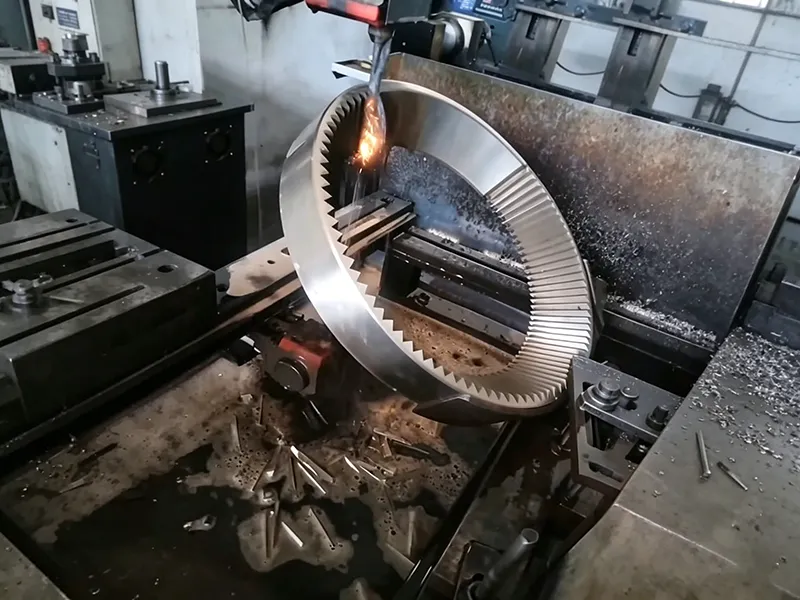
Wire EDM is especially advantageous when:
- High-precision contours are required: When tight tolerances, smooth surfaces, or intricate profiles are critical.
- Material is very hard or exotic: Parts made of tool steel, carbide, titanium, Inconel, etc., where conventional tooling cannot easily cut.
- Part geometry is complex: Internal slots, acute angles, and delicate features that are hard to mill or drill.
- Thin walls or small delicate parts: When mechanical clamping or tool forces might damage the part, the non-contact EDM method avoids distortion.
- Prototyping or low-volume production: The lack of custom tooling makes wire EDM cost-effective for prototypes or specialized parts requiring precision.
In short, engineers “reach for” wire EDM when conventional methods cannot reliably achieve the needed accuracy, surface finish, or feature geometry.
Factors That Affect Wire EDM Cutting Performance
Several parameters influence EDM speed, accuracy, and surface quality:
- Wire Type and Diameter: Thinner wires can cut finer detail but may break more easily, while thicker wires cut faster on large features. Coated wires (e.g. zinc-coated brass) can improve speed or surface finish.
- Electrical Settings: Pulse energy, duration (on/off time), and frequency determine erosion rate. Higher current pulses remove material faster but may roughen the surface. Modern CNC controls adjust these in real-time for optimal performance.
- Material Thickness and Conductivity: Thicker or less conductive materials cut more slowly. Very thin or warped parts may also require special fixturing.
- Flushing Conditions: The pressure and flow of dielectric fluid affect how well debris is cleared. Insufficient flushing can lead to arcing or uneven cuts.
- Machine Accuracy and Calibration: The precision of the machine’s guides, stages, and servo controls impacts final tolerances. Proper alignment and maintenance are important for repeatable accuracy.
By optimizing these factors (wire feed rate, spark parameters, flushing pressure, etc.), operators can balance cutting speed against surface finish and precision.
Summary
Wire EDM is a specialized, high-precision machining process in which a thin wire electrode cuts conductive materials by electrical discharges. The core principle is spark erosion: tiny sparks between the wire and workpiece melt away material, with a dielectric fluid cooling and flushing debris. This non-contact process yields extremely accurate parts (often micron-level tolerance) with intricate profiles and excellent surface finish. It works only on conductive materials (steel, titanium, carbide, aluminum, etc.), making it ideal for tooling, aerospace, medical, and electronics applications where tight tolerances and complex shapes are required. The lack of cutting forces means even very hard or delicate parts can be cut without distortion. In summary, wire EDM’s strength lies in precision and complexity – it is the go-to method for parts too difficult or precise for conventional machining.
FAQ
What is wire EDM used for?
Wire EDM is used to cut precise, complex shapes in conductive metals. It’s ideal for manufacturing components like fine molds and dies, aerospace parts, medical implants, electronic connector plates, and any parts with tight tolerances or intricate features.
What is wire EDM machining?
Wire EDM machining is a non-traditional process that uses a thin metal wire and controlled electrical sparks to erode a conductive workpiece. The wire, held under tension, serves as the electrode; sparks jump the gap and melt away material, shaping the part exactly to the programmed design.
How does wire EDM cutting work?
In wire EDM, the part and wire are submerged in a dielectric fluid. A high-voltage pulse causes a spark to bridge the small gap, melting and vaporizing a tiny part of the workpiece. The fluid then flushes away the eroded debris. The wire is slowly moved along the programmed path by CNC controls, repeating the spark-and-flush cycle until the cut is complete.
What materials can be cut by wire EDM?
Any electrically conductive material can be cut by wire EDM. Common materials include tool steels, stainless steels, titanium alloys, tungsten carbide, copper, aluminum, and even conductive ceramics. Non-metals like plastics or glass cannot be cut unless made conductive.
Is wire EDM more accurate than CNC milling?
Yes. Wire EDM generally achieves tighter tolerances than milling because there is no tool deflection or mechanical force. Precision wire EDM machines routinely hold micrometer-level accuracy (e.g. ±0.001 mm). Milling accuracy is typically limited by tool stiffness and size, so for ultra-fine features or true sharp corners, wire EDM is superior.
What are the advantages of wire EDM cutting?
Key advantages include very high precision, the ability to cut very hard or exotic metals, and the capability to produce intricate, burr-free profiles. Because cutting is done by electrical sparks, wire EDM imposes no mechanical stress on the part. It also typically yields an excellent surface finish, reducing or eliminating the need for secondary polishing.