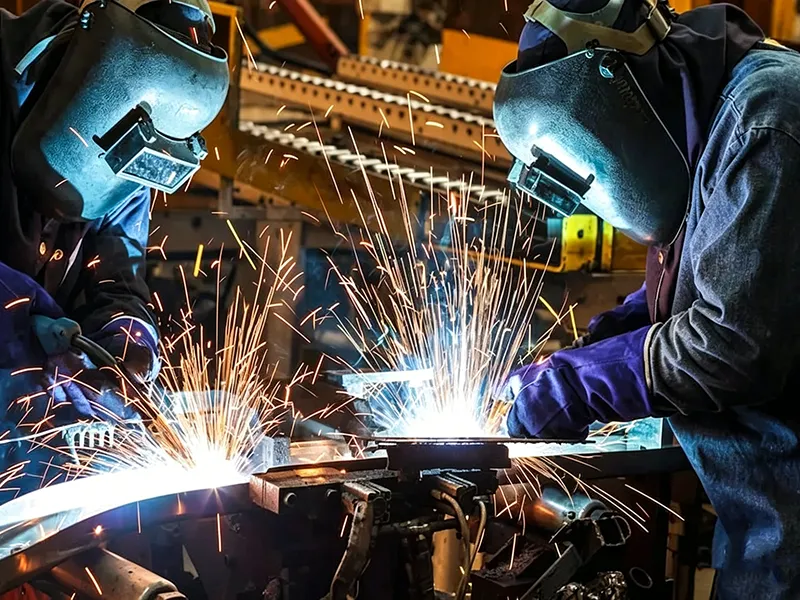
Welding is a craft that blends technical know-how with hands-on skill. Two of the most common arc welding processes are MIG (Metal Inert Gas) and TIG (Tungsten Inert Gas) welding. MIG uses a continuously fed consumable wire electrode and an inert shielding gas, making it versatile and fast. TIG welding, on the other hand, uses a non-consumable tungsten electrode and pure argon for shielding, giving the welder finer control and cleaner results. Many welders get torn between the two because each excels in different areas. In this article we’ll compare how MIG and TIG work, their weld quality, speed, cost, suitable materials, and typical uses. Ultimately, the “right” process depends on factors like material, thickness, appearance needs, strength requirements, budget, and production rate.
What Is MIG Welding?
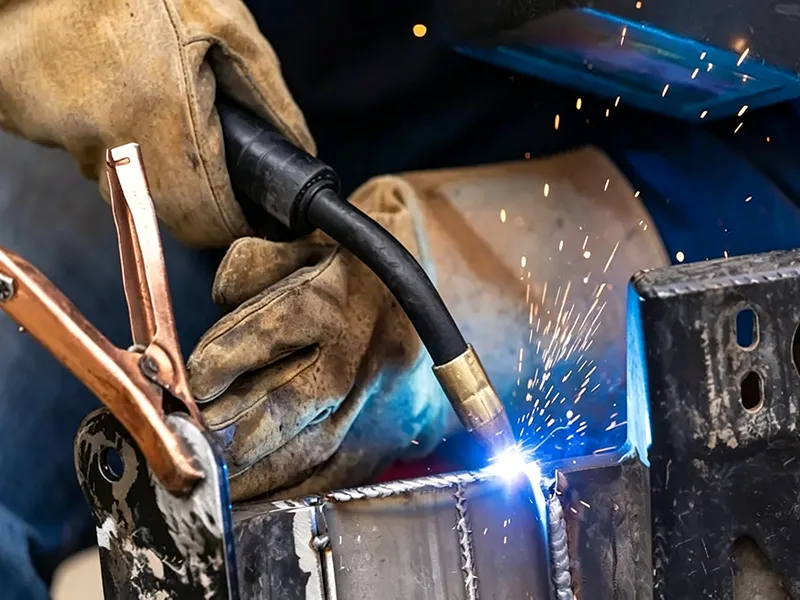
MIG welding (Metal Inert Gas) – also known as GMAW (Gas Metal Arc Welding) – is a semi-automatic arc welding process. It creates an electric arc between a continuously fed consumable wire electrode and the metal pieces being joined. As the arc strikes, the wire melts and fuses with the base metal, forming the weld. Simultaneously, a shielding gas (commonly a blend of argon and CO₂ for steel, or 100% argon for aluminum) flows through the gun to protect the molten weld pool from oxygen and nitrogen. MIG welding is known for its speed and adaptability – welders can quickly lay down consistent beads on a wide range of metals without stopping to change electrodes.
How MIG Welding Works
In MIG welding, the welder holds a gun that is connected to a wire feeder and power source. When you pull the trigger, the wire electrode is fed out of the gun tip automatically. An electric arc jumps between the wire and the workpiece, generating intense heat. The heat melts both the wire and the base metal, creating a pool of molten metal that solidifies into the weld joint. Meanwhile, the shielding gas (often a 75% argon/25% CO₂ mix) pours out around the arc, forming an invisible blanket that keeps contaminants out of the weld.
- The welding torch feeds filler metal (wire) continuously as you move.
- The arc melts the wire and base metal together into a puddle.
- The shielding gas protects the puddle from air, preventing oxidation.
- Because the wire feed is automated, the welder mainly needs to maintain correct torch angle and travel speed.
This automation makes MIG relatively easy to learn. It’s often recommended for beginners, as you only guide the gun – there’s no separate filler rod to worry about, and no foot pedal to master. The result is a process well suited to long welds and high-volume work. For example, in fabrication shops and manufacturing plants, MIG lets welders make long seams rapidly. The trade-off is that MIG welding tends to produce more spatter and requires some cleanup of the bead and surrounding area.
What Is TIG Welding?
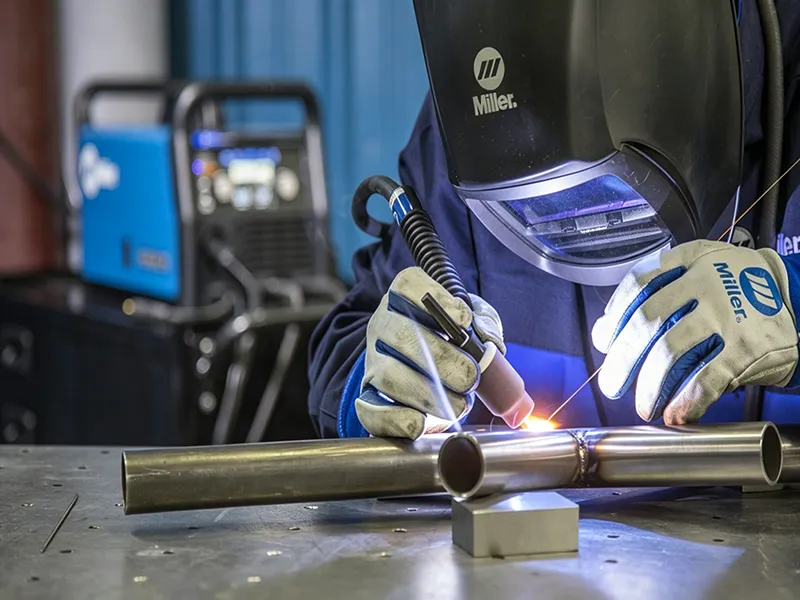
TIG welding (Tungsten Inert Gas), technically called GTAW (Gas Tungsten Arc Welding), uses a non-consumable tungsten electrode to create the arc. The tungsten electrode does not melt; instead, the welder manually adds filler rod into the puddle as needed. TIG always uses pure inert gas (usually argon) to shield the torch and weld zone. This combination – a stable arc with a clear view of the weld – gives TIG welding its signature precision and cleanliness.
In TIG welding, the welder typically uses two hands (and sometimes a foot pedal). The torch in one hand holds the tungsten electrode to produce the arc, while the other hand feeds a thin filler rod into the pool, if extra metal is needed. The argon gas flows through the torch and envelopes the arc. This makes the arc practically transparent (you can see the puddle clearly) and prevents oxygen from contaminating the weld. Because the tungsten electrode does not burn up, TIG allows precise control over heat input. Welders often use a foot pedal to gently ramp up and down the amperage, giving a smooth start and finish to each bead.
TIG welding is slower and more skill-intensive than MIG, but it excels in tasks requiring accuracy. You can weld very thin sections (like 16-gauge sheet metal or tubes) without making holes. TIG is also ideal for tough metals like stainless, titanium, or aluminum where a clean, uncontaminated weld is critical. The result is a weld bead that’s extremely neat – often described as a “stack of coins” – with virtually no spatter to clean up. This makes TIG the go-to for high-end fabrications, aerospace parts, and any work where appearance and strength of the weld are paramount.
MIG vs TIG Welding: Main Differences
At their core, the biggest contrast is speed and ease versus precision and finish. MIG welding is generally faster and easier; it feeds wire continuously and requires only one hand, so it’s great for quick, high-volume welding on thicker parts. TIG welding is slower but more precise; you hand-feed the filler rod and must coordinate torch, rod, and often foot pedal, which yields higher control and cleaner welds on thin or specialty materials.
- Electrode & Filler: MIG uses a consumable wire electrode that melts as part of the weld. TIG uses a non-consumable tungsten electrode, and any filler metal is added separately by hand.
- Shielding Gas: MIG typically uses a blend of argon/CO₂ or pure CO₂ (for steel). TIG usually uses 100% argon (or an argon mix) because the tungsten arc is sensitive to even trace oxygen or nitrogen.
- Ease of Use: MIG is easier to master. You pull a trigger and the machine feeds wire – one hand does the work. TIG requires two hands (plus sometimes a foot pedal) and cleaner preparation.
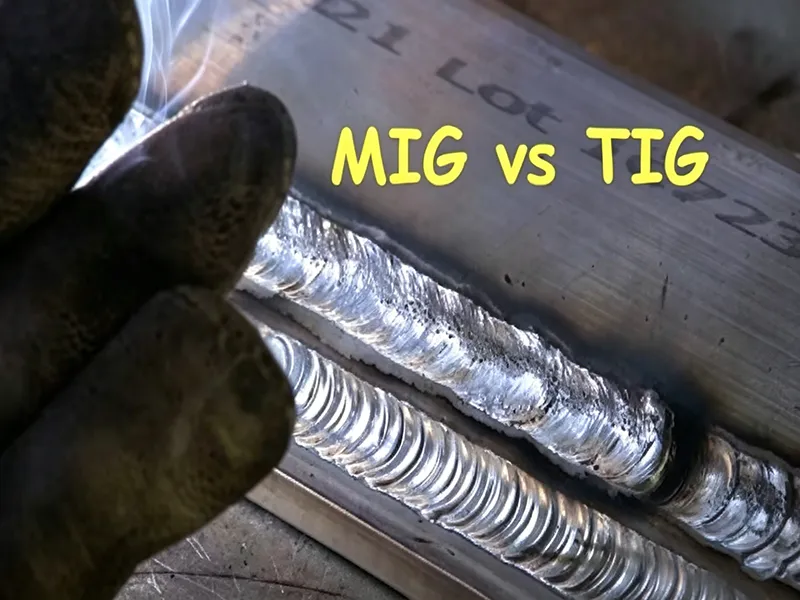
- Aesthetics: TIG welds look neater. They have almost no spatter and very uniform beads. MIG beads look good but usually have more ripple and some spatter around them.
- Cost: Generally, TIG is more expensive. TIG welds take longer (lower deposition rate) and require highly skilled labor. MIG machines and wire are usually cheaper than TIG torches and filler.
- Ideal Use: MIG is perfect for production, thicker materials, and joints where speed matters. TIG is best for delicate, visible, or high-quality welds and thin or exotic metals.
| Factor | MIG Welding | TIG Welding |
|---|---|---|
| Speed | Faster (continuous wire feed) | Slower (manual torch movement) |
| Skill Level | Easier (one-handed operation) | Harder (two hands + pedal) |
| Weld Appearance | Good (more spatter/cleanup) | Excellent (minimal spatter) |
| Precision | Medium (good for general work) | High (fine control on thin parts) |
| Cost | Lower (cheaper equipment & wire) | Higher (expensive power sources & gas) |
| Best For | Production, thick parts, structure | Thin parts, clean welds, high-end projects |
MIG Welding Advantages
- Faster Welding Speed: MIG’s continuous wire feed allows welders to lay metal down quickly. Long beads can be run without stopping to change electrodes, which is ideal for bulk manufacturing.
- Easier to Learn: MIG welding is more forgiving for beginners. You hold the gun in one hand, pull the trigger, and move along the joint. There’s no filler rod or foot pedal to juggle. This simplicity earns it nicknames like the “hot glue gun” of welding.
- High-Volume Production: In factories, MIG is a workhorse. Welders can complete long seams or many parts quickly, lowering labor costs per part.
- Thicker Materials: MIG handles medium and thick steel, stainless, and aluminum efficiently. The high deposition rate (melt-off of wire) means it can build up large welds fast. It’s great for frames, beams, and heavy structures.
- Versatility: MIG can weld steel, aluminum, stainless, and more (often with different gases or wires). It performs well in flat, horizontal, vertical, and overhead positions, making it adaptable to many scenarios.
MIG Welding Disadvantages
- Appearance: MIG welds usually aren’t as smooth as TIG welds. They tend to have visible ripple patterns and more spatter, requiring grinding or finishing for a polished look.
- Spatter and Cleanup: One downside is spatter – tiny droplets of molten metal that fly out of the weld. Spatter can stick to the workpiece and surroundings, so you often need to chisel or wire-brush it off after welding.
- Thin Metals: MIG’s powerful wire feed can easily burn through thin sheet metal if not controlled carefully. It’s harder to avoid warping or holes on very thin parts.
- Precision: For fine-detail or high-precision work, MIG is less ideal. The arc is broader and the wire feed speed is fixed, so it’s not suited for tiny welds or intricate joints.
- Position Limitations: The MIG gun and continuous wire can be bulky. In some overhead or tight-spot applications, a skilled TIG welder might find it easier to maneuver.
- Shielding Gas Needs: MIG welding needs a constant gas supply. Outdoors or in windy conditions, you may lose shielding gas unless you use special flux-cored wire.
TIG Welding Advantages
- Excellent Weld Appearance: TIG welds come out very clean and uniform. With almost no spatter, the bead can look like shiny stacked coins. This makes TIG perfect for visible joints and high-end products.
- High Precision and Control: TIG gives you fine control over the arc and filler, which is useful for complex precision parts that require careful heat control. You can weld tiny corners, complex shapes, or delicate thin-walled parts with precision. The ability to feather in heat and filler makes TIG ideal for intricate work.
- Thin Materials: Because you can dial down the heat, TIG is great for very thin metal. It dramatically reduces burn-through. Thin sheet metal, tubing, and delicate sections are easily handled by TIG without warping.
- Clean Welds: TIG produces virtually no slag or spatter. There’s little to no cleanup after welding – you often just brush the weld and it’s done. This is a big plus for assemblies that must be immaculate (like food equipment or medical devices).
- Exotic Materials: TIG is often the go-to for difficult metals (titanium, zirconium, magnesium alloys) and high-alloy stainless steels. The pure argon shield and precise arc make it easier to get a sound weld on these materials.
TIG Welding Disadvantages
- Slow Welding Speed: TIG is inherently slower because you feed the filler by hand and usually move more carefully. For large welds or production lines, this can make TIG much less efficient.
- Skill Required: TIG is one of the hardest welding techniques to master. Juggling the torch, filler rod, and often a foot pedal takes practice. Welders must keep the tungsten sharp and the joint perfectly clean.
- Higher Labor Cost: Because TIG welding takes longer and needs experts, the labor cost per part is higher. If time is money, TIG’s slower pace can be expensive.
- Equipment Cost: TIG machines (especially those for aluminum with AC power and pulse features) are more expensive. And you need high-purity argon gas (costlier than MIG gas blends) and consumable tungsten electrodes.
- Not Ideal for Big Jobs: On very large or outdoor jobs, TIG’s precision is overkill. An open jobsite with wind or a thick steel beam might be better tackled with MIG or stick welding.
MIG vs TIG Welding Strength
Weld strength depends on many factors (joint prep, welding parameters, material, etc.). In general, TIG welds can be very strong because the focused arc and steady heat produce a clean fusion. TIG beads tend to have fewer defects and good penetration relative to the bead width. MIG welds on thick sections, however, deposit more weld metal and can also achieve excellent strength after proper finishing (like adding weld passes or grinding grooves for better penetration). In practice, both processes can make equally strong joints when done right. For a thin, precision piece, TIG’s strong, clean weld might outperform a MIG weld. For heavy steel parts, MIG will usually be more efficient at producing a strong structural weld.
MIG vs TIG Welding Speed
MIG wins in speed. The automatic wire feed and ability to make long, continuous beads mean MIG welders work faster overall. TIG welding is like fine craftsmanship – you often move at half or less the speed of MIG, carefully feeding rod. So if you have long seams or high-volume work, MIG will get it done quicker. TIG’s slower speed is acceptable (and even necessary) for precision tasks, but on big projects it’s simply more time-consuming.
MIG vs TIG Welding Cost
Equipment Cost
MIG equipment is generally cheaper. Basic MIG welders and wire supplies cost less than comparable TIG units and rods. MIG guns and feeders are simpler devices. TIG machines (especially those with advanced features like AC balance for aluminum) and consumables (tungsten electrodes, high-end torch kits) add up to a higher upfront cost.
Labor Cost
Because MIG is easier and faster, the labor cost per weld tends to be lower. A production welder can knock out more MIG welds per hour, lowering labor expense. TIG requires more time and skill, so per-hour welding charges are higher.
Post-Processing Cost
MIG welds may require more cleanup (grinding spatter, dressing beads), which adds a bit to the overall time/cost. TIG welds are cleaner with almost no cleaning needed, saving on finishing costs – but remember the initial TIG weld cost was higher due to time.
MIG vs TIG Welding for Different Materials
- Steel: MIG is excellent for carbon steel structures and frames; it handles thick steel easily. TIG is chosen for precision steel work, thin gauge, or where appearance (like stainless railings) is important.
- Stainless Steel: TIG often takes the lead here for thin or visible stainless work (like exhausts, sanitary pipes) because it avoids contamination and leaves a shiny bead. MIG (using argon/CO₂) is used for heavier gauge stainless or where speed matters more than finish.
- Aluminum: TIG is typically best for aluminum, especially thin sheets or critical welds, because TIG’s AC balance cleans the aluminum oxide and the welder can control heat gently. However, for thicker aluminum (like heavy castings or structural parts), MIG (with special equipment) can join it faster. MIG aluminum welding uses a spool gun or push-pull feeder with 100% argon.
- Titanium: TIG is the standard choice. Titanium must be welded in a very clean, inert environment, and TIG’s argon shield and precise arc are well-suited. MIG is rarely used on titanium due to gas and contamination issues.
- Other Metals: For copper, nickel, or exotic alloys, TIG usually has the advantage of control and cleanliness. MIG can weld many metals too, but welders typically reserve TIG for the most demanding materials.
MIG vs TIG Welding for Thin and Thick Materials
- Thin Materials: TIG is the clear choice. Its pinpoint arc and low amperage (with careful control) reduce the risk of burning through or distorting thin metal. MIG can weld thin metal, but it’s easy to overheat it. In most cases, for sheet metal, tubing, and anything delicate, TIG gives a better result.
- Thick Materials: MIG is more efficient for thick plates and sections. The high deposition rate means you can fill large joints faster. For multi-inch steel or big aluminum pieces, MIG (or flux-core MIG) will weld much quicker than TIG with comparable strength.
MIG vs TIG Welding Appearance
TIG weld beads are generally more aesthetically pleasing. They are uniform, shiny, and free of spatter, often requiring only a quick polish. If the weld will remain exposed and appearance matters, TIG is usually preferred. MIG welds have a coarser look – you’ll see ripples and possibly some discoloration or spatter droplets around the joint. For parts that will be painted, plated, or otherwise finished over, MIG’s appearance is often “good enough,” but if the naked metal matters or needs controlled surface finishing, go with TIG.
MIG vs TIG Welding Applications
- Common MIG Applications: Automotive repair (frame work, body panels), structural steel fabrication (beams, frames), metal furniture and fixtures, industrial manufacturing (ducts, appliances), and anywhere thick plates or quick welds are needed. MIG is also used in shipbuilding, heavy equipment repair, and agricultural equipment maintenance – basically, any place where durable welds are needed fast.
- Common TIG Applications: Aerospace components, automotive motorsports (exhausts, roll cages), custom bike frames, artistic metalwork, medical/food equipment (stainless tubing), and precision industrial parts. Essentially, TIG is used whenever weld appearance and exactness are critical, or the materials are thin or reactive.
MIG vs TIG Welding for Manufacturing
In a manufacturing setting, MIG welding is typically chosen when the priority is production efficiency and cost. It’s well-suited to high-volume, large-scale welding where throughput and labor efficiency are key. Factories will use MIG for the main welds on thick steel or for parts that can be coated after welding. TIG welding is used for specialized sections or finishing stages – for example, welding thin aluminum chassis components, or final stitch welds on products that must look perfect. Often, a combination is used: MIG for the bulk welds and TIG for critical details.
Which Is Better: MIG or TIG Welding?
Neither is universally “better” – it’s about the right tool for the job.
- Choose MIG if you need speed, cost-effectiveness, and are working with thicker metal or hidden joints. MIG is great for structural steel, frames, and any application where production speed outweighs weld looks.
- Choose TIG if you need precision, top-notch weld quality, and are working with thin or exotic metals. TIG is the go-to for stainless or aluminum products where the weld is visible or must meet strict standards.
For example, for a bulky steel gate, MIG would likely be better – it can be welded quickly and painted afterward. For a sleek stainless handrail, TIG would be preferable to give that smooth, polished seam.
How to Choose Between MIG and TIG Welding
When deciding between MIG and TIG, consider:
- Material Type: What metal are you welding? Aluminum and titanium often favor TIG; common steels and thicker parts favor MIG.
- Material Thickness: Very thin (TIG) vs. thick (MIG).
- Weld Appearance: Does the seam need to look flawless (TIG)? Can it be hidden or cleaned up later (MIG)?
- Production Volume: Large runs and long beads (MIG); small batches and short precision welds (TIG).
- Budget and Time: MIG usually costs less and is faster; TIG costs more in labor and time.
- Available Skill Level: Do you have experienced TIG welders? If not, MIG might be the safer starting point.
- Post-Weld Processes: If you can sand/paint, MIG’s rougher bead may be okay. If no post-processing is allowed, TIG’s clean weld is advantageous.
Often, projects will use both methods in different stages or on different parts, based on these factors.
Common Mistakes When Comparing MIG and TIG Welding
- Assuming one is always stronger: In reality, both can make strong welds. TIG is often seen as stronger because it’s neat, but a good MIG weld on thick material can be just as strong.
- Thinking MIG is “low quality” only: MIG can produce very good welds; it just may need a bit more finishing. It’s not automatically “bad” – it’s simply different.
- Focusing only on equipment cost: MIG machines are cheaper, but remember to consider labor and finish costs. TIG’s higher skill requirement and time per weld can outweigh cheap gear.
- Ignoring material thickness: Using MIG on a very thin sheet without adjustment will cause burn-through. Using TIG on a very thick plate will waste a lot of time.
- Neglecting weld position: MIG guns can be heavy and tricky overhead; TIG’s lighter torch and control might be easier in tight spots once you have the skill.
- Forgetting about shielding gas in outside work: MIG’s gas can blow away outside, so people sometimes choose flux-cored MIG outdoors. TIG’s pure argon is also at risk, so setting matters.
Always match the process to the application, material properties, and machining materials rather than jumping to the popular choice.
MIG vs TIG Welding: Quick Selection Guide
| Requirement | Recommended Process |
|---|---|
| Fast, high-volume production | MIG |
| Clean, high-quality appearance | TIG |
| Thin metal (e.g. <1/8″) | TIG |
| Thick metal and structure | MIG |
| Lower overall cost | MIG |
| Highest precision | TIG |
| Aluminum sheet | TIG |
| Steel frames | MIG |
| Beginner-friendly | MIG |
| Exotic metals (Ti, Cu) | TIG |
Summary
MIG welding and TIG welding each have their place. MIG is faster, easier, and more cost-effective for general fabrication, thick plates, and high-volume work. TIG is slower and requires more skill, but it yields extraordinary weld quality and precision on thin or special metals. The choice isn’t about which is “better” overall, but which is better for your specific project. Consider the material, thickness, appearance needed, and budget. Often, savvy welders use both: MIG where speed rules, and TIG where finesse is required.
FAQ
What is the main difference between MIG and TIG welding?
MIG uses a consumable wire electrode and is generally faster and easier to run. TIG uses a non-consumable tungsten electrode and separate filler rod, giving tighter control and cleaner welds.
Is MIG welding stronger than TIG welding?
Both can produce very strong welds. TIG often makes stronger-looking welds on thin materials because of its focused arc and clean technique. On thick structural pieces, MIG can deposit more weld metal and also be extremely strong. In practice, if done correctly, neither process has an inherent strength disadvantage.
Is TIG welding better than MIG welding?
“TIG better” depends on the job. TIG is better for precision, appearance, and thin metals. MIG is better for speed, cost, and thicker metals. Each has its advantages – choose based on the project needs.
Which is easier to learn, MIG or TIG welding?
MIG is much easier to start with. You pull the trigger and go – only one hand needed and the machine feeds wire automatically. TIG welding requires coordinating two hands (and often a foot pedal), so it’s more challenging for beginners.
Which welding process is better for aluminum?
For thin aluminum, TIG is usually better. It avoids burn-through and deals with aluminum oxide effectively using AC output. For thicker aluminum, MIG (with a proper spool gun or push-pull setup) can weld it faster, though it often requires heavier equipment.
Which welding process is better for stainless steel?
TIG is often chosen for thin or visible stainless welds because it keeps the weld very clean and shiny. MIG stainless works for thicker sections where speed is more important than appearance. If the stainless weld will be exposed and must look smooth, TIG is preferable.
Should I choose MIG or TIG for custom metal parts?
If the custom part is thin, decorative, or made of exotic metal, TIG is usually the choice. If the part is heavy, structural, or will be finished/painted, MIG may be more practical. Many custom builders use both: MIG for most of the build, then TIG for final fit-up and detailing.