If you are asking is titanium magnetic, the short answer is this: titanium is usually treated as a non-magnetic metal in everyday engineering and manufacturing, because an ordinary magnet typically will not stick to it. The more precise scientific answer is that titanium is paramagnetic, which means it can respond weakly to an external magnetic field, but not in the strong, obvious way that iron or carbon steel do. One official Ti-6Al-4V datasheet, for example, lists magnetic permeability at about 1.00005 and describes the alloy as nonmagnetic, which is why titanium is commonly grouped with low-magnetic-response materials in practice.
That distinction matters because many readers use “magnetic” to mean “a hand magnet sticks to it,” while materials scientists use more specific categories such as ferromagnetic, paramagnetic, and diamagnetic. For titanium, the practical answer and the scientific answer are both useful: no, Titanium is not magnetic like steel, but yes, it can still show a very weak magnetic response under an applied field, while still being valued as one of the strongest metals for lightweight applications.
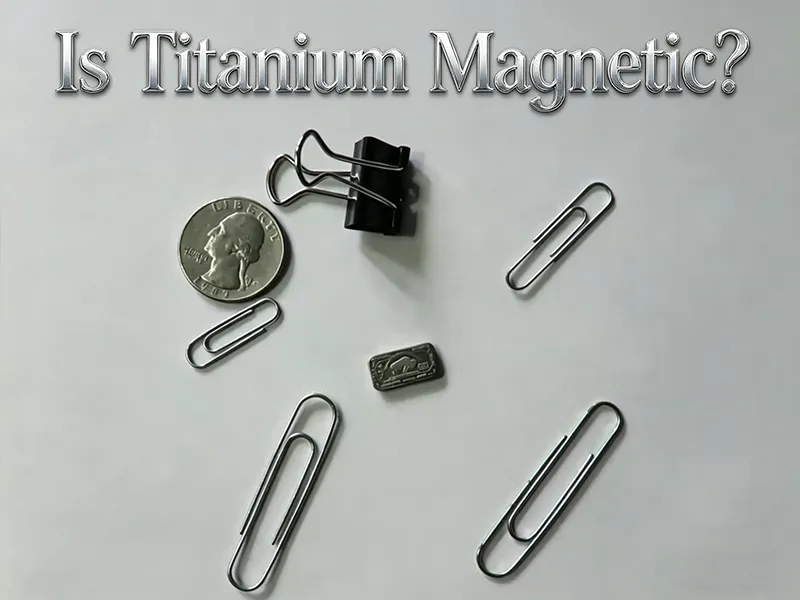
Is Titanium Magnetic?
In normal conditions, commercially pure titanium and most common titanium alloys are not magnetic in the way people usually mean the term. A shop magnet, refrigerator magnet, or magnetic pickup tool will normally show little to no attraction. That is why titanium is widely described in industry as a non-magnetic or low-magnetic-response material. A peer-reviewed implant-safety source describes titanium as a paramagnetic metal that is only weakly magnetized by an external magnetic field, and official alloy data for Ti-6Al-4V similarly characterizes it as nonmagnetic.
At the same time, saying titanium is “non-magnetic” does not mean it has absolutely no magnetic behavior. It means its response is so weak that, in ordinary use, it does not behave like a ferromagnetic material. That is a critical difference. Ferromagnetic metals such as iron, nickel, and cobalt have large magnetic moments and can be magnetized easily; titanium does not belong in that category.
So if your core question is “is titanium magnetic or non-magnetic?”, the practical answer is: titanium is generally considered non-magnetic for real-world use, but technically it is weakly paramagnetic rather than perfectly magnetically inert.
Why Titanium Is Usually Considered Non-Magnetic
Titanium and paramagnetism
The reason titanium confuses so many people is that there are several kinds of magnetic behavior. Ferromagnetic materials produce the kind of strong attraction most people recognize immediately. According to National Institute of Standards and Technology, ferromagnetic metals such as iron, nickel, and cobalt have large magnetic moments, while peer-reviewed titanium literature describes titanium as paramagnetic, meaning it is only weakly magnetized when an external magnetic field is present. In other words, titanium can respond, but the response is small.
This is why titanium does not behave like mild steel, tool steel, or many iron-based alloys. Those materials can show clear magnetic attraction because their internal magnetic behavior is much stronger. Titanium lacks that kind of strong ferromagnetic response, so it does not become the kind of “sticky” metal people associate with magnets.
Why a magnet usually does not stick to titanium
A hand magnet usually fails the “stick test” on titanium simply because the magnetic force is too small to produce obvious attraction under everyday conditions, which is consistent with published TIMETAL 6-4 magnetic permeability data. That is also consistent with official Ti-6Al-4V property data showing permeability extremely close to 1, which is very near the baseline behavior expected for a low-response metal. In plain English, titanium does not give the magnet enough to grab onto in a dramatic way.
This is also why people often misclassify titanium by sight. Gray or silver-colored metals can look similar even when their magnetic behavior is very different. Titanium, stainless steel, aluminum, and coated steels can all look superficially alike, but they do not behave the same around a magnet. So appearance alone is a poor guide.
How Titanium Interacts With Magnetic Fields in Practice
Static magnetic fields and changing magnetic fields are different
One of the biggest misconceptions around titanium magnetic properties is the idea that a metal must either be “magnetic” or “not magnetic” in every sense. Reality is more nuanced. In a static magnetic field, titanium’s response is weak because it is paramagnetic. In a changing magnetic field, however, conductive metals can interact through eddy currents. National Institute of Standards and Technology explains that time-varying magnetic fields interact with metallic objects by inducing eddy currents on their surfaces, and those currents modify the incident field. That is an electromagnetic interaction, but it is not the same thing as ferromagnetic attraction.
That difference helps explain why titanium may still matter in metal detectors, MRI imaging, or other electromagnetic environments even though a simple magnet does not stick to it. A non-sticking metal can still influence imaging quality, local fields, or detector response because conductivity and magnetic susceptibility are not the same property.
What titanium looks like in real life
In real-world parts, titanium is commonly treated as a low-magnetic-response engineering metal. That is why you see it described this way in medical, aerospace, and corrosion-critical applications. Studies comparing implant materials have repeatedly found that titanium creates less MRI artifact than stainless steel, even though artifact is not eliminated completely. In one PubMed-indexed study, titanium alloy screws consistently produced smaller MRI artifacts than stainless steel screws; in another, titanium caused the least artifact among the metallic implant materials tested.
That is the practical takeaway most readers need. If you hold a magnet to a titanium fastener, implant component, or structural part, you should not expect the strong pull you would get from carbon steel. But in high-field or imaging environments, titanium is still not “invisible.” It may cause local artifact or interact weakly with the field, just much less aggressively than ferromagnetic metals do.
Common myths about titanium magnetism
Myth: Titanium is magnetic like steel.
This is false. Steel and iron-based materials are often ferromagnetic, while titanium is generally weakly paramagnetic. That is why the everyday magnet test gives such different results.
Myth: If titanium is non-magnetic, it must be weak.
Magnetic behavior and mechanical strength are not the same thing. Official sources from U.S. Geological Survey and NASA both describe titanium’s value in terms of its high strength-to-weight ratio, which is one reason it is used in aerospace and other demanding environments.
Myth: All gray metals behave the same around magnets.
Also false. Industry guidance on stainless steels notes that austenitic stainless steels are non-magnetic, while ferritic and martensitic stainless steels are magnetic. Titanium and aluminum are also commonly treated as low-response metals in practice, but they are not interchangeable materials.
Myth: Titanium never interacts with magnetic fields.
False again. Titanium does not attract magnets like steel, but conductive metals in changing magnetic fields can still develop eddy currents, and titanium implants can still create MRI artifact even when they are safer and less disruptive than stainless steel implants.
Titanium Compared With Steel, Stainless Steel, and Aluminum
A useful way to answer is titanium magnetic is to compare it with the metals people confuse it with most often:
| Material | Typical magnetic behavior in practice | What an ordinary magnet does |
|---|---|---|
| Titanium | Weakly paramagnetic / low magnetic response | Usually does not stick |
| Iron or carbon steel | Ferromagnetic | Usually sticks strongly |
| Austenitic stainless steel | Usually non-magnetic | Often little or no attraction |
| Ferritic or martensitic stainless steel | Magnetic | Can attract a magnet clearly |
| Aluminum | Low-response, commonly treated as non-magnetic in daily use | Usually does not stick |
This comparison reflects the standard descriptions of titanium as weakly paramagnetic, iron and nickel as strongly magnetic metals, austenitic stainless steels as non-magnetic, ferritic and martensitic stainless steels as magnetic, and aluminum as another metal that is commonly treated as non-magnetic in ordinary handling.
The material choice, however, is not only about magnetism. Titanium is widely valued because of its high strength-to-weight ratio and corrosion resistance, while aluminum is even lighter, and steel families often offer different balances of stiffness, strength, cost, and fabrication convenience. That is why two metals can both appear “non-magnetic” in a quick test but still serve very different engineering purposes.
This is especially important when comparing titanium with stainless steel. Some stainless grades are intentionally chosen when magnetism is acceptable or even useful, while titanium is selected when engineers want a combination of low magnetic response, corrosion resistance, and strength at relatively low weight.
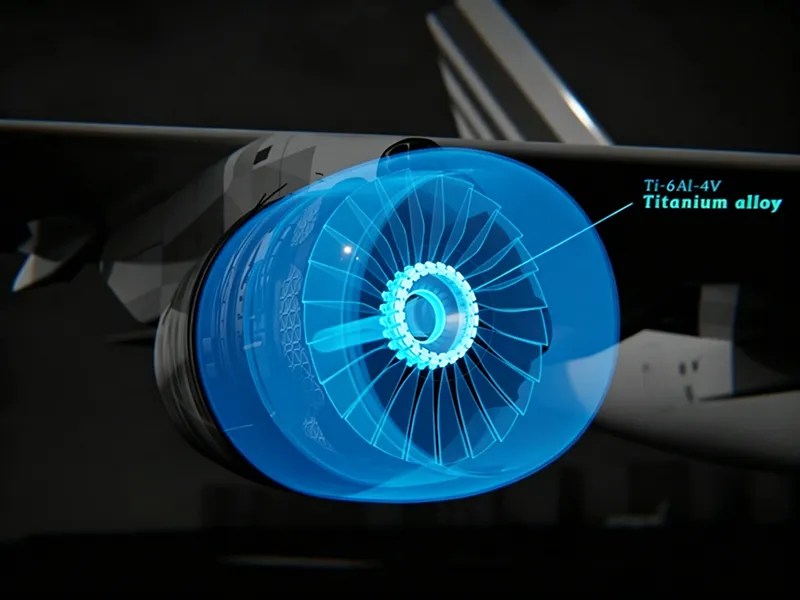
Why Titanium’s Low Magnetic Response Matters
Medical implants and imaging
One of the clearest reasons people ask is titanium magnetic is medicine. Titanium and titanium alloys are common implant materials because of their biocompatibility, corrosion resistance, and relatively low magnetic susceptibility. Peer-reviewed literature notes excellent biocompatibility for commercially pure titanium and many titanium alloys, and MRI studies consistently show fewer artifacts from titanium than from stainless steel implants.
That said, low magnetic response does not automatically mean every titanium device is universally MRI-safe under all conditions. Food and Drug Administration guidance says devices used in the MR environment should be tested and labeled appropriately, and FDA terminology distinguishes MR Safe, MR Conditional, and MR Unsafe devices. The agency’s guidance also states that MR Safe items contain no metal, which means titanium implants are typically evaluated through the more specific device-labeling framework rather than assumed to be universally safe by default.
That is the nuance many SEO articles miss. Titanium is often a good material for imaging-adjacent medical use because it is non-ferromagnetic and low in artifact compared with many steels, but device geometry, fixation, field strength, and manufacturer labeling still matter. FDA also notes that it is not aware of adverse events reported for MRI or X-ray procedures with dental implants, while also warning that implants can distort imaging. In practice, the main issue is often image artifact, not the dramatic magnetic pull people imagine.
Aerospace, marine, and corrosive industrial service
Titanium’s low magnetic response is only one part of its appeal. Official sources from the U.S. Geological Survey and NASA emphasize titanium’s high strength-to-weight ratio, while titanium industry references highlight its performance in corrosive environments. That combination is why titanium appears in aerospace systems, marine hardware, harsh chemical-service equipment, and custom CNC machining projects.
In those environments, low magnetic response can be a valuable supporting property. It may reduce unwanted magnetic interference compared with ferromagnetic steels, while the main material advantages still come from low weight, corrosion resistance, and strong mechanical performance. In other words, magnetism is not always the primary reason titanium is chosen, but it can be an important bonus in sensitive or specialized systems.
Consumer and performance products
Titanium is not limited to high-end industrial use. Official and industry references point to consumer goods and performance products as well. Titanium shows up in areas such as eyewear, wearables, and other consumer products because the same combination of properties that helps in engineering, namely light weight, durability, corrosion resistance, and low magnetic response, can also improve everyday products.
For the average buyer, the headline benefit may not be “this product is non-magnetic.” It may be “this product is light, durable, and corrosion-resistant.” But underneath those benefits is the same material reality: titanium behaves very differently from iron-based magnetic metals.
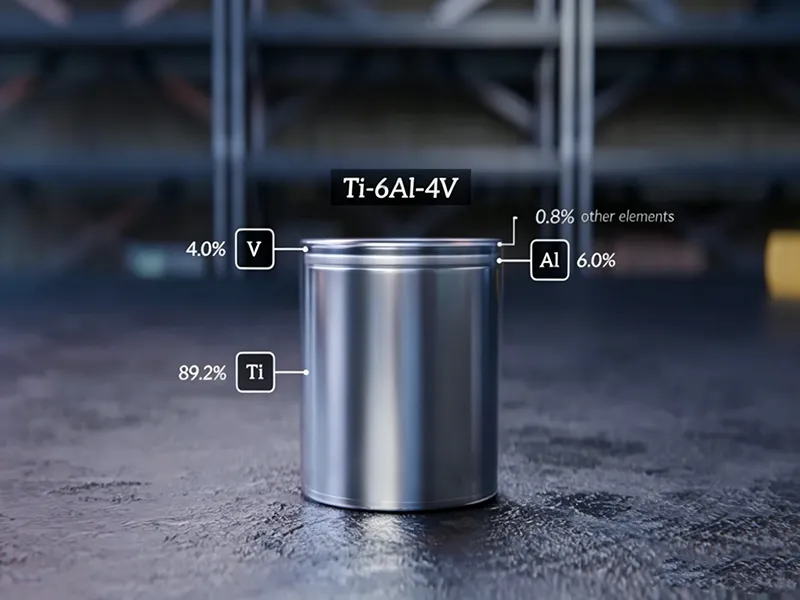
Do Titanium Alloys Change Magnetic Behavior?
Pure titanium and titanium alloys are not exactly the same material, so the follow-up question are titanium alloys magnetic is a good one. The answer is that most common titanium alloys still remain low-magnetic-response materials in normal use, even though the exact magnetic behavior can vary slightly with composition and microstructure. An official Ti-6Al-4V datasheet explicitly calls the alloy nonmagnetic and lists a permeability of about 1.00005, which is very close to magnetically neutral behavior in practice.
Research in biomedical materials also shows that alloy design can matter. Recent work has focused on developing titanium-based implant materials with even lower magnetic susceptibility to reduce MRI artifact further. That tells us two things at once: first, common titanium alloys are already relatively low-response; second, alloy chemistry can still nudge the magnetic response up or down at the margin depending on the application.
That is why a simple magnet test should be treated as screening, not proof. If a magnet sticks strongly to a supposed titanium object, the part is likely not bulk titanium, or it may be a mixed assembly with a ferromagnetic insert, clip, coating, or fastener. But if a magnet does not stick, that still does not prove the metal is titanium, because aluminum and some stainless steels can also appear non-magnetic in casual testing.
For reliable identification, manufacturing and recycling operations use positive material identification methods such as XRF. XRF analyzers are used to identify the elemental composition or alloy grade of a sample across manufacturing, scrap sorting, and quality control workflows, and titanium is one of the detectable elements. That makes XRF a far better method than relying on magnetism alone.
If you are trying to distinguish titanium by hand, the best practical rule is this: magnetism can rule titanium out, but it cannot confirm titanium by itself. Weight, material certification, alloy markings, and instrument-based analysis are better ways to verify what the metal really is before you send your drawing for a quote.
Summary and FAQ
So, is titanium magnetic? In practical terms, no, not like steel. In scientific terms, titanium is weakly paramagnetic, which means it can respond slightly to an external magnetic field, but not strongly enough for a normal magnet test to show obvious attraction. That is why titanium is widely described as non-magnetic in engineering, medicine, and manufacturing, even though it is not perfectly magnetically inactive in the strict physics sense.
Titanium’s low magnetic response matters because it combines with other valuable properties: high strength-to-weight ratio, corrosion resistance, and biocompatibility. Those traits make titanium useful in medical implants, aerospace hardware, corrosive-service equipment, and selected consumer products. Still, low magnetic response does not automatically make every titanium device universally MRI-safe; device labeling, geometry, and use conditions remain important.
Is titanium magnetic or non-magnetic?
Titanium is usually treated as non-magnetic in practice, because an ordinary magnet typically does not stick to it. Technically, it is paramagnetic, meaning it has a weak positive response to an applied magnetic field rather than the strong ferromagnetic behavior seen in iron-based metals.
Why does a magnet not stick to titanium?
A magnet usually does not stick because titanium’s magnetic response is too weak to generate the kind of attraction you see with steel. Official alloy data for Ti-6Al-4V shows permeability very close to 1, and peer-reviewed sources describe titanium as only weakly magnetized by an external field.
Can titanium interact with a magnetic field?
Yes. Titanium can respond weakly to a static magnetic field because it is paramagnetic, and it can also interact with changing magnetic fields through induced eddy currents because it is a conductive metal. That interaction is different from ferromagnetic attraction.
Are titanium alloys magnetic?
Most common titanium alloys are still considered low-magnetic-response or nonmagnetic in practical use. One official Ti-6Al-4V datasheet explicitly describes the alloy as nonmagnetic, although alloy design can slightly affect magnetic susceptibility depending on the application.
Is titanium good for low-magnetic applications?
Yes. Titanium is often a strong choice when low magnetic response is important, especially when that requirement must be combined with corrosion resistance, biocompatibility, or a high strength-to-weight ratio. That is one reason it is widely used in implants and aerospace-related applications.
How can you tell if a metal is titanium?
A magnet test is only a first filter. If a part is strongly magnetic, it is probably not titanium. But if it is not magnetic, it could still be aluminum or some stainless steels. For reliable confirmation, manufacturers use material certificates or positive material identification tools such as XRF, which identify alloy chemistry directly.