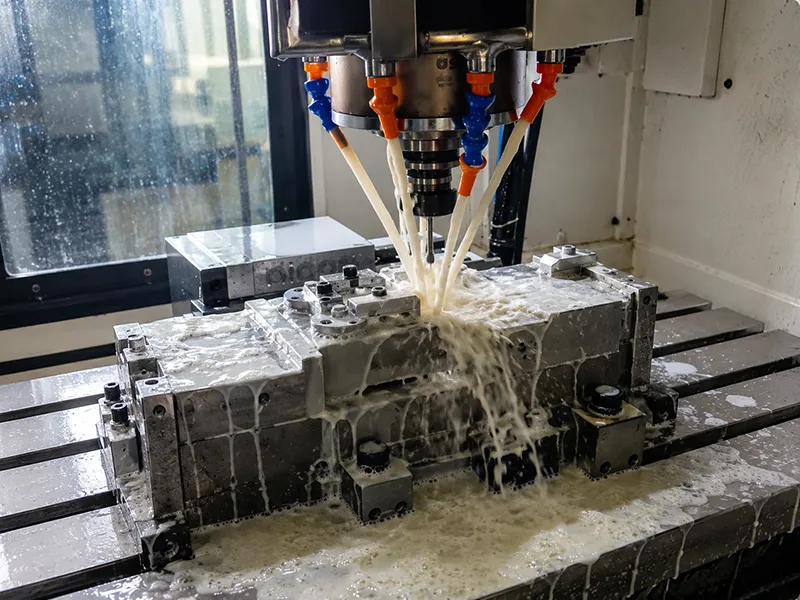
Coolant selection has a direct effect on CNC machining performance because the fluid at the cutting zone must remove heat, reduce friction, evacuate chips, and help protect the machine, tool, and workpiece from corrosion or staining. When coolant chemistry or delivery is mismatched to the job, shops commonly see faster tool wear, unstable cutting, poor surface finish, foam, odor, rust, residue, or cosmetic defects on finished parts. Just as important, even a well-chosen coolant can underperform if concentration, water quality, filtration, nozzle aim, pressure, circulation, or sump hygiene are poorly controlled. In real production, the best CNC coolant is not universal; it depends on the material being machined, the cutting operation, the machine and tooling, the cutting speed, and the required finish. This guide explains the main coolant types and shows how to select, apply, and maintain them for stable machining results.
What Is CNC Coolant and Why Is It Used?
CNC coolant is a fluid supplied to the cutting zone during machining. Depending on the application, it may be delivered externally, through the spindle, through the tool, as directed high-pressure jets, or as a fine mist or MQL stream. Its job is not limited to “cooling”: in practice, coolant can also lubricate the tool–workpiece interface, flush chips out of the cut, help maintain surface quality, and reduce corrosion risk inside the machine and on finished parts. Some operations depend more heavily on heat removal, while others depend more on lubricity and chip evacuation.
Main Functions of CNC Coolant
The main functions of CNC coolant are to remove heat from the cutting zone, reduce friction between the tool and the material, wash chips away from the cutting edge, improve tool life, support a better surface finish, reduce built-up edge, and help protect machines and parts from corrosion. The official Sandvik cutting-fluid application guidance provides additional information about cooling, lubrication, chip evacuation, coolant pressure, and nozzle positioning. Sandvik notes that chip evacuation, cooling, and lubrication are the primary functions of cutting fluid in turning and boring, while Haas states that correctly maintained coolant improves part finish, lengthens tool life, and protects machine components from rust and damage.
Coolant is important, but it is not a cure for poor process fundamentals. Troubleshooting guidance from Sandvik and Haas consistently shows that worn tools, incorrect cutting data, excessive overhang, poor geometry, unstable workholding, and chatter can all cause poor finish and short tool life even when coolant is present. In other words, coolant should be treated as part of the machining system, not as a substitute for sound tooling and setup.
Main Types of CNC Coolants
The main coolant families used in CNC machining are soluble oils, semi-synthetics, synthetics, straight cutting oils, and minimum quantity lubrication systems. NIOSH and CCOHS both classify metalworking fluids along these lines, distinguishing water-miscible fluids from straight oils. In practice, the trade-off is simple: fluids with more water generally cool better, while fluids with more oil generally lubricate better.
Soluble Oil Coolants
Soluble oil coolants are water-miscible emulsions made by mixing mineral-oil-based concentrate with water. CCOHS describes soluble oils as emulsifiable fluids containing petroleum oil plus emulsifiers, and industry guidance positions them as a balanced choice when both cooling and lubrication are needed. That makes them common in general-purpose milling, turning, drilling, and tapping. Their main drawbacks are that they can be more vulnerable to bacterial growth, residue, and emulsion instability when concentration, water quality, or sump cleanliness are poorly controlled.
For many shops, soluble oils remain a practical option for steel, stainless steel, aluminum, and mixed general machining because they offer a familiar balance of lubrication and heat control at moderate cost. The trade-off is that they reward disciplined maintenance more than neglect.
Semi-Synthetic Coolants
Semi-synthetic coolants contain less oil than traditional soluble oils, but more lubricating content than full synthetics. CCOHS classifies them as fluids with a smaller fraction of severely refined petroleum oil plus water and additives, while current product literature emphasizes their mixed-metal compatibility, high lubricity, bio-stability, and improved foam control. That combination is why semi-synthetics are widely used in production machining, CNC milling, and turning centers that need cleaner operation than a classic soluble-oil emulsion but more lubrication than a full synthetic may provide in heavier cutting.
For mixed-material workshops, semi-synthetics are often the safest default direction because they tend to offer a strong compromise between cooling, lubrication, cleanliness, and maintenance effort.
Synthetic Coolants
Synthetic coolants contain little or no mineral oil. CCOHS describes them as petroleum-free fluids that rely on detergent-like wetting components and additives, while OSHA notes that synthetics are typically clear in good condition, which improves visibility in the work area. They are often chosen for grinding, high-speed machining, light-to-medium cutting, and operations where clean machine interiors, strong cooling, and low residue matter. They can also be less prone to bacterial issues than traditional emulsions, although poor maintenance can still lead to mold or biological instability.
The main limitation is lubricity. In severe cutting, tapping, or other boundary-lubrication-dominated operations, a synthetic fluid may not provide the same performance margin as a higher-oil fluid or straight cutting oil.
Straight Cutting Oils
Straight cutting oils are used without water dilution. CCOHS identifies them as “neat” or “cutting” oils, and training guidance notes that mineral oils generally provide better lubrication than cooling. Straight oils are especially useful when friction reduction and anti-weld performance dominate the process requirement, such as tapping, threading, broaching, deep-hole drilling, gear cutting, and difficult alloy machining. Their disadvantages are equally well known: lower cooling efficiency than water-based fluids, more smoke and mist potential, more residue, and greater fire-management concerns.
For severe cutting, straight oils can materially improve performance, but they also demand stronger housekeeping, ventilation, and operator-safety controls than most water-miscible systems.
Minimum Quantity Lubrication
Minimum Quantity Lubrication, or MQL, applies a very small amount of lubricant as an aerosol or targeted mist near the cutting edge. Sandvik identifies mist and MQL as common methods for targeted lubrication, especially where fluid use must be minimized. MQL reduces coolant consumption, disposal burden, and post-machining wet cleanup, and it can work well in selected drilling, milling, and aluminum applications when tooling and chip flow are compatible. However, it does not provide the same bulk heat-removal capacity as flood coolant or high-pressure coolant. Effective mist extraction and ventilation are therefore essential, both for process reliability and operator safety.
The table below synthesizes the usual trade-offs among the main coolant types reported by occupational guidance and tooling literature.
| Coolant Type | Cooling | Lubrication | Cleanliness | Typical Uses |
|---|---|---|---|---|
| Soluble oil | Good | Good | Moderate | General machining |
| Semi-synthetic | Very good | Good | Good | Production machining |
| Synthetic | Excellent | Moderate | Very good | Grinding and high-speed cutting |
| Straight oil | Low to moderate | Excellent | Low | Heavy cutting, tapping, threading |
| MQL | Limited | Good at contact zone | Very good | Selected milling and drilling |
Key Factors in CNC Coolant Selection
Coolant selection should start with the process, not the catalog. The same product can perform very differently when the material, operation, tool grade, coating, pressure, or water quality changes. That is why supplier guidance, machine capability, and actual cutting conditions all matter at the selection stage.
Workpiece Material
Different CNC machining materials require different coolant strategies because alloys respond differently to cutting heat, lubrication, corrosion inhibitors, extreme-pressure additives, and coolant chemistry.Sandvik notes that aluminum milling generally benefits from coolant for chip removal and heat control, while titanium’s poor thermal conductivity traps heat in the work zone and accelerates tool wear. Work-hardening stainless grades and heat-resistant superalloys also place a premium on process security, edge protection, and precise coolant application. Cast iron adds another challenge: metal fines and swarf contaminate coolant systems quickly and can destabilize the sump if filtration is weak. Copper and brass require attention to staining compatibility, because active sulfur can stain copper-containing alloys.
Machining Operation
Different operations ask coolant to do different things. CNC milling often prioritizes cooling and chip evacuation; turning balances cooling, lubrication, and surface finish; drilling needs point cooling and reliable chip evacuation; tapping needs strong lubricity; reaming depends on lubrication and finish control; grinding demands heat control and efficient removal of fine particulate; and deep-hole work benefits heavily from internal or high-pressure delivery. Sandvik’s drilling and reaming guidance repeatedly links coolant performance to chip jamming, hole quality, built-up edge, and surface finish.
Cutting Speed and Heat Generation
Cutting speed changes the coolant problem. Higher speeds usually increase heat generation, while slow, heavy cuts often increase the need for lubricity and anti-weld protection. Interrupted cuts can expose some tool materials to heat-shock variation. Sandvik also distinguishes between carbides, ceramics, and hard-turning materials: some ceramic milling applications should run dry to avoid thermal shock, while titanium and HRSA turning often require well-directed coolant for reliability.
Tool Material and Coating
Tool material and coating must be considered alongside coolant. Carbide, ceramic, CBN, and PCD do not respond identically to coolant application, and Sandvik specifically warns that ceramics have thermal-shock limitations in some applications, while hard turning with CBN or ceramics can often be done without coolant. At the same time, PCD and sharp polished geometries are favored in aluminum where built-up edge must be minimized. In day-to-day selection, shops should therefore review not only whether the tool is HSS, carbide, ceramic, CBN, or PCD, but also whether coatings such as TiN, TiAlN, AlCrN, or diamond-based layers were chosen for a coolant-compatible cutting strategy.
Surface-Finish Requirements
If finish requirements are tight, coolant choice and delivery become more critical. Too little lubricity can increase built-up edge and tearing, contaminated coolant can leave residue or staining, and poorly aimed or inconsistent coolant can worsen chip recutting and surface marks. Sandvik specifically links insufficient coolant and poor chip removal to built-up edge and poor reaming finish, and also notes that inadequate precision coolant can cause chip jamming, higher tool wear, and poor surface finish.
Machine Compatibility
A coolant recommendation is only useful if the machine can actually support it. Check pump capacity, tank size, filtration capability, seal compatibility, through-spindle or through-tool capability, high-pressure hardware, return-flow design, and mist extraction. Sandvik notes that modern machines often run high-pressure systems in the 70–100 bar range when properly equipped, while Haas maintenance guidance emphasizes filter condition, coolant concentration, tramp oil checks, and circulation as ongoing machine-level controls.
Choosing Coolant for Different Workpiece Materials
The material guide below is a practical starting point. It does not replace a supplier data sheet, but it reflects the recurring patterns reported in tooling and coolant literature.
Aluminum
For aluminum, use a non-staining coolant with good lubricity and solid chip evacuation. Sandvik recommends coolant in aluminum milling to help chip removal, control heat at the cutting edge, and improve quality, while sharp polished PCD-style geometries are specifically associated with better resistance to built-up edge in aluminum. In production, aluminum problems often show up as built-up edge, staining, sticky chips, poor finish, and foaming if chemistry or concentration is poorly controlled.
Carbon and Alloy Steel
For carbon and alloy steels, soluble oils and semi-synthetics are common general-purpose choices because they provide a useful balance of cooling and lubrication. When the job shifts into tapping, thread forming, or heavier cutting, a higher-lubricity direction becomes more attractive. Corrosion protection also matters because both the machine and the finished parts can rust if concentration, pH, or water quality drift out of control.
Stainless Steel
Stainless steel usually rewards higher lubricity, extreme-pressure support, and more consistent delivery than easy-cutting materials. Work-hardening stainless grades and other low-thermal-conductivity materials benefit significantly from precise coolant application, especially in drilling, tapping, and slower heavy cuts where edge loading rises quickly. In practice, stainless problems often come from a combination of heat concentration, work hardening, and chip control difficulty rather than from one isolated variable.
Titanium and Nickel Alloys
Titanium and nickel alloys need focused coolant strategy because they keep heat near the cutting edge and can accelerate wear quickly. Sandvik explicitly notes that titanium’s poor thermal conductivity traps heat in the work zone, and it describes coolant as a decisive factor when machining exotic alloys. High-pressure delivery, strong cooling, strong lubricity, and direct access close to the cutting edge are therefore especially valuable in titanium, HRSA, and deep or enclosed cuts.
Copper and Brass
Copper and brass need coolant that is chemically compatible with yellow metals. Active sulfur is a known staining risk for copper-containing alloys, so low-staining, low-residue fluids are preferred where appearance matters. In many shops, this means screening out sulfur-active products unless the supplier specifically certifies compatibility.
Cast Iron
Cast iron is a special case. Some cast-iron operations are commonly machined dry, and Sandvik and Seco both document successful dry practices in selected cast-iron work. When wet machining is used, however, filtration becomes critical because cast-iron fines and swarf contaminate the sump quickly. Cleaner, lower-residue water-miscible fluids can help keep machine interiors more manageable, but only if chip removal and filtration are strong enough to control the abrasive fines.
The table below summarizes the dominant coolant priority by material.
| Material | Main Coolant Requirement | Common Risk |
|---|---|---|
| Aluminum | Non-staining lubricity | Built-up edge and staining |
| Carbon steel | Balanced cooling and corrosion protection | Rust and tool wear |
| Stainless steel | High lubricity | Work hardening |
| Titanium | High-pressure cooling | Heat concentration |
| Copper and brass | Non-staining compatibility | Discoloration |
| Cast iron | Filtration and cleanliness | Fine-particle contamination |
Coolant Delivery Methods and Their Applications
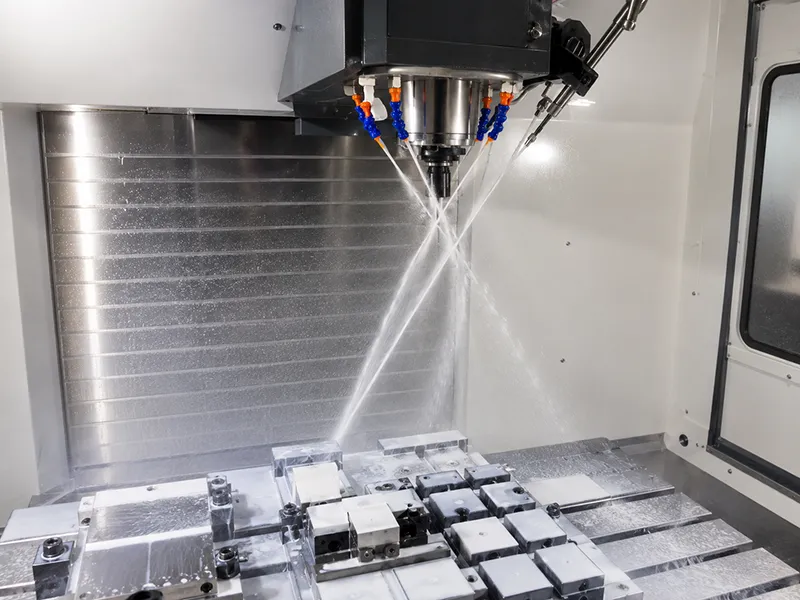
Coolant chemistry matters, but delivery often decides whether that chemistry reaches the place where it can actually work. Sandvik repeatedly emphasizes that precision coolant aimed directly at the cutting zone improves chip control, process security, and component quality.
Flood Coolant
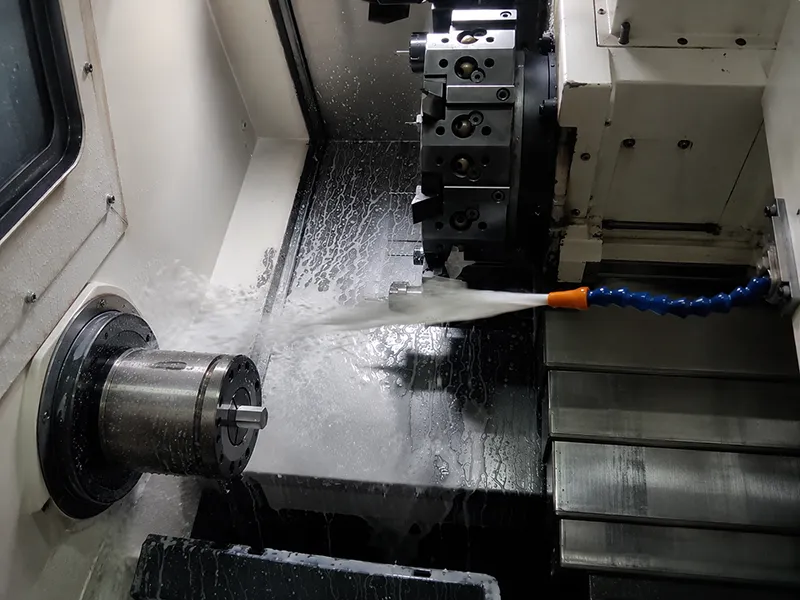
Flood coolant is the most common general-purpose approach in CNC milling and turning because it delivers a relatively large fluid volume for bulk cooling and chip washing. Its effectiveness, however, depends heavily on nozzle positioning. If the stream misses the tool–chip interface and only wets the surrounding workpiece, the process may still behave as if coolant is inadequate.
Through-Spindle Coolant
Through-spindle and through-tool coolant are especially useful for drilling tools, pocketing operations, and other enclosed cutting zones where external nozzles cannot reliably reach the cutting edge. Sandvik states that internal coolant is preferred in deeper drilling, particularly in long-chipping materials and holes deeper than roughly 3× diameter, because it reduces chip jamming and improves hole quality.
High-Pressure Coolant
High-pressure coolant is not only about “more force”; it is mainly about better chip breakage and direct energy delivery into the cut. Sandvik and Seco both show that high-pressure or precision coolant improves chip control, chip evacuation, part quality, and process reliability, especially in stainless steel, titanium, nickel alloys, and deep-hole or turning applications. The trade-off is hardware: pumps, seals, toolholders, filtration, and pressure-rated plumbing all need to be compatible.
Mist Cooling and MQL
Mist cooling and MQL use very small fluid quantities and are attractive when dry parts, lower fluid usage, or easier downstream cleaning are priorities. They can work well in selected aluminum, drilling, and milling processes, but they are more sensitive to tooling choice, chip flow, and heat load than flood systems. Ventilation and mist extraction are essential because poorly controlled aerosols create both health and housekeeping issues.
Dry Machining
Dry machining is possible in selected materials, tools, and operations. Cast iron and some hard-turning applications are common examples, while ceramic milling in superalloys is a classic case where no coolant may be preferred to avoid thermal shock. Even so, dry machining reduces fluid management only by trading it for other challenges such as higher cutting temperatures, dust, chip-control difficulty, and more stringent tool selection.
Poor nozzle position can make a suitable coolant behave like the wrong coolant. The fluid has to reach the tool–chip interface with enough direction and consistency to influence friction, temperature, and chip flow. Otherwise, shops often blame chemistry for what is really a delivery problem.
Coolant Concentration, Water Quality, Maintenance, and Common Problems
Coolant management is as important as coolant selection. BOHS, OSHA, Haas, and coolant suppliers all point to the same conclusion: concentration drift, poor water, tramp oil, metal fines, low circulation, and biological contamination can shorten sump life and degrade machining performance even when the original coolant choice was correct.
Correct Mixing Procedure
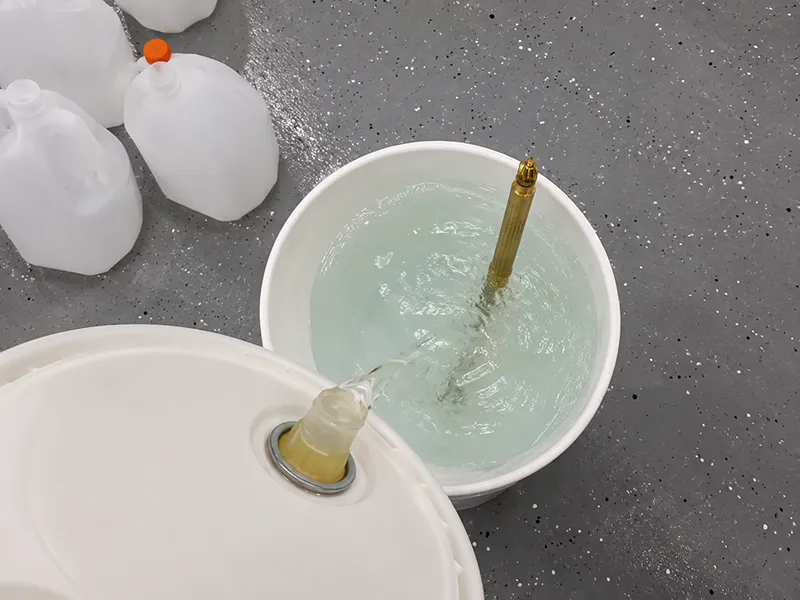
Always mix according to the coolant supplier’s instructions, and for emulsions add concentrate to water rather than reversing the mixing sequence. Master Fluid’s corrosion bulletin explicitly recommends adding coolant concentrate to water before charging the sump, and Haas also promotes controlled mixing systems to maintain correct ratios. Use clean mixing equipment, circulate the fluid before final checks, and avoid topping off by guessing.
Coolant Concentration
If concentration is too low, lubrication and corrosion protection drop; if it is too high, foam, residue, skin irritation, and cost can rise. BOHS notes that evaporation can increase concentration and foaming while over-dilution can stimulate microbial growth, and both Master Fluid and Blaser emphasize using a refractometer together with the product-specific refractometer factor. For that reason, concentration should be measured routinely, not estimated visually.
Water Quality
Water quality can make or break a coolant program. OSHA states that hard water, chlorides, and sulfates can contribute to corrosion, deposits, and microbial trouble; Blaser highlights hardness, chloride, conductivity, and foam behavior as routine diagnostic checks; and Master Fluid notes that chloride ions can contribute heavily to corrosion while water composition affects conductivity. In practice, review hardness, chlorides, sulfates, pH, conductivity, and microbial content before blaming the coolant concentrate itself.
Filtration and Chip Removal
Metal fines, swarf, and tramp oil can shorten coolant life and interfere with stable fluid delivery. Shops should regularly remove chips, clean or replace filters, inspect circulation, and remove tramp oil from the tank. The official Haas coolant maintenance checklist includes routine checks for coolant concentration, tramp oil, coolant filters, tank level, and filtration equipment. Haas maintenance checklists also call for routine chip-filter cleaning, filter checks, concentration checks, and tramp-oil removal. This matters for both machining quality and sump life.
pH and Biological Control
Monitor pH and biological condition regularly. BOHS recommends at least weekly pH checks and warns that sharp pH drops may indicate bacterial growth, while stagnant fluid, tramp oil, and overheating encourage biological instability and odor. Unapproved tank-side biocide additions should be avoided because incorrect use can create resistant organisms or operator-risk issues. When coolant smells rancid, turns dark, forms slime, or shows sudden pH change, treat that as a maintenance signal, not a cosmetic nuisance.
The maintenance checks below summarize the controls most consistently recommended across guidance from machine builders, occupational sources, and coolant suppliers.
| Check | Typical Purpose |
|---|---|
| Concentration | Maintain cooling, lubrication, and corrosion control |
| pH | Detect fluid degradation |
| Tramp oil | Reduce bacterial growth and smoke |
| Filter condition | Maintain coolant flow |
| Tank cleanliness | Prevent contamination |
| Odor and appearance | Identify biological instability |
Common coolant-related problems and their most likely causes are summarized below. This table is a practical synthesis of recurring issues documented by OSHA, BOHS, Haas, Sandvik, Master Fluid, and Blaser.
| Problem | Likely Cause | Recommended Solution |
|---|---|---|
| Excessive foam | Soft water, high pressure, air entrainment, wrong concentration | Check water quality, concentration, return flow, and pump setup |
| Bad odor | Bacterial growth, tramp oil, stagnant coolant | Remove tramp oil, improve circulation, clean the system |
| Rust on parts or machine | Low concentration, contamination, poor corrosion protection | Correct concentration and verify coolant compatibility |
| Aluminum staining | Incorrect chemistry or excessive concentration | Use a non-staining coolant and review concentration |
| Short tool life | Insufficient lubricity, poor delivery, contamination | Improve coolant type, pressure, flow, and nozzle position |
| Poor surface finish | Built-up edge, dirty coolant, unstable concentration | Improve lubrication, filtration, and fluid control |
| Skin irritation | Excess concentration, contamination, poor hygiene | Correct the fluid, clean equipment, and follow handling procedures |
| Sticky residue | High concentration or unsuitable coolant | Dilute correctly and review coolant formulation |
| Chips remain in pockets | Low flow or poor nozzle position | Improve flow direction or use through-tool coolant |
Changing coolant should not be the first response to every problem. Before switching products, verify cutting parameters, tool condition, tool overhang, nozzle position, coolant reach, filtration, concentration, and basic machine condition. Many “coolant problems” are actually process or maintenance problems.
Best Practices, Selection Workflow, and FAQs
A practical coolant program is usually less about finding a miracle product and more about controlling the variables that make a good product work. The checklist below captures the best recurring shop-floor practices.
- Match coolant chemistry to the workpiece material.
- Prioritize cooling or lubrication according to the operation.
- Follow the supplier’s mixing ratio exactly.
- Use a refractometer and the product-specific correction factor.
- Record concentration, pH, odor, and appearance regularly.
- Remove tramp oil and accumulated chips.
- Maintain filters, pumps, nozzles, and circulation.
- Keep incompatible coolant products from mixing.
- Clean the machine before changing coolant families.
- Train operators to recognize foam, odor, staining, corrosion, and unstable emulsions.
- Validate the coolant on actual parts before full production.
When Should CNC Coolant Be Replaced?
Coolant should be replaced when normal maintenance no longer restores performance. Persistent odor after cleaning, unstable pH, severe bacterial contamination, heavy sludge, repeated foam or residue issues, major cross-contamination, loss of lubricity, or loss of corrosion protection are all valid replacement signals. BOHS and coolant suppliers both emphasize that cleaning the tank and removing old deposits matter as much as changing the fluid itself. Simply adding fresh coolant to a dirty, biologically unstable system usually leaves the root cause in place.
How to Choose the Right CNC Coolant
Start with the workpiece material. Confirm the alloy, hardness, corrosion sensitivity, staining risk, and thermal behavior. Aluminum, stainless, titanium, copper alloys, and cast iron each place different demands on coolant chemistry and delivery.
Define the machining operation clearly. Decide whether the job mainly needs maximum cooling, maximum lubricity, strong chip evacuation, high-pressure delivery, fine filtration, or low residue. Drilling, tapping, reaming, grinding, turning, and milling do not ask for the same balance.
Check the tool and machine together. Review tool material and coating, coolant pressure, nozzle strategy, filtration capacity, through-spindle capability, seal compatibility, and mist control. A coolant strategy that fits the tooling but exceeds the machine’s hardware will fail in practice.
Confirm the quality requirement. Surface finish, dimensional tolerances, part cleanliness, coating or welding steps, anodizing, painting, and inspection requirements can all affect which coolant family is acceptable. Low-residue, non-staining chemistry is often as important as raw tool life when cosmetic or downstream-process quality matters.
Evaluate total operating cost, not purchase price alone. Include dilution ratio, tool life, maintenance labor, filtration, disposal, downtime, part rejection, and machine cleaning. Multiple supplier sources note that the right fluid can extend sump life and improve tool performance enough to outweigh a higher upfront price.
Run a controlled trial before full production. Record tool life, surface finish, foam, odor, staining, residue, and corrosion behavior, then confirm compatibility with downstream processes before wider approval. That is the most reliable way to turn coolant selection from opinion into process data.
The decision guide below offers a practical starting direction.
| Machining Requirement | Recommended Coolant Direction |
|---|---|
| General milling and turning | Semi-synthetic or soluble oil |
| High-speed grinding | Synthetic coolant |
| Heavy tapping and threading | High-lubricity coolant or straight oil |
| Titanium machining | High-pressure water-miscible coolant |
| Aluminum cosmetic parts | Non-staining semi-synthetic coolant |
| Minimal-fluid operation | MQL where process conditions allow |
Conclusion
Choosing the right CNC coolant is a balancing exercise between cooling, lubrication, chip evacuation, corrosion protection, cleanliness, and operating cost. Soluble oils, semi-synthetics, synthetics, straight oils, and MQL each have valid use cases, but none is automatically “best” outside a specific material, operation, tool, and machine setup. In practice, coolant performance depends just as much on concentration control, water quality, filtration, nozzle reach, circulation, and sump maintenance as it does on formulation. Shops that monitor their coolant with the same discipline they apply to tooling and cutting data usually get more stable machining, better part quality, longer tool life, and fewer avoidable failures such as foam, odor, rust, and staining. The most effective coolant program is therefore not the most expensive one; it is the one that stays stable in real production and delivers consistent results at a manageable total cost.
FAQs About CNC Coolant Selection
What is the best coolant for CNC machining?
There is no single best coolant for all CNC machining. The correct choice depends on the workpiece material, machining operation, tool material, cutting speed, required finish, and the machine’s coolant-delivery capability. A shop cutting aluminum cosmetic parts, for example, may need a different fluid than a shop tapping stainless or roughing titanium.
What is the difference between soluble oil and synthetic coolant?
Soluble oil coolant contains mineral oil dispersed in water and usually offers stronger lubrication, while synthetic coolant contains little or no mineral oil and generally emphasizes cooling, cleanliness, and visibility. The trade-off is that synthetics may not lubricate as strongly as higher-oil fluids in severe cutting.
How do you check CNC coolant concentration?
Use a refractometer, calibrate it correctly, and apply the coolant manufacturer’s correction factor to convert the Brix reading into actual concentration. Routine concentration checks are widely recommended because both evaporation and over-dilution can cause machining and maintenance problems.
Can CNC machining be performed without coolant?
Yes, selected materials and operations can be machined dry or with MQL, but the decision should be based on heat generation, tool material, chip control, dust, and finish requirements. Some cast-iron and hard-turning jobs run successfully dry, while some ceramic milling applications intentionally avoid coolant to reduce thermal shock. That does not mean dry machining is suitable for every process.