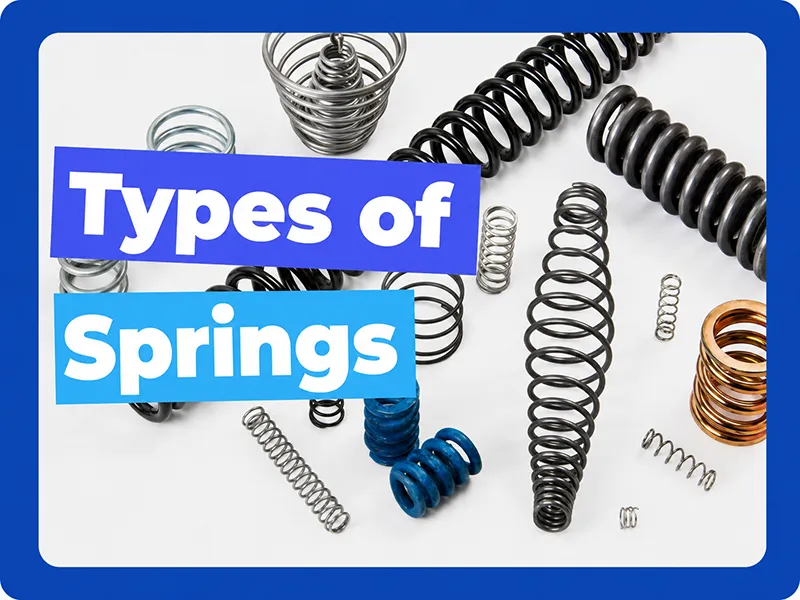
Springs are elastic mechanical components that deform under load and return to their original shape, allowing them to store and release mechanical energy. They are used to absorb shocks, provide restoring force or constant pressure, and control motion in many systems. You’ll find springs in machinery, vehicles, electronics, medical devices, valves, fixtures, and industrial assemblies. Because each spring type has a different load direction and geometry, the choice of spring greatly affects performance. This article explains the common spring types (compression, extension, torsion, leaf, disc, wave, constant-force, gas), the materials used to make them, their applications, and how to select the right spring for a design.
What Are Springs?
Springs are flexible mechanical parts that store energy when they are deformed and release it when the load is removed. Under load, a spring undergoes elastic deformation; when the force is removed, the spring exerts a restoring force to return to its original shape. In practice, springs act as shock absorbers, retainers, or force-delivery elements. They appear in everything from fasteners and valves to automotive suspensions, industrial machines, and consumer electronics. For example, spring washers keep bolts tight, and compression springs open/close valves in pumps and engines. The performance of a spring depends on its shape, material, wire diameter, number of coils, heat treatment, and operating environment. These factors determine the spring’s stiffness (rate), strength, fatigue life, and suitability for high/low temperatures or corrosive conditions.
How Do Springs Work?
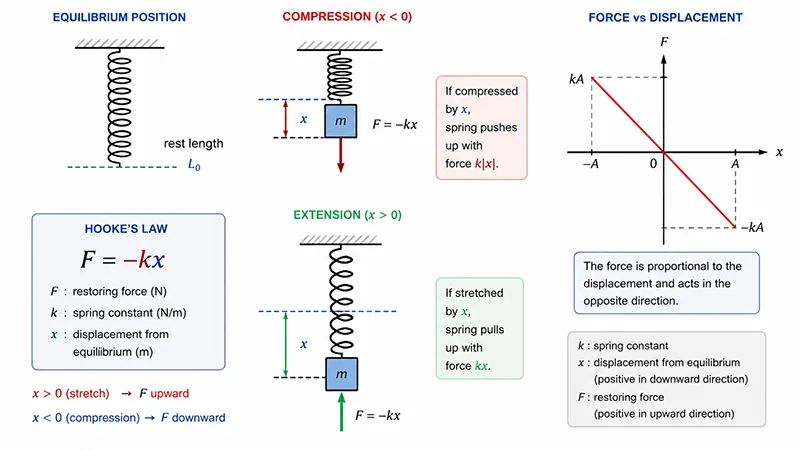
A spring works by storing mechanical energy when it is deformed and releasing that energy when the load is removed. When you apply a force to a spring, it stretches, compresses, or twists and stores potential energy. Once the force is released, the spring’s elastic properties cause it to return toward its original size or orientation, exerting a force back on its surroundings. In ideal linear springs, this behavior follows Hooke’s Law, meaning the spring force is related to the displacement from equilibrium, with spring constant k (stiffness) as the proportionality. The “spring rate” or stiffness k is the force needed to deflect the spring by a unit distance. A higher spring rate means the spring is harder to deflect. Different spring types achieve this energy storage in different ways: compression springs work under axial compression, extension springs under axial tension, torsion springs by twisting, and some springs by bending. In all cases, the spring’s design and material determine how it responds to a given load and displacement.
Main Types of Springs
The table below summarizes the major spring types, their load directions, and typical uses:
| Spring Type | Main Load Direction | Common Uses |
|---|---|---|
| Compression Spring | Compressed by axial force | Valves, switches, shock absorbers, fixtures |
| Extension (Tension) Spring | Stretched by tensile force | Garage-door mechanisms, trampolines, linkages |
| Torsion Spring | Twisted by torque (rotational) | Hinges, clips, door mechanisms, return levers |
| Leaf Spring | Bent under load (flexural) | Vehicle suspensions, trailers, heavy machinery |
| Disc (Belleville) Spring | Compressed axially in small space | Bolted joints, clutches, brakes, high-force clamps |
| Wave Spring | Compressed axially with waves | Bearings, seals, connectors in compact assemblies |
| Constant-Force Spring | Provides nearly constant force | Retractors, counterbalances, cable reels |
| Gas Spring | Driven by compressed gas | Hoods and hatch supports, chairs, medical beds |
Compression Springs
Compression springs are among the most common spring types and are designed to resist compressive loads along the spring axis. Under an axial force, the coils squeeze together, and the spring stores energy; when the force is removed, it pushes back to its original length. Compression springs are used wherever an axial pushing force or shock absorption is needed – for example in engine valves, hydraulic valves, push-buttons, ball-point pens, mattresses, and machinery. They come in shapes such as straight cylindrical coils, conical (tapered) coils, barrel (hourglass) coils, and stepped varieties, chosen to fit space or load requirements. Key design parameters include the spring rate (stiffness), free (uncompressed) length, solid (fully compressed) height, wire diameter, coil diameter, and the required load or deflection. When selecting a compression spring, engineers consider how much force it must carry, how far it will compress, and space limits. They also ensure the spring won’t buckle under load and that the end coils are shaped (ground or squared) to seat properly.
Extension Springs
Extension springs (also called tension springs) operate under tensile (stretching) loads. They are made as tightly wound coils and generate a pulling force when their ends are pulled apart. Extension springs usually have loops, hooks, or special end fittings to attach to other parts. They are often used to connect two components and pull them together when released – for example, in garage door mechanisms, trampolines, screen doors, and linkages. When designing or selecting an extension spring, important factors are the initial pre-load (how much tension is in the spring at rest), the strength of the end hooks/loops, and the fatigue life under cyclic stretching. Designers must also ensure the spring is not over-stretched beyond its elastic limit. Common mistakes include ignoring the spring’s built-in tension (so it won’t retract properly) or using it in a way that it can be pulled past its failure point. Extension springs are wound to order but are available in many standard sizes, and they may be coated or plated for corrosion resistance.
Torsion Springs
Torsion springs are designed to work by twisting (rotational force) rather than by linear push/pull. A torsion spring is usually a helical coil whose ends are attached to other components. When those components rotate relative to each other, the spring twists and exerts torque to return them to the original position. This makes torsion springs ideal for hinge-like applications. Common uses include door hinges, clothespins, lever arms, and counterbalances – anywhere a rotational “spring” force is needed. Unlike compression or extension springs, the load on a torsion spring is perpendicular to the coil’s axis. In design, key parameters include the direction of wind (right-hand or left-hand coil), the angle and length of the spring’s legs (straight or custom-bent ends), and the required torque at specific angles. Good practice is to load the spring in the direction that tightens the coil (which utilizes residual forming stresses favorably) and to maintain clearance so the coils do not bind.
Leaf Springs
Leaf springs are long, flat, curved strips of metal (steel) that flex under load. A typical leaf spring is made from one or more stacked “leaves” (planks) of metal bound together. When weight is applied, the leaves bend (flex), storing energy and providing suspension. Leaf springs are historically common in vehicle suspensions (cars, trucks, trailers) and other heavy-duty applications because they can support very large loads. They have a simple, robust construction but are bulky compared to coil springs. Mono-leaf springs (single tapering leaf) are lighter and used in performance or light vehicles, whereas multi-leaf springs (several layered leaves) share the load across leaves and handle much heavier loads. Multi-leaf springs also offer good damping of shocks because the leaves slide slightly. The drawbacks of leaf springs are their space/weight and lack of compact precision; they are rarely used where compactness or precision is needed. Leaf springs are usually made of medium- to high-carbon spring steel and may be heat-treated and shot-peened for fatigue resistance.
Disc Springs (Belleville Washers)
Disc springs are conical (dished) washers that act like springs under axial compression. Also known as Belleville springs or washers, they are stamped from sheet steel into a shallow cone shape. A single disc spring, when squeezed flat, exerts a very high force in a very small deflection. Because of this, disc springs are used where high load is needed in a tight space – for example, preloading bolts in heavy machinery, applying force to clutches or brakes, and maintaining contact pressure in valves or clamping fixtures. Engineers often stack disc springs in series (for greater deflection) or parallel (for higher force) to tailor the spring rate. In a bolted joint, a stack of Belleville springs under a bolt head can keep the joint from loosening by compensating for vibration or thermal expansion. The high spring rate and compact form make them ideal for heavy-load applications that traditional coil springs cannot fit into.
Wave Springs
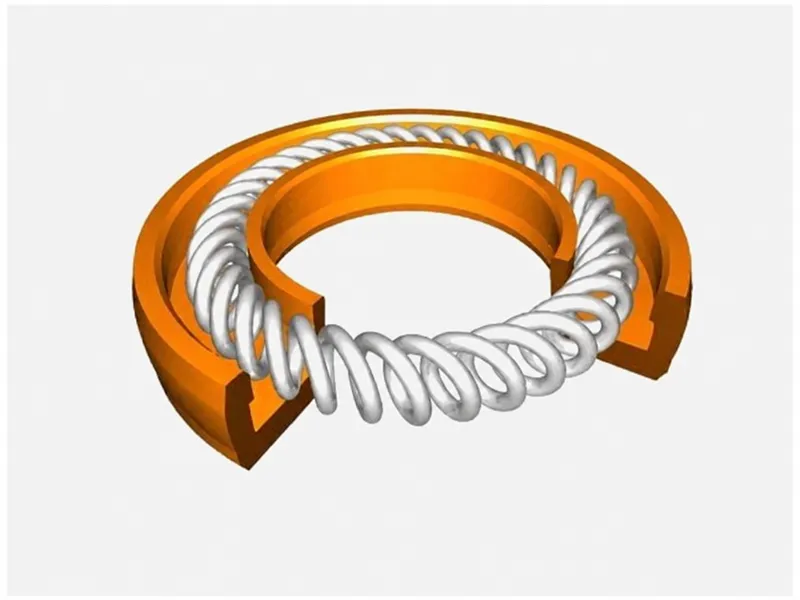
Wave springs are a type of spring shaped like a flat ring with a wavy cross-section. They consist of one (single-turn) or multiple turns of wavy (corrugated) metal, so that under compression the waves flatten out. A wave spring provides a spring force similar to a compression coil spring but occupies much less axial space. They are typically used where only a small deflection is required and space is very limited. Common applications include preloading bearings (taking up axial clearance), sealing assemblies, electrical connectors, and other compact mechanical assemblies where a conventional coil spring would be too tall. Wave springs save space and weight, and they give a more or less linear load-deflection in the low-deflection range. Their design (single wave vs multi-wave vs nested waves) is chosen based on required force and available space.
Constant Force Springs
Constant-force springs are made from a strip of spring steel coiled tightly. Unlike a coil spring, when pulled out they exert (approximately) a constant force over their range of travel. In use, one end is fixed to a drum or housing and the other end is attached to the load. As the strip unrolls, its inherent stress produces nearly constant tension. These springs are often used in applications requiring a long stroke with near-constant force – for example, counterbalance mechanisms, retractable reels and cable systems, and tape measures. Common examples include seat belt retractors, window balances, and spring-loaded measuring tapes. Selection factors include the strip material (often high-yield stainless steel) for fatigue life, the coil diameter (drum size) which affects force, and guides to prevent the strip from buckling. Because constant-force springs can unwind freely, designs usually include a drum or guide to constrain the motion and maintain stability.
Gas Springs
Gas springs (gas struts) look like hydraulic cylinders but use pressurized gas (usually nitrogen) to provide a pushing force. When the gas inside is compressed by pushing in the rod, it exerts pressure on a piston, creating a spring-like extension force. Gas springs provide smooth, damped support and are very common in assist devices. Typical uses include supporting and softly closing lids or hatches (automotive tailgates, engine hoods, office chairs, machine covers), as well as in medical and furniture applications (adjustable beds, hospital tables). They allow a lid or panel to stay open in any position and to close at a controlled rate. When selecting a gas spring, one must consider the required force (determined by the gas pressure and piston area), stroke length, mounting configuration (angle of use), and temperature (since gas pressure changes with temperature). Corrosion-resistant finishes are also important for long-term reliability. In automotive hoods and chairs, for example, gas springs eliminate the need for manual props or levers.
Common Spring Materials
Springs are usually made from high-strength machining materials such as carbon steel, stainless steel, alloy steel, copper alloys, and titanium. Common materials include:
- Carbon Steel (Spring Steel) – Often the lowest-cost option, high-carbon steels have good strength and elasticity. These steels can be heat-treated for fatigue resistance. However, carbon steel springs corrode in moist or harsh environments, so they are often coated or plated. They are widely used in general industrial applications, automotive valves, and machinery.
- Stainless Steel – Stainless alloys (e.g. 301, 17-7PH, 316) resist corrosion and work well in hot or corrosive environments. Stainless springs are used in medical devices, food equipment, marine hardware, and outdoor applications. They typically have higher cost and slightly lower elastic limits than carbon steel.
- Alloy Steel – Alloy spring steels (chromium, silicon, vanadium alloyed steels) offer very high strength and fatigue life. Low-alloy steels (with small amounts of Ni, Cr, Mo) provide higher toughness and can handle heavier loads than simple carbon steel. They are used in high-performance automotive springs, aerospace landing gears, and demanding industrial equipment.
- Copper Alloys (Phosphor Bronze, Beryllium Copper, Brass) – These non-ferrous alloys have good corrosion resistance and excellent electrical conductivity. Springs made of phosphor bronze or beryllium copper are common in electrical contacts, connectors, relays, and precision instruments. They spring back reliably and are used where both good springiness and conductivity or non-magnetic properties are needed.
- Titanium – Titanium and its alloys are very strong for their weight and highly corrosion-resistant. Titanium springs are lighter than steel, making them ideal for aerospace and high-performance automotive use. They are also biocompatible, so titanium springs are found in medical implants and surgical devices. The downside is higher material cost.
In addition to the base material, springs are often surface-treated (e.g. shot-peened, nitrided, or coated) to improve fatigue life or corrosion resistance.
How to Choose the Right Type of Spring
Choosing the correct spring involves considering the application’s specific requirements. Key factors include:
- Load Direction and Magnitude – What direction is the force applied (axial, bending, torsional)? How much force is needed at the endpoints?
- Desired Spring Rate and Deflection – How stiff must the spring be, and how far will it move (stroke or extension)? The spring rate (stiffness) is determined by geometry and material.
- Available Space (Form Factor) – What envelope can the spring occupy? Helical springs require more length, while wave or disc springs save space.
- Environment – Will the spring operate in high/low temperature, corrosive, or vacuum conditions? This affects material and finish choices. As one engineering guide notes, you must choose spring materials that can withstand the anticipated loads and the environmental factors (temperature, humidity, chemicals).
- Fatigue Life – How many cycles will the spring experience? Springs under repeated loading must be designed with a safe stress range and possibly surface treatments.
- End Fittings and Assembly – How will the spring attach to other parts? (Hooks, loops, threads, etc.) Also consider solid height (fully compressed length) and maximum allowable load to avoid coil binding or yield.
- Cost and Production – The required quantity and target cost can influence material and type (e.g. standard vs custom spring stock).
In short, select the spring type that matches the load mode (compression, tension, torsion, or bending) and that fits within space and force requirements. Then refine the design by choosing material and size to meet life and environmental needs. One industry guideline sums it up: engineers must consider load requirements, environmental conditions, and desired lifespan when selecting a spring material and design.
Spring Applications in Manufacturing
Springs are used across many industries to perform vital roles. Some examples include:
- Automotive springs are everywhere in vehicles – coil springs and leaf springs in suspension systems absorb shocks and support the chassis, brake return springs in brakes help retract the brake shoes, and valve springs control engine valve timing. Gas springs and torsion springs assist with hood and hatch opening, and constant-force springs appear in some retractors.
- Aerospace: Aircraft rely on lightweight, high-performance springs. Landing gear struts often use heavy-duty coil or gas springs to absorb touchdown loads. Springs are also used in control linkages (ailerons, rudders) and actuation systems for flaps, as well as in vibration-damping mounts. Military/aerospace machinery use special springs (e.g. titanium or stainless disc springs) for reliability in extreme conditions.
- Medical Devices: Springs enable precision and comfort in medical equipment. Surgical tools and diagnostic devices use small springs for actuating and returning mechanisms. Springs in hospital beds and wheelchairs provide adjustable support and shock isolation. Prosthetic and orthotic devices use springs to mimic muscle action. In short, medical springs (often stainless or non-magnetic) must be extremely reliable and biocompatible.
- Electronics: In small electronics and gadgets, miniature springs are ubiquitous. Battery contacts, push-button switch plungers, connector pins, and relay contacts all use tiny coil or leaf springs to ensure electrical contact and return forces. For example, a spring-loaded battery terminal ensures good contact pressure. (Springs are found in everyday items – from retractable pens to switches and connectors.)
- Industrial Machinery: In heavy machinery and automation, springs serve as clamps, dies, shock absorbers, and counterbalances. Compression springs preload safety valves; torsion or flat springs in fixtures secure workpieces; and leaf/coil springs cushion moving parts. Conveyor systems often use extension springs to maintain belt tension, and industrial doors use large torsion or constant-force springs. In factories, you’ll also see springs in vibratory feeders, robot grippers, and as safety buffers – essentially anywhere controlled force or return motion is needed.
Custom Springs and CNC Machined Spring Components
While springs themselves are typically produced by coiling, stamping, or forming spring steel, they rarely act alone. Real assemblies require mating components that are often custom CNC-machined to precise dimensions. For example, spring seats, retainers, shafts, pins, guides, washers, and mounting blocks must match the spring’s size and motion. Machining ensures that these parts have the correct bore holes, bearing surfaces, and fits to properly hold the spring. In a valve assembly, a precisely machined spring seat and retainer keep the spring aligned and prevent buckling. In complex fixtures, CNC-made collars and stops integrate with the spring’s ends or hooks. Therefore, when designing custom spring-based mechanisms, it’s important to consider the spring and its machined hardware together so that tolerances, surface finish, and materials are all compatible.
Common Mistakes When Selecting Springs
Engineers often make mistakes by focusing only on size or cost and overlooking critical factors. Common pitfalls include:
- Choosing by dimensions alone: Picking a spring just because it fits spatially, without checking if it carries the required load or deflects the right amount.
- Ignoring spring rate: Not ensuring the spring’s stiffness is suitable for the force-displacement needs, leading to too soft or too stiff a spring.
- Overlooking fatigue life: Failing to account for the number of cycles or dynamic loading can lead to early spring failure.
- Wrong material for the environment: Using ordinary carbon steel springs in corrosive or high-temperature environments (instead of stainless or special alloy), causing rust or loss of strength.
- Neglecting solid height or maximum deflection: Designing an assembly where a compression spring is squashed completely flat (coil bind) or an extension spring is pulled beyond its elastic limit.
- Insufficient space for travel: Not allowing enough clearance for the spring’s compressed or extended length.
- Forgetting end types: Overlooking the required end fittings (hooks, eyes, flats, etc.) or how the spring seats against other parts.
- Temperature effects: Ignoring that springs can weaken at high temperature or become brittle at low temperature.
- Poor assembly: Not verifying that mating parts (e.g. spring seats, holes, screws) fit the spring’s ends and motion path.
Avoiding these mistakes requires careful analysis of loads, environment, and installation along with the spring’s specifications.
Conclusion
Springs are indispensable components in mechanical systems for storing energy, damping shocks, resetting mechanisms, and applying forces. The common spring types – compression, extension (tension), torsion, leaf, disc (Belleville), wave, constant-force, and gas – each serve different load directions and functions. Compression springs handle axial loads, extension springs pull components together, torsion springs provide rotational force, and specialized springs (leaf, disc, wave) solve high-load or space-constrained problems. The choice of spring depends on the required load path, force, deflection, available space, and environment. Material, dimensions, spring rate, fatigue life, and operating conditions must all be considered. For complex machinery, both the spring and its mating CNC-machined parts (retainers, seats, guides) should be co-designed. In the words of one industry source, springs in countless mechanisms across industries enhance performance and absorb shocks, making them versatile and reliable parts.
FAQ About Types of Springs
What are the main types of springs?
The common spring types are compression springs (work under axial compression), extension (tension) springs (work under tensile load), torsion springs (work by twisting), leaf springs (flat curved plates that flex under load), disc or Belleville springs (conical washer springs), wave springs (corrugated ring springs), constant-force springs (strip coils that exert nearly constant tension), and gas springs (pressurized gas struts).
What is the most common type of spring?
Compression springs are among the most common types because of their simple design and versatility. They are widely used in valves, switches, shock absorbers, fixtures, and general machinery components. In fact, compression springs are used more often than extension springs in critical applications because a compression spring cannot be pushed past its breaking point, whereas an extension spring can fail if overextended.
What materials are springs made from?
Springs are usually made from spring steels. Common materials include carbon steel (low-cost, high-strength spring steels), stainless steel (for corrosion resistance), alloy steels (higher-strength, higher-fatigue alloys), copper-based alloys like phosphor bronze (for electrical conductivity and corrosion resistance), and titanium (lightweight, strong, used in aerospace/medical).
How do I choose the right spring?
Selection depends on the application. Consider the load direction (compression, tension, torsion, bending), required force and deflection, the spring rate (stiffness), and available space. Then factor in the environment (temperature, corrosion), desired fatigue life, and material properties. For example, choose stainless steel in moist or food environments, and a stiff spring if a large force over small deflection is needed. As engineers advise, pick a spring material and design that can withstand the anticipated load and environmental conditions.
What is the difference between compression and extension springs?
A compression spring resists being compressed – it pushes back when an axial load tries to shorten it. An extension spring resists being stretched – it pulls back when an axial load tries to lengthen it. In other words, compression springs provide force when squeezed, whereas extension (tension) springs provide force when pulled. The end fittings also differ: compression springs usually sit between parts, while extension springs have hooks or loops on the ends to attach to other components.