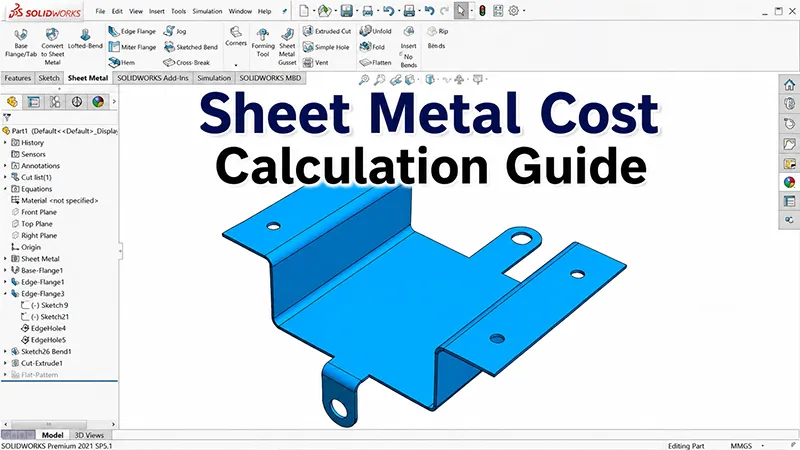
Sheet metal cost calculation is the process of estimating the total manufacturing cost of a sheet metal part. It involves more than just multiplying material price by weight – it accounts for material type, thickness, cutting method, number of bends, welding or assembly, surface finishing, labor, equipment time, quantity, and tolerance requirements. An accurate quote depends on the part’s design details and production plan. For example, providing a precise flat-pattern drawing or CAD model with specified material, thickness, quantity, and finish requirements leads to a more reliable estimate. This article reviews the main cost factors, presents common calculation formulas and an example, and suggests ways to reduce sheet metal fabrication cost.
What Is Sheet Metal Cost Calculation?
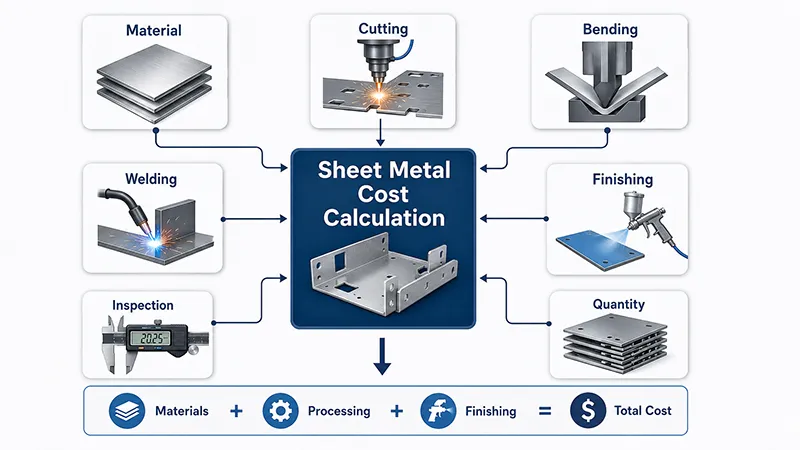
Sheet metal cost calculation means breaking down the fabrication process to estimate total part cost. In practice, a quote typically sums up material cost + cutting cost + bending cost + welding/assembly cost + finishing cost + inspection cost + overhead + profit and then divides by quantity. Different suppliers may package these elements differently, but the components are usually the same. Accurate drawings and specifications are critical: for instance, uploading a 2D DXF or 3D CAD file with the material grade, sheet thickness, tolerances, and finish options allows automated quoting systems to give precise per-unit costs. Conversely, missing or vague information (e.g. “2mm steel” without exact alloy or finish) forces the vendor to add contingency to the price.
Main Factors That Affect Sheet Metal Cost
The key cost drivers in sheet metal fabrication include material, labor, production method, machine usage, tooling, overhead, and design complexity; Xometry’s sheet metal fabrication cost calculator gives a useful overview of these pricing factors.
| Cost Factor | How It Affects Price |
|---|---|
| Material type | Different metals have vastly different prices. For example, 304 stainless steel can cost ~2.5–3× as much per kg as mild steel, and copper/brass even more. |
| Material thickness | Thicker sheets use more material (higher weight) and are slower to cut or bend. Cutting and bending cycle times increase nonlinearly with thickness. |
| Part size (area) | Larger or longer parts require more raw material and more machine time. Part area directly scales material weight (area×thickness×density). |
| Cutting method | Laser, waterjet, plasma and punching all have different costs. Fiber laser cutting is common (clean, fast) and costs roughly $30–$60/hr, while plasma is cheaper per hour but lower precision. Waterjet is used for very thick or heat-sensitive parts. Long cut lengths or complex profiles raise the cutting cost proportionally. Turret punching can be very cost-effective for large runs with many identical holes, since its setup cost is amortized over thousands of cuts. |
| Number of bends | Each bend adds machine and setup time. Bending is typically priced per bend, plus a one-time program/setup fee for each unique bend sequence. A part with many bends, especially different angles or radii, can cost much more than a simpler part. Design tips like keeping bend radii consistent and grouping bends on the same axis help reduce cost. |
| Welding / Assembly | Welded or assembled parts require more labor. Welding costs include the weld time (e.g. TIG welding in Asia ~$1.50–$4.00 per inch) plus any cleanup/prep before finishing. Installing hardware (nuts, studs) adds labor (typically $0.30–$0.80 per piece). Whenever possible, using tabs, slots or interlocking flanges can eliminate welding and its extra costs. |
| Surface finish | High-quality or protective finishes (painting, powder coating, plating, anodizing, etc.) significantly add to cost. Finishing is often 25–40% of part cost on small enclosures. Typical finishing rates are on the order of $10–$45 per m² (e.g. powder coat $15–$35, anodize $25–$45, zinc plate $10–$20, decorative brush $8–$18). Each finish also has setup overhead, and masking/protecting holes or mating surfaces increases price. |
| Tolerance / quality | Tight tolerances and high inspection requirements increase cost. Standard sheet metal parts often use generic tolerances; but if critical features (hole positions, bend angles, flatness, assembly fits) need precision, extra control and inspection tools are needed. Over-specifying tolerances can raise fabrication and inspection efforts (e.g. tighter bend angle tolerances alone can add 30–60% to bending cost). Inspection equipment (calipers, height gauges, CMMs, go/no-go gauges, etc.) adds labor overhead, so only apply tight tolerances where functionally required. |
| Quantity | Higher volumes spread fixed costs over more parts. The first piece of a run bears the full programming, nesting, machine setup and tooling costs. Each additional unit only incurs the marginal processing cost. For example, studies show that 10 pieces might cost roughly 40% of 1-piece pricing per unit, and 50–100 pieces only ~20%. In contrast, prototyping orders have a much higher per-unit cost due to one-time setup. However, very large runs may still incur extra costs for packaging, logistics and quality control. |
| Lead time | Rush or expedited orders typically incur premiums. (Factories may add overtime or prioritize jobs at higher rates, though specifics vary by shop.) |
(*) These factors compound: a heavy material in a thick gauge with many bends and tight tolerances will cost much more than a simple, light-gauge, blunt-tolerance part.
Sheet Metal Material Cost
Material cost usually makes up a large base of the quote. It is calculated from the flat-pattern area of the part (not the 3D dimensions) and incorporates thickness, density and current material price. For example:
Material Cost = (Flat Area × Thickness × Density × Price_per_kg) × (1 + Scrap_Rate).
The scrap factor (typically 15–35%) accounts for nesting waste. Long rectangular parts nest more efficiently (lower scrap) while odd shapes leave more offcuts. In high-volume runs, raw material can be up to ~86% of total cost, making scrap minimization critical. Common materials include mild steel (baseline cost), stainless steel, aluminum, galvanized steel, copper and brass. Stainless alloys and copper/brass are generally far more expensive per kilogram (often 2–4× or more than mild steel). Low material utilization (poor nesting or ordering oversized blanks) drives up the effective material cost per part.
Cutting Cost
Cutting cost depends on the chosen cutting method, the material type and thickness, and the total length and complexity of cuts. Fiber laser cutting is prevalent for precision parts due to its speed and fine edge quality, with equipment rates on the order of $30–$60 per hour for 2–5 kW machines. Plasma cutting is cheaper per hour ($20–$40/hr) but is less precise and typically used only for very thick or rougher applications. Waterjet cutting ($45–$90/hr) is slower but avoids heat damage, making it suitable for very thick sections or heat-sensitive metals.
Long or complex cut paths increase cutting time (and cost). For example, cutting a 2 mm steel profile may take 2–3× longer than cutting a 1 mm profile of the same shape. Additionally, if a design has many repeated holes or slots, turret punching can be cost-effective at high volumes – its initial setup is amortized across thousands of punch cycles. In summary, complex geometry (long cuts, many holes, intricate contours) drives up cutting cost, while simple outlines are faster.
Bending Cost
Bending cost is charged per bend (per part) plus an extra setup fee for each unique bend operation. For instance, every time a bending machine needs a new program or tooling setup (e.g. a different angle or bend radius), that attracts a fixed setup charge (often $15–$45 per new program). Consequently, a part with 4 identical 90° bends will cost less to set up than one with 4 bends of different angles or radii, even though the total bend count is the same.
More bends also require more machine time and repositioning. Thicker materials or higher-strength alloys need slower press breaks and can further raise bending cycle time. Other geometric features affect bend cost too: for example, if holes or features are close to the bend line, extra care or trimming is needed. Design simplification reduces bending cost: keeping bend radii consistent and aligning bends along one axis helps reduce setup changes; Protolabs’ sheet metal design guidelines are a useful reference for bend radius, flange length, holes, slots, and countersinks. In practice, each additional bend typically adds a fixed per-bend cost, so parts with many bends (especially if they use different tooling) will have higher fabrication costs.
Welding and Assembly Cost
If your sheet metal assembly requires welding, riveting, bolting, or insertion of hardware (nuts, studs), the cost goes up. Welding adds both time and prep work: for example, TIG welding stainless steel or aluminum may cost roughly $1.50–$4.00 per inch of weld (in Asia – rates in US/EU are about twice as high). After welding, parts often need grinding or brushing to smooth the bead before any finish can be applied. Inserting self-clinching nuts or studs (PEM hardware) adds labor too (typically $0.30–$0.80 per insert).
Assembly operations (like tapping holes, installing fasteners, or tab-fixture assembly) incur additional labor time. Whenever possible, DFM techniques like tabs-and-slots or interlocking flanges can eliminate the need for welding entirely. These alternatives lock pieces together without welds, saving on welding labor and post-weld cleaning. In summary, each joint added (weld bead, rivet, hardware) adds cost – assemblies with many welds or fasteners will be significantly more expensive than equivalent single-piece parts.
Surface Finishing Cost
Surface treatments and coatings can have a big impact on cost. Finishing often becomes a large fraction of the total on small parts (25–40% of cost on small enclosures). Each finish type has setup charges (e.g. masking, racking, preparation) and per-unit charges. Common finishes include:
- Powder coating (polyester, epoxy, etc.): roughly $15–$35 per m². Durable and good for outdoor use, but adds both material and curing labor.
- Anodizing (clear or color): about $25–$45 per m². Used on aluminum for corrosion resistance or appearance.
- Zinc plating / galvanizing: around $10–$20 per m². Provides rust protection, often on steel.
- Brushing / bead blasting / polishing: $8–$18 per m². Decorative or to clean the surface.
Remember: only specify a finish if needed. For example, powder-coating the inside of a sealed box (where it isn’t seen or needed) doubles finishing cost for no benefit. Also consider that complex parts may need holes masked and edges taped (which adds labor). High-visibility or corrosion-critical surfaces justify the cost; plain internal or mechanical surfaces may not. In general, tight color/tone matching or multi-color painting will be premium, so discuss finish requirements with your supplier.
Tolerance and Quality Inspection Cost
Tighter tolerances increase both processing and inspection cost. Typical sheet metal parts can often use “general” tolerances (e.g. ±0.1 mm or ±0.5 mm on bends) without issue. However, if you specify very tight tolerances on hole positions, bend angles, flatness, or overall dimensions, the shop must slow down and check more rigorously. Over-tolerancing can be very expensive: for example, adding strict angle tolerances alone can add 30–60% to bending cost.
Precision work may require specialized fixturing or multiple measurements (using calipers, height gauges, coordinate-measuring machines, go/no-go gauges, etc.), all of which add labor time. Each inspection step (especially if CMM or specialized fixtures are used) contributes to cost. Thus, it’s best to apply tight tolerances only on critical features that truly affect the part’s function or fit. If high precision is needed, mention that explicitly so the quote includes the proper inspection plan.
Quantity and Setup Cost
The order quantity has a major effect on unit price due to setup costs. Sheet metal fabrication has significant upfront setup: generating CNC programs, nesting the parts on sheet layouts, calibrating machines, changing dies or tooling, and performing first-article inspection all take time. These setup costs are fixed for the job and do not scale with quantity. Therefore, for a small batch, those fixed costs are divided among few parts, making the per-piece price high. As quantity increases, the same setup cost is spread over more parts, so unit cost drops sharply.
For example, one shop’s data shows that producing a single part might reflect 100% of the setup burden on that piece, whereas the 10th piece might cost only ~40–50% of that, and 50–100 pieces only ~20–30% per unit. In short: “Order volume amortizes the fixed costs.” (You can think of it as: Unit Cost ≈ Total Cost / Quantity.)
Keep in mind that extremely large volumes could introduce new costs (e.g. bulk packaging, dedicated forklift runs, extended QC checks), but these typically add a small per-unit amount. In most cases, increasing order quantity significantly lowers the per-part cost (beyond material economies, through lower amortized setup).
Basic Sheet Metal Cost Calculation Formula
A simple overall framework for sheet metal cost is:
Total Sheet Metal Cost = Material Cost + Cutting Cost + Bending Cost + Welding/Assembly Cost + Surface Finishing Cost + Inspection Cost + Packaging Cost + Overhead + Profit.
In practice, each term can be estimated as follows:
- Material Cost: Compute the blank or weight needed. Usually: sheet area × thickness × material density gives weight, then multiply by the alloy’s $/kg. Include a scrap allowance (e.g. a 20% markup on material).
- Cutting Cost: Estimate the machine time for all cuts (cut length ÷ feed rate or cut speed) and multiply by the machine’s hourly rate. Laser rates might be $30–$80/hr; punching rates may be similar once setup is done.
- Bending Cost: Typically (number of bends × cost per bend) + any unique bend setup fees. For example, count bends in the part and multiply by a per-bend cost.
- Welding / Assembly Cost: (Labor hours for welding/assembly) × (shop’s hourly labor rate). Insert any hardware fees (e.g. self-clinching nuts) per piece.
- Finishing Cost: Often charged per area or per batch. For example, (surface area × finish rate) or per-piece painting cost.
- Inspection Cost: Add cost for any special inspection or measurement (e.g. CMM time or gauge setup). Sometimes a percentage of labor.
- Packaging Cost: If special packaging or kitting is needed, add per-part or per-order packaging.
- Overhead & Profit: Finally, the manufacturer applies overhead percentage and profit margin on top.
Each supplier may use slightly different formulas or overhead rates, but this manufacturing cost structure covers the main cost categories. The key is to sum all categories of labor and material, then divide by quantity (for a per-unit quote).
Sheet Metal Cost Calculation Example
Example Part: A small 304 stainless steel bracket, 2 mm thick, qty. 100. Processes: laser cutting, 4 bends, simple deburring, and a light surface brush finish.
| Cost Item | Example Calculation |
|---|---|
| Material: | (Bracket flat area × 0.002 m thickness × 7.9 g/cm³) × $X/kg + scrap. (Use stainless price per kg.) |
| Laser cutting: | (Total cut length ÷ laser feed rate) × ($60/hr) (e.g. $1 per 5 sec) |
| Bending: | 4 bends × ($Y per bend) = 4 × $Y |
| Deburring: | (Labor time for 100 parts, e.g. 0.1 hr) × (labor rate) |
| Brushing: | (Bracket surface area × finishing rate) |
| Setup: | (Programming + first-piece setup time) / 100 parts |
| Total: | Sum of all above components |
Note: Actual numbers will vary by supplier, location, and current prices. This breakdown illustrates how each stage adds to the total. For instance, stainless 304 might be priced around $3–5/kg, laser cutting might cost $1–2 per part depending on complexity, and each bend might add a fixed amount. In general, the total quote = material + (laser + bends + misc. labor) + finishing + overhead.
How to Reduce Sheet Metal Fabrication Cost
Good design and planning can cut sheet metal costs dramatically, and Protolabs’ cost-saving design practices provide practical ideas such as using standard tooling, avoiding unnecessary complexity, and reducing fabrication effort. Key tips include:
- Standardize material and thickness. Using a single common gauge across your parts avoids extra sheet setups.
- Minimize bend count. Fewer bends mean less machine time and fewer setups. When designing, combine or eliminate bends if possible.
- Use consistent bend radii. Changing punch or die mid-run costs time; one radius for all bends saves setup changes.
- Simplify geometry. Avoid unnecessary cutouts or complex profiles. Use standard hole sizes and avoid rounded slots that require slowing down the cutter. Simplify straight edges and avoid fine teeth in patterns.
- Limit tight tolerances. Only specify tight tolerances on critical features. Over-tolerancing (e.g. all holes ±0.01 mm) adds cost with little benefit.
- Optimize nesting/layout. Arrange parts on the sheet to minimize scrap. Better nesting uses more of the sheet area, reducing material waste. If you can fit more parts onto one sheet or change part orientation, you save material.
- Choose the right finish. Use the simplest adequate finish. Avoid painting or coating non-visible surfaces, and consider pre-finished materials (e.g. galvanization or stainless) when possible.
- Consolidate parts. If practical, combine multiple smaller parts into a single larger part (e.g. by folding extra flanges) to reduce fasteners and assembly steps.
- Increase order quantity. When feasible, ordering more parts at once spreads fixed costs and lowers unit price.
Following Design-for-Manufacturing (DFM) guidelines can save 10–40% in costs. Working with a fabricator’s engineering team early (to review your CAD drawing) often uncovers simple changes that cut significant cost.
Common Mistakes in Sheet Metal Cost Estimation
- Only budgeting for raw material: Ignoring cutting/bending/assembly labor leads to serious underestimates.
- Overlooking bend and setup costs: Assuming bends are “free” or not counting unique bend setups can double-count or miss costs.
- Ignoring scrap/waste: Not accounting for nesting efficiency means underpricing material. Remember to include a waste factor.
- Specifying all-tight tolerances: Every dimension to ±0.1 mm or better makes the part expensive. Use precision only where needed.
- Forgetting finishing or packaging: A simple paint or a protective wrap adds time and money – don’t overlook them.
- Vague or incomplete drawings: Missing dimensions, materials, or finish instructions force higher quotes. Always provide clear 2D/3D drawings.
- Not updating quotes after changes: Even a small design change (e.g. adding a bend or hole) requires re-calculation.
- Underestimating small batches: A 10-piece prototype can cost 3–5× more per part than the 1000-piece price because of setup overhead.
- Ignoring material price fluctuations: Metal markets change; be aware of current pricing.
- Skipping logistics: Don’t forget potential extra costs for kitting, shipping, or customs on international orders.
What Information Is Needed for an Accurate Quote?
To get an accurate sheet metal quote, customers should provide as much detail as possible. At minimum, include:
- Complete 2D drawing: A flat-pattern drawing (DXF, DWG) with all dimensions, bend lines/angles, and critical tolerances marked.
- 3D CAD file (if available): This helps verify bend allowances and part volume. Rapid quoting platforms use the 3D model to compute material and process info automatically.
- Material specification: Exact grade/alloy name (e.g. SS 304, Al 5052, A36 steel, galvanized finish, etc.).
- Sheet thickness: In mm or gauge, for each part.
- Quantity needed: Total number of parts for this order (and future run if known).
- Surface finish requirement: Describe coating, painting, or plating (and color or thickness if applicable).
- Assembly requirements: Note any welding, riveting, tapped holes or inserted hardware needed.
- Critical dimensions or features: Call out holes or interfaces that are essential. This informs tolerance requirements.
- Inspection or certification needs: If aerospace sheet metal components require special inspection (e.g. CMM report, material certs), mention that.
- Delivery info: Required delivery date or lead-time, and destination (to estimate any rush fees or shipping).
Providing a full set of engineering drawings and any special notes ensures the fabricator can quote confidently. As one supplier notes, you can upload your CAD and simply select materials, thickness, tolerances, and finishes to get an instant quote. The more complete your input (DXFs with bend notes, clear finish instructions, etc.), the fewer assumptions the shop needs to make, and the more accurate the price will be.
Sheet Metal Cost Calculation for Custom Parts
Custom sheet metal parts have no off-the-shelf price – each design is quoted individually based on its specifics. The cost depends on factors like material, gauge, geometry, finishing and quantity (as discussed above). For example, small brackets, enclosures, panels, mounting plates and frames each have different cost profiles. A simple flat bracket in stainless steel will cost far less than a complex multi-bend enclosure with welded seams and powder coating.
Manufacturers typically perform a DFM review on custom quotes, considering material nesting, machine tooling, and labor steps. Precision assemblies (with tapped holes, alignment features, CNC-machined sections or welded supports) will incur extra machining and inspection charges. In summary, every custom part is quoted on its own merits – two parts of the same size but different complexity or finishes can end up with very different prices.
Custom fabricators usually rely on quoting systems or engineering analysis that factor in sheet utilization and processing routes. As one industry guide explains, “the cost of your metal parts is influenced by several factors, ranging from the material you choose to the complexity of your part’s design”. To ensure a fair custom quote, engage with your supplier’s engineers: they can suggest design changes or material choices that save cost without sacrificing function.
Conclusion
Accurately estimating sheet metal costs requires a holistic view of the part and process. Material cost is only one piece of the puzzle – you must also account for cutting, bending, any welding or assembly, finishing, inspection, overhead and profit. Complex shapes, tight tolerances, special finishes and small batch sizes can greatly raise the per-part price. Conversely, simpler designs, standardized materials, and larger quantities drive costs down. In practice, four key variables dictate sheet metal cost: material yield, cutting efficiency, bending complexity, and finishing scope. Each design decision (e.g. adding a flange or a 5th bend) shifts these factors.
For custom parts, clear communication with your fabricator is essential. Provide complete drawings and specify exactly what you need. Consider DFM advice: good design can cut costs by up to 20–40%. Ultimately, engineers who internalize the above cost factors and engage early with vendors gain the most accurate quotes and lowest final prices.
FAQ About Sheet Metal Cost Calculation
How do you calculate sheet metal cost?
You tally up all the costs of making the part and then divide by quantity. In other words: Total Cost = Material + Cutting + Bending + Welding/Assembly + Finishing + Inspection + Packaging + Overhead + Profit. Material is weight×unit price (with scrap allowance). Cutting and bending costs come from machine-time calculations. Welding or hardware costs come from labor time. Finishing is usually by area or piece. Summing these and dividing by the number of parts gives the per-piece price.What is the biggest factor in sheet metal fabrication cost?
Material choice is often the largest single cost driver (stainless and copper are much pricier than mild steel). Other major factors include material thickness (thicker means more weight and slower processing), total cutting length/complexity, and number of bends/setup changes. Tight tolerances and surface finishes are also big drivers. Often for low volumes, the fixed setup and labor costs dominate the price. In short: material and geometry usually top the list of cost influences.Why does quantity affect sheet metal unit cost?
Because of fixed setup costs. Programming the CNC and setting up each machine (laser, brake press, etc.) take time regardless of how many parts you make. If you only make 1 part, that one part must absorb all setup time. If you make 100 parts, the same setup time is spread over 100 parts, so each one “pays” only 1/100 of the setup cost. Thus, as quantity rises, the per-unit cost drops sharply.Does tighter tolerance increase sheet metal cost?
Yes. Tight tolerances require slower production speeds, more precise tool setups, and often additional inspection. For example, specifying tight flatness or angle tolerances can increase fabrication time and scrap rates. One guideline notes that unnecessary precision can add 30–60% to bending costs. In general, the tighter the tolerance relative to normal sheet metal standards, the more expensive the part will be. Only assign tight tolerances to critical features to save cost.How can I reduce sheet metal part cost?
The most effective strategy is DFM (design for manufacturing). For example, use standard materials and thicknesses; minimize the number of bends and keep bend radii consistent; use common hole sizes and avoid small corner radii; avoid excessively tight tolerances. Improve nesting by arranging parts efficiently on the sheet. Replace welds with sheet-metal tabs/slots when possible. Choose simpler finishes or limit finishing area. Increase order quantity to lower unit price. Providing complete 2D/3D files also helps the fabricator give a tighter quote. In short: a smart, simple design (and full documentation) usually lowers cost without compromising function.