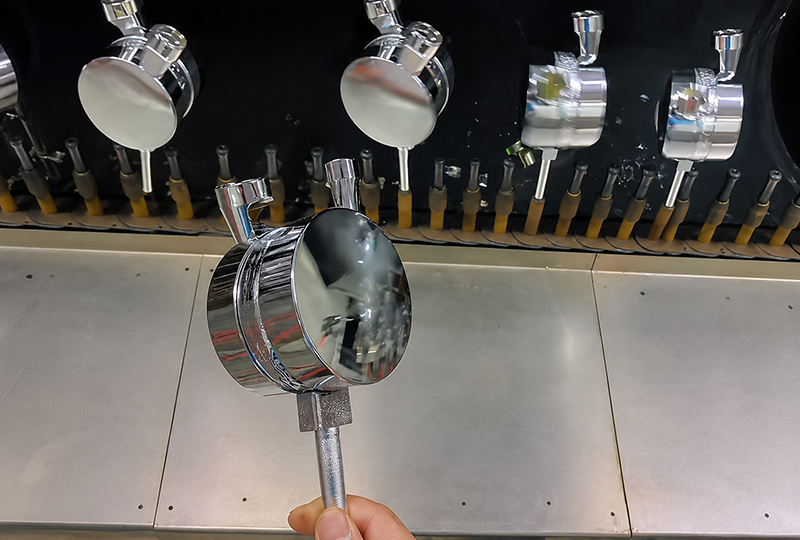
Vacuum metalizing is widely used because it can deposit a very thin metallic layer onto plastics, glass, metals, ceramics, films, and other substrates inside a vacuum chamber, creating bright decorative finishes or adding selected functional properties without making the entire part from solid metal. In decorative production, aluminum is the most common deposited metal because it evaporates efficiently, is lightweight, and forms highly reflective coatings widely used in mirrors, automotive headlamps, packaging, and consumer products. Depending on the full coating system, vacuum metalizing can improve appearance, reflectivity, light control, electrical conductivity, and certain barrier properties, but the final result depends heavily on cleaning, basecoat quality, vacuum conditions, coating thickness, part geometry, adhesion, and topcoat selection.
If you are sourcing vacuum-metalized parts for automotive trim, cosmetic packaging, electronics housings, lighting reflectors, or decorative consumer products, the key buying questions are usually not just price per part. Buyers also need to confirm substrate compatibility, Class A cosmetic zones, acceptable fixture marks, target durability, and which validation tests will be used before production approval. Those factors directly affect yield, appearance stability, and long-term field performance.
What Is Vacuum Metalizing?
Vacuum metalizing is a surface-finishing process in which a metal is evaporated inside a low-pressure vacuum chamber, travels through the chamber as vapor, and then condenses onto the exposed surfaces of a substrate as an extremely thin film. In industrial practice, decorative vacuum metalizing is commonly treated as a form of physical vapor deposition, especially when thermal evaporation is used to produce metallic, reflective, or light-controlling surfaces on production parts.
The process is especially common on injection-molded plastic parts, but it is also used on glass, selected metals, composite materials, films, fabrics, and some ceramic components, depending on the application and coating system. Common deposited metals include aluminum, chromium, copper, silver, and nickel; depending on the equipment and functional target, manufacturers may also use other evaporation materials, including zinc- or tin-containing materials. For decorative vacuum metalizing, aluminum remains the most common choice because it produces bright reflective coatings and is widely used in optical, packaging, lighting, and decorative applications.
How Does the Vacuum Metalizing Process Work?
Step 1: Part Cleaning and Surface Preparation
The process starts with cleaning. Oils, dust, mold-release residue, fingerprints, moisture, and other contaminants must be removed before coating, because contamination is a common cause of poor adhesion, haze, pinholes, and other coating defects. Industrial lines may use solvent cleaning, IPA wash, de-stat treatment, flame treatment, plasma treatment, or other pre-cleaning methods depending on the substrate and the finish target.
Surface inspection is just as important as cleaning. Because the deposited metal layer is extremely thin, vacuum metalizing does not hide major substrate defects. Scratches, sink marks, flow lines, poor mold finish, dust, and handling damage can remain visible and may become even more noticeable under a bright mirror-like coating.
Step 2: Apply the Basecoat
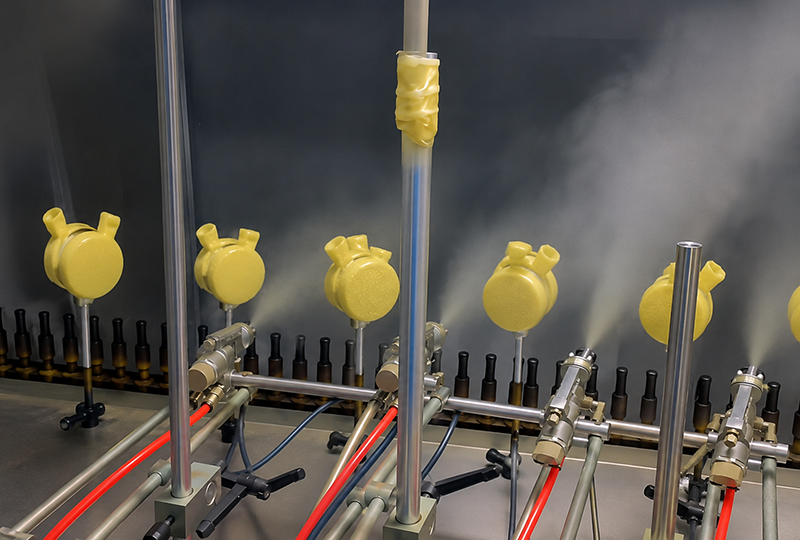
A basecoat is usually applied before metallization to create a smoother and more uniform surface, reduce the visibility of minor imperfections, promote adhesion, and increase the brilliance of the final metallic appearance. Industrial sources also note that basecoats can be UV-cured or thermally cured and may be tinted to influence the final visual effect.
For decorative parts, basecoat choice is often one of the most important process variables. If the coating is too thin, contaminated, poorly cured, or incompatible with the substrate, the result can be dullness, haze, poor adhesion, visible texture, or other appearance failures.
Step 3: Load Parts Into the Vacuum Chamber
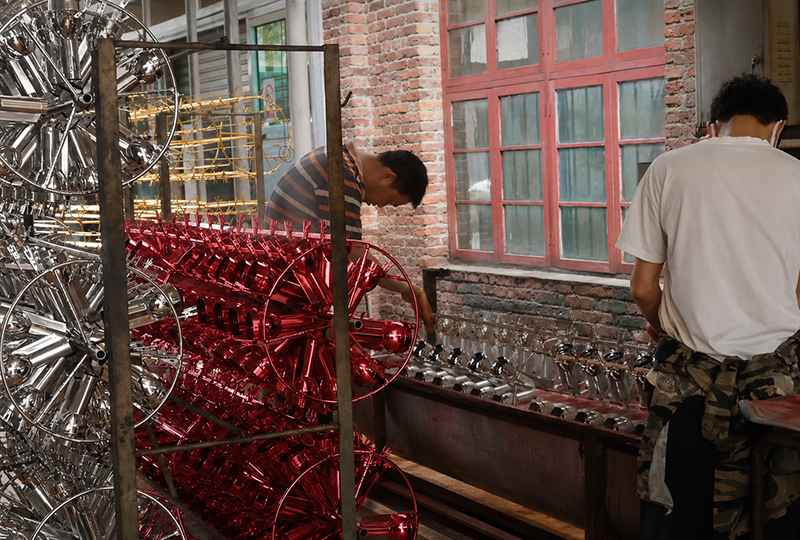
After preparation, parts are mounted on racks, fixtures, or rotating carriers. Fixturing needs to expose the surfaces that require coating while placing contact points on hidden or non-cosmetic areas whenever possible. In production equipment, molded plastic parts often undergo planetary or rotational motion above the coating sources to improve uniformity.
Uniform spacing matters. If parts are shadowed by other parts, placed too close together, or oriented poorly relative to the source, coating thickness and appearance can vary across the batch.
Step 4: Create the Vacuum
The chamber is then evacuated to low pressure. Vacuum conditions reduce collisions between vaporized metal atoms and gas molecules, help limit contamination, and support consistent transport of the vapor toward the substrate. In vacuum evaporation, the metal vapor generally follows a line-of-sight path from source to substrate, which is why part geometry and fixture design matter so much.
Step 5: Evaporate the Metal
Once vacuum conditions are established, the source metal is heated until it vaporizes. In decorative vacuum metalizing, aluminum is commonly fed as wire or other source material onto heated boats, filaments, coils, or related evaporation sources. Industrial references note that aluminum is widely used because evaporated aluminum forms bright reflective coatings for headlamps, mirrors, packages, toys, and optical applications.
Step 6: Deposit the Metallic Layer
The vaporized metal travels through the chamber and condenses on the exposed surfaces of the part, forming the metallic film. Coverage and thickness are controlled by evaporation quantity, source geometry, exposure time, part motion, and process settings. In decorative coating systems, rotation is commonly used to improve consistency, but deep recesses and shadowed zones still remain challenging because the process is fundamentally line-of-sight.
Step 7: Apply and Cure the Topcoat
After metallization, a clear or tinted topcoat is typically applied to protect the thin metallic layer from scuffing, environmental exposure, and appearance loss. Topcoats also help tune gloss, durability, and color. In decorative production, colored protective topcoats can create bright chrome, satin chrome, gold, bronze, black chrome, gunmetal, or other special metallic effects.
A simple process flow looks like this: Cleaning → Basecoat → Curing → Vacuum deposition → Topcoat → Final curing → Inspection.
If you are evaluating a new project, this is the point where most buyers should ask for a process review rather than only a unit-price quote. A good supplier should confirm material compatibility, cosmetic standards, expected environment, and fixture strategy before final pricing. Request a Quote
Coating Layers and Suitable Materials
Most production vacuum-metalized parts are not just “metal on plastic.” They are usually a multilayer coating system consisting of the substrate, a basecoat, the deposited metallic film, and a topcoat. Treating these layers as one system is important because appearance, adhesion, and durability depend on how the layers work together rather than on the metal film alone.
Coating Layers in a Vacuum-Metalized Part
The layer stack below summarizes how the system typically works.
| Layer | Main Function | Typical Materials |
|---|---|---|
| Substrate | Provides part geometry and end-use structure | Plastic, glass, ceramic, metal, composite |
| Basecoat | Smooths the surface, seals the substrate, promotes adhesion | Clear or pigmented lacquer, UV-cured or thermal-cured coating |
| Metal Layer | Creates reflective or metallic appearance; can add selected functional properties | Usually aluminum; sometimes chromium, copper, silver, nickel, or other evaporation materials |
| Topcoat | Protects the metal layer, controls gloss, adds tint, improves environmental resistance | Clear, tinted, matte, UV-resistant, or application-specific protective coating |
Suitable Substrate Materials
Plastics are the most common vacuum-metalized substrates because they allow complex molded geometries and low part weight while still delivering a premium metallic appearance. Common examples cited across industrial and applied-research sources include ABS, PC, ABS/PC blends, acrylics such as PMMA, nylon, polypropylene, polystyrene, SAN, and other engineering plastics. Some low-surface-energy plastics, especially polyolefins such as PE and PP, often require additional pretreatment or primer systems to achieve acceptable adhesion.
Glass is also used because it offers a naturally smooth surface and works well in reflective, decorative, and optical applications. Vacuum-deposited aluminum is widely used on mirrors, optical components, and reflective products, which is one reason aluminum remains so common in metallization lines.
Selected ceramic components can also be metallized when the application requires decorative, electronic, or joining-related surface functions. In ceramic metallization more broadly, thin metal films are routinely deposited onto ceramic surfaces for technical applications, though the exact process flow and metal system may differ from decorative plastic vacuum metalizing.
Vacuum metalizing can also be applied to selected metal parts and composites when the goal is appearance, reflectivity, or another thin-film function rather than the thicker wear or corrosion protection normally associated with heavy plating systems. On metal substrates, contamination, oxide layers, and surface roughness still need close control because they directly influence adhesion and coating reliability.
Common Deposited Metals
Aluminum is the default choice for many decorative and reflective jobs because it is lightweight, highly reflective, and extensively used in vacuum-deposited mirror, lighting, packaging, and optical coatings. Chromium can be selected where bright appearance, decorative styling, or certain barrier and corrosion-related functions are needed. Copper is frequently used in conductive layers, sensors, shielding systems, and circuit-related thin films. Silver is valued for reflectivity and conductivity. Nickel is also used in vacuum deposition where appearance, conductivity, or barrier-layer roles are required.
From a sourcing perspective, the key decision is not just “Which metal do I want?” It is “Which substrate–basecoat–metal–topcoat system will meet my cosmetic, functional, and durability targets at production scale?” That is the question suppliers should answer during RFQ review. Contact Us
Benefits of Vacuum Metalizing
One of the biggest commercial advantages of vacuum metalizing is that it gives lightweight molded parts the look of polished metal without the mass, machining cost, or assembly burden of making the component from metal. This is why the process is widely used in automotive trim, packaging closures, consumer goods, and electronic housings.
Aluminum-based vacuum metalizing can also create very high reflectivity, which makes the process especially useful for lighting reflectors, optical components, mirrors, headlamps, flashlights, and light-management systems. Industrial coating suppliers cite high reflectivity and broad use in automotive, lighting, electronics, and optical sectors as core reasons aluminum remains dominant.
Decorative flexibility is another major benefit. By pairing the metallic film with different basecoats and topcoats, manufacturers can create bright chrome-like finishes, satin metallic surfaces, gold and bronze tones, black chrome, colored chrome effects, and other appearance variants that help brands differentiate products in retail environments.
Material consumption is low because the deposited film is extremely thin compared with bulk metal construction or thicker plating systems. That thin-film nature can reduce weight and metal usage while preserving complex molded geometry. Multiple components can also be processed in a single chamber cycle, making the process well suited to repeatable batch production when fixturing and process control are well developed.
Depending on the coating system, vacuum metalizing may also add functional properties such as light reflection, light blocking, electrical conductivity, EMI/RFI shielding, heat reflection, or improved moisture and oxygen barrier performance. These functional outcomes should always be validated by testing because actual performance depends on layer continuity, thickness, substrate, and topcoat design.
Limitations, Common Problems, and Quality Inspection
Vacuum metalizing has clear advantages, but it is not a universal replacement for plating or other finishing methods. The deposited metal film is thin and can be delicate on its own, so it normally requires a protective topcoat when abrasion, chemical contact, moisture, or outdoor exposure are expected. Without appropriate protection, the metallic layer can rub off, scratch, discolor, or lose appearance.
Another major limitation is line-of-sight deposition. Because the vapor largely travels directly from the source to the exposed surface, deep recesses, undercuts, narrow internal channels, and shadowed zones often receive less coating. Part rotation and fixturing improve coverage, but they do not eliminate all shadowing on difficult geometries.
Adhesion failure is one of the most common production risks. Likely causes include poor cleaning, incompatible basecoat chemistry, insufficient surface activation, oxide or contaminant layers, silicone or mold-release residue, incomplete curing, or weak bonding between the basecoat and substrate. Appearance problems such as dullness, fish-eyes, haze, cloudiness, and non-uniform coating may also stem from contamination, poor basecoat coverage, dust, thin basecoat, or fixturing problems.
Outdoor durability also has limits unless the finish is engineered for that service environment. UV exposure, humidity, thermal cycling, salt, cleaners, and abrasion can all degrade the finish, which is why exterior programs should specify environmental and appearance validation up front rather than relying on visual approval alone.
A practical troubleshooting guide is below. The causes and actions are summarized from common industrial failure modes reported by coating suppliers and technical references.
| Problem | Likely Cause | Recommended Action |
|---|---|---|
| Peeling or delamination | Contamination, poor pretreatment, weak basecoat adhesion | Improve cleaning, pretreatment, curing, and adhesion testing |
| Dull appearance | Rough or thin basecoat, contamination, insufficient curing | Improve basecoat quality, curing control, and cleanliness |
| Uneven coating | Fixture shadowing, poor orientation, inconsistent rotation | Redesign rack layout and part orientation |
| Scratches or rub-off | Weak or missing topcoat | Upgrade protective topcoat and validate abrasion targets |
| Color or gloss variation | Uneven topcoat/basecoat thickness, substrate variation, process drift | Tighten coating thickness control and standardize incoming parts |
| Pinholes or particles | Dust, porosity, poor filtration, residue | Improve cleaning, sealing, filtration, and handling control |
Quality Inspection
Quality inspection for vacuum-metalized parts usually begins with visual evaluation. Cosmetic inspectors look for color consistency, reflectivity, gloss, complete coverage, fixture marks, dust particles, pinholes, streaks, scratching, cloudiness, and burn-like defects. Because appearance language can be subjective, approved reference samples are often more useful than broad descriptors such as “bright chrome” or “satin silver.”
Adhesion is commonly checked with tape-based methods such as the ASTM D3359 adhesion test. Depending on the coating system and substrate, the test can help identify inadequate cleaning, weak intercoat bonding, poor curing, or insufficient adhesion between the basecoat and the underlying part. Additional environmental conditioning may be performed before or after adhesion testing to evaluate application durability.
Thickness and uniformity can be more difficult to verify than in thicker plating systems because the deposited metallic layer is extremely thin. Depending on the part and coating specification, manufacturers may use cross-sectional microscopy, reflectivity, electrical conductivity, or other indirect performance measurements together with approved samples. The ASTM B487 coating-thickness method provides a recognized approach for measuring the local thickness of metal and oxide coatings through microscopical examination of prepared cross sections.
Functional and environmental validation should match the end use. Common evaluations include reflectance, electrical resistance, EMI/RFI performance, humidity resistance, accelerated UV exposure, abrasion resistance, and salt-spray testing where corrosion exposure is relevant. Widely cited standards include ASTM D2247 for humidity exposure, ASTM D4587 for fluorescent UV and water exposure, ASTM D4060 for abrasion resistance of organic coatings, and ASTM B117 for salt spray.
Vacuum Metalizing Applications
Vacuum metalizing is used across industries where manufacturers need premium metallic appearance, high reflectivity, reduced weight, or selected technical performance from a thin deposited film. Automotive applications include interior trim, emblems, grilles, lighting reflectors, instrument details, and decorative control components. The long-standing use of evaporated aluminum on headlamp reflectors and automotive trim is one of the clearest examples of the process at scale.
In consumer electronics, vacuum metalizing is used on housings, bezels, decorative covers, trim rings, buttons, display components, and shielding-related enclosures. Conductive coating systems may also support EMI/RFI control when coating continuity, thickness, grounding, and electrical performance are properly validated.
Lighting and reflector applications are another major category. Vacuum metalized aluminum is widely used in headlamps, flashlights, projectors, LEDs, decorative lamps, and optical reflectors because it can direct and intensify light while keeping parts lightweight.
Packaging and beauty products use vacuum metalizing to create premium-looking bottle caps, cosmetic containers, fragrance packaging, spirits closures, and decorative retail components. Decorative films and packaging structures also use metallization to add appearance, light barrier, and selected moisture or oxygen barrier properties.
Consumer products and industrial parts also use the process for appliance trim, toys, furniture accents, sensors, light-blocking parts, control panels, and decorative hardware. In technical sectors, multi-layer vacuum metalized systems may be selected for conductivity, heat shielding, vapor barrier performance, or reflective functionality rather than appearance alone.
| Industry | Example Parts | Primary Purpose |
|---|---|---|
| Automotive | Trim, emblems, reflectors, panels | Appearance and reflectivity |
| Electronics | Housings, bezels, buttons, covers | Cosmetic finish and shielding |
| Lighting | Reflectors, LED optics, flashlights | Light control |
| Packaging | Caps, containers, closures | Premium appearance |
| Consumer goods | Knobs, trim, decorative parts | Lightweight metallic finish |
| Industrial | Sensor housings, conductive or barrier parts | Functional thin-film performance |
Design Considerations and Vacuum Metalizing vs Other Finishing Processes
Good results start at the design stage. Because vacuum evaporation is line-of-sight, designers should avoid requiring perfectly uniform metallic coverage inside deep recesses, narrow slots, hidden pockets, and difficult undercuts. Drawings should identify which areas are cosmetic, which areas may be shadowed, and where rack contact points or masked zones are acceptable.
For plastic parts, molded surface quality matters. A bright metallic finish can emphasize sink marks, weld lines, flow marks, scratches, and inconsistent mold texture, so DFM review should address resin choice, surface finish, release-agent control, and handling protection before coating starts. Tight assemblies may also need masking or extra clearance because the full basecoat–metal–topcoat system adds measurable thickness even when the metal layer itself is thin.
The final service environment should be validated intentionally. If the part will face humidity, cleaners, UV, thermal cycling, abrasion, or corrosive exposure, the finish specification should include the corresponding tests before production launch. A supplier quote is more reliable when it is based on drawings, cosmetic zone definitions, finish samples, annual volume, and performance requirements rather than on appearance terms alone.
From a buying perspective, vacuum metalizing is most attractive when you need a lightweight metallic look, reflective performance, or functional thin-film properties on plastic or mixed-material parts. Electroplating generally produces a thicker deposited metal layer through an electrolytic bath and electrical current, while anodizing is a conversion process that turns the aluminum surface itself into aluminum oxide rather than depositing a separate metal film. Metallic painting uses metallic pigments or flakes dispersed in a coating film, whereas vacuum metalizing creates a deposited metal layer, which is why it usually delivers stronger mirror-like reflectivity. Powder coating is primarily used on conductive grounded substrates such as metals and generally provides a thicker polymer coating for color, corrosion protection, and surface durability.
| Process | Typical Substrate | Coating Character | Common Purpose |
|---|---|---|---|
| Vacuum metalizing | Plastic, glass, selected metals, composites, some ceramics | Very thin deposited metal film | Reflective and decorative finish, selected functional thin-film properties |
| Electroplating | Conductive metal or treated plastic | Thicker metal layer deposited by electrical current in solution | Appearance, wear, and corrosion-related performance |
| Metallic painting | Many materials | Pigmented paint film with metallic flakes or pigments | Decorative metallic look |
| Anodizing | Mainly aluminum | Converted oxide layer integrated with substrate | Corrosion, wear, and appearance |
| Powder coating | Mostly conductive grounded substrates | Polymer coating | Protection and color |
If you are choosing between these options for a new product, the best route is usually a short engineering review. Send your 2D/3D files, target finish photos, annual volume, and test requirements to Shenzhen Sincere Mold Technology Co., Ltd. for a coating recommendation and quote.
Conclusion
Conclusion
Vacuum metalizing deposits a thin metallic layer onto a substrate inside a vacuum chamber and is most often used to create reflective, decorative, or selected functional surfaces. Aluminum is the most common deposited metal because it is lightweight, economical, and highly reflective, which is why it appears so often in lighting, packaging, automotive, and consumer applications. In real production, successful vacuum-metalized parts usually rely on a multilayer system of substrate, basecoat, metal film, and protective topcoat rather than on the metal layer alone. The process offers strong advantages in appearance, weight reduction, design flexibility, and batch production, but it also has clear limits: line-of-sight coverage, sensitivity to substrate defects, and the need for disciplined cleaning, fixturing, curing, and inspection. Before production, buyers should define cosmetic zones, masking, performance tests, and approved finish samples so suppliers can quote and validate the process correctly.
FAQ About Vacuum Metalizing
What materials can be vacuum metalized?
Vacuum metalizing can be applied to many plastics, glass, selected metals, composites, films, fabrics, and some ceramic components when the substrate and coating system are prepared correctly. Plastics such as ABS, PC, ABS/PC blends, acrylics, nylon, polystyrene, and polypropylene are common, although lower-surface-energy materials often need pretreatment or primers to improve adhesion.
What metal is commonly used in vacuum metalizing?
Aluminum is the most commonly deposited metal in decorative vacuum metalizing because it evaporates efficiently and is widely used where bright reflectivity and low weight matter. Industrial sources also identify chromium, copper, silver, and nickel as important evaporation materials for other decorative, optical, or conductive uses.
Is vacuum metalizing durable?
It can be durable enough for many commercial products, but the metallic layer itself is thin and usually needs a properly selected topcoat when abrasion, chemicals, moisture, or outdoor exposure are expected. Durability should be validated with tests such as adhesion, humidity, UV, abrasion, and salt spray when the application requires them.
What is the difference between vacuum metalizing and electroplating?
Vacuum metalizing forms a thin deposited metal film by evaporating metal in a vacuum chamber, while electroplating deposits metal through an electrolytic solution with electrical current. In general, electroplating produces a thicker metal layer, whereas vacuum metalizing is often preferred for lightweight decorative plastic parts, reflective systems, and certain functional thin-film applications.