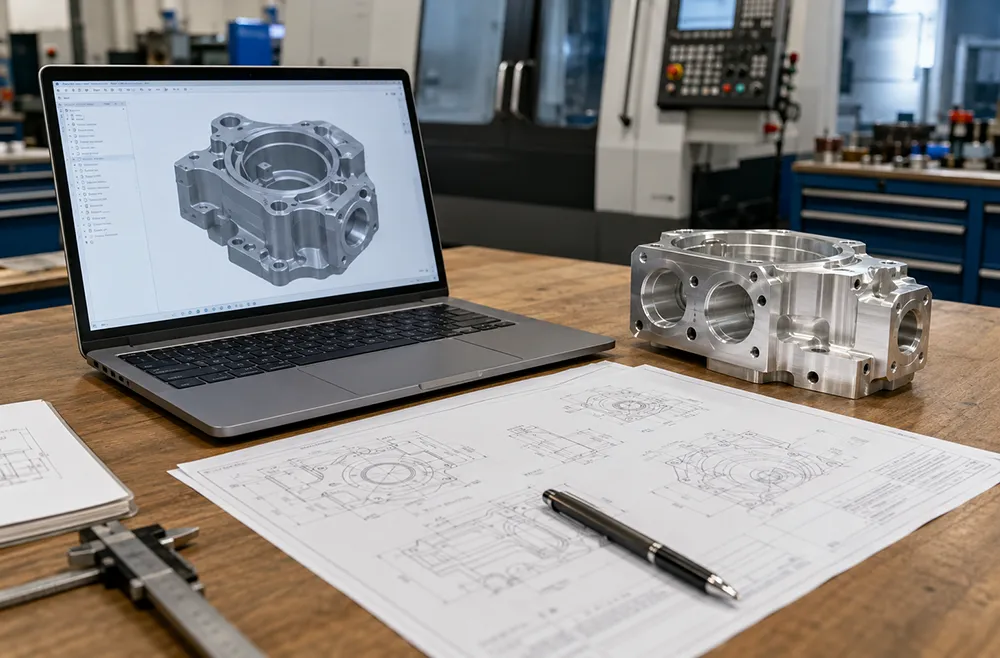
To get an accurate CNC machining quote, you should normally provide a 3D CAD model, a 2D engineering drawing when critical dimensions or tolerances are involved, material requirements, quantity, surface finish, and any inspection or special quality requirements.
A complete RFQ package allows the machining supplier to evaluate part geometry, material, programming and setup requirements, tolerances, finishing, inspection, and production volume before preparing a quotation. Missing or unclear information may require additional engineering questions, force the supplier to make assumptions, or result in pricing changes once the requirements are clarified.
The checklist below explains what files are needed for a CNC machining quote, what information should be included, and when a 2D engineering drawing should be provided in addition to the 3D CAD model.
What Do You Need to Send for a CNC Machining Quote?
A good CNC machining RFQ should give the supplier enough information to understand both what the part looks like and how the finished part must perform and be accepted. CNC suppliers commonly use 3D models together with drawings, material selections, finishing instructions, quantity, and quality requirements during quoting and manufacturing preparation.
Here is the basic CNC machining quote requirements checklist:
| RFQ Item | What to Provide |
|---|---|
| 3D CAD model | STEP/STP or another supported solid CAD format |
| 2D engineering drawing | Critical dimensions, tolerances, GD&T, threads, datums, surface requirements |
| Material | Material family and exact alloy or grade where required |
| Quantity | Prototype quantity, initial batch, and/or production volume |
| Surface finish | As-machined, bead blasted, anodized, plating, polishing, powder coating, etc. |
| Inspection | Standard inspection, dimensional report, CMM inspection, FAI, certificates, if required |
| Special requirements | Marking, packaging, assembly, traceability, cosmetic requirements, or other project notes |
Not every project requires every item in this checklist. A simple prototype may be quotable from a solid CAD model, material, and quantity, while a precision production component may require a detailed 2D drawing, GD&T, inspection documentation, and material certification.
During quotation review, the key question is whether the files clearly define the geometry, material, quantity, critical tolerances, finishing requirements, and acceptance criteria. If one of these items is unclear, the engineering team may need additional information before the manufacturing process and price can be confirmed.
The goal is not to send more documents than necessary—it is to make every requirement that affects manufacturing, inspection, or acceptance clear before quotation.
Which CAD File Format Is Best for CNC Machining Quotes?
For most CNC machining RFQs, STEP/STP is the safest default format when sharing a 3D model between different CAD systems and machining suppliers. It preserves solid geometry accurately and is widely supported in CAD/CAM workflows.
If you are unsure which format to send, start with a clean STEP file and include the original native CAD file only when the supplier specifically requests it.
STEP / STP
A STEP (.step or .stp) file is a widely used neutral format for exchanging product-model data between different CAD and manufacturing systems. STEP is standardized under ISO 10303, making it particularly useful when the customer and machining supplier use different software.
In practical terms, when a supplier asks, “Can you send the 3D model?” and does not specify another format, sending a STEP file is often the simplest solution.
IGES and Parasolid
IGES (.igs/.iges) and Parasolid (.x_t/.x_b) may also be suitable when STEP is unavailable or when the supplier specifically requests them. Parasolid can be particularly useful when both CAD systems support the format.
Because supported formats vary between suppliers, confirm file compatibility when submitting an RFQ through an online system.
STL
STL is generally not the preferred format for precision CNC machining quotes when a solid CAD model is available. An STL represents the part as a triangle-based mesh rather than mathematically defined solid geometry, which can make it less suitable for communicating precise machined geometry.
Whenever possible, send the original solid CAD model—preferably STEP/STP—instead of converting the part to STL.
Do I Need a 2D Drawing If I Already Have a 3D Model?
Not always, but a 2D drawing is strongly recommended when the part has requirements that cannot be communicated by nominal 3D geometry alone.
A 3D model defines the nominal shape of a part, but it may not communicate every requirement that affects manufacturing and inspection. A 2D engineering drawing can specify critical dimensional tolerances, GD&T, datums, threads, surface finishes, inspection criteria, and other manufacturing notes that are not fully defined by nominal 3D geometry.
ASME Y14.5 provides standardized rules for communicating geometric dimensioning and tolerancing through engineering drawings and digital product definitions.
For a simple prototype using standard machining tolerances, the 3D model may be sufficient. For precision or production parts, however, a 2D drawing helps identify which dimensions and requirements are function-critical and reduces ambiguity before quotation.
| 3D Model Only May Be Enough | Add a 2D Drawing When |
|---|---|
| Simple prototype geometry | Tight tolerances are required |
| Standard features | GD&T controls are required |
| No special inspection | Datums or critical dimensions must be controlled |
| Standard/as-machined condition | Threads or surface finish requirements apply |
| Supplier’s default tolerances are acceptable | Inspection or certification requirements apply |
Common RFQ Mistake: The CAD Model and Drawing Do Not Match
Before submitting an RFQ, make sure the 3D CAD model and 2D engineering drawing represent the same revision of the part.
If the drawing specifies one dimension, tolerance, thread, or feature while the CAD model shows something different, the supplier must determine which requirement takes precedence before the quotation or manufacturing plan can be finalized.
Clearly identify the part number and revision level on the drawing and confirm that the corresponding CAD file is the current version.
What Material and Quantity Information Should Be Included?
Have Your CAD Files Ready?
Send us your 3D CAD model, drawing, material, and quantity. Our engineering team can review your files, identify any missing information, and clarify the manufacturing requirements before quotation.
Writing only “aluminum” or “stainless steel” may leave important decisions unresolved. When the material affects function, specify the exact alloy, grade, and condition required.
A single material family can include many alloys or grades with different mechanical properties, machinability, corrosion resistance, heat-treatment conditions, availability, and raw-material costs.
For example:
Better: Aluminum 6061-T6
Less specific: Aluminum
Likewise, specifying only “stainless steel” may leave the exact grade unresolved because 303, 304, 316, and 17-4PH can have different properties and machining requirements.
Your RFQ should ideally state:
Material family → exact grade → temper or condition where relevant → whether substitutes are allowed.
When the exact material is not yet known, you can still request a quote. Explain the application and key requirements—such as strength, corrosion resistance, weight, temperature exposure, or cost target—and ask the supplier to recommend an appropriate machinable material. If you are still comparing material options, our CNC machining materials guide covers commonly machined metals and plastics and their key selection considerations.
Quantity is equally important. Tell the supplier whether you need 1 piece, 10 pieces, 100 pieces, 1,000 pieces, or another volume. CNC pricing is not simply the price of one part multiplied by quantity because programming, machine setup, and fixturing create job-level costs that can be distributed across more parts.
For B2B projects that may move into production, provide both numbers when possible:
Prototype quantity: 5 pcs
Estimated production volume: 500 pcs per batch / 2,000 pcs annually
That gives the supplier more useful information for evaluating both prototype and production pricing.

Which Tolerance, Surface Finish, and Inspection Requirements Should You Specify?
Your RFQ should clearly identify the tolerances and acceptance requirements that actually affect part function rather than applying unnecessarily tight specifications to every dimension.
Critical tolerances
Call out the dimensions and geometric controls that are functionally important. Tighter tolerances can require additional finishing passes, more controlled machining conditions, and additional inspection.
Some GD&T requirements may also require advanced measurement methods such as CMM inspection rather than basic hand measurement. These requirements should be identified before quotation because they can affect machining strategy, inspection time, documentation, cost, and lead time.
Avoid assigning an extremely tight tolerance such as ±0.01 mm to every dimension unless the design genuinely requires it. Instead, clearly identify mating surfaces, hole locations, diameters, flatness, position, runout, or other features that directly affect fit, assembly, or performance.
Surface finish
Specify the required condition of the part after machining. Common finishing options include:
As-machined, bead blasting, anodizing, powder coating, electroless nickel plating, polishing, black oxide, and passivation.
For cosmetic components, also identify appearance surfaces and specify requirements such as color, gloss, texture, masking areas, or cosmetic acceptance criteria where necessary.
Avoid writing only “anodized” when the anodizing type, color, thickness, masking, or appearance requirement affects the finished component.
Inspection requirements
Inspection requirements should be included in the RFQ rather than added after pricing whenever they are contractual requirements. Depending on the project, this may include standard dimensional inspection, a dimensional report, CMM inspection, First Article Inspection (FAI), material certification, Certificate of Conformity (CoC), or material traceability.
Additional inspection, documentation, and certification requirements can affect inspection time, cost, and production lead time. Defining them before quotation reduces the risk of pricing or delivery changes later.
What Information Is Commonly Missing From CNC RFQs?
Many quote delays are not caused by complicated geometry. They happen because the supplier needs clarification before the manufacturing requirements are defined.
The most important items to check are quantity, material, tolerance requirements, surface finish, drawings, and inspection requirements. Also verify that the revision of the 2D drawing matches the revision of the 3D CAD model; conflicting model and drawing data can trigger clarification before manufacturing.
CNC Machining RFQ Checklist Before You Send Your Files
Before sending your RFQ, confirm:
- 3D CAD model attached, preferably STEP/STP or another supported solid format
- 2D engineering drawing attached when tolerances or manufacturing notes require it
- Material family and grade specified
- Prototype and/or production quantity specified
- Critical tolerances and GD&T identified
- Surface finish and cosmetic requirements specified
- Inspection and certification requirements included
- Threads, markings, packaging, assembly, or other special notes included
- Drawing and CAD revisions match
- Contact, part number, revision, and project information are clear
A complete RFQ package allows the supplier to evaluate the part geometry together with the requirements that determine how the component must be machined, finished, inspected, and accepted.
The objective is not to send unnecessary documentation. It is to make every requirement affecting manufacturing, quality, cost, or lead time clear before quotation.
Ready to Request a CNC Machining Quote?
Send your CAD files, engineering drawings, material, quantity, finish, tolerance, and inspection requirements for engineering review.
FAQ About CNC Machining Quotes
Can I get a CNC quote with only a STEP file?
Yes. A STEP file may be sufficient for a simple part when the supplier’s standard tolerances, surface condition, and inspection requirements are acceptable. If the component includes tight tolerances, threads, GD&T, special surface finishes, or specific inspection requirements, include a 2D engineering drawing as well.
Is a 2D drawing required for CNC machining?
Not for every part. A solid 3D model can communicate nominal geometry, but a drawing becomes important when additional manufacturing information must be controlled. This commonly includes tolerances, GD&T, threads, datums, critical dimensions, and inspection requirements.
Can I request a quote if I do not know the exact material?
Yes. You can begin an RFQ by providing the intended application and performance requirements. However, before final production, the material specification should be sufficiently clear for the supplier to select and verify the correct stock. Material families can contain many different alloys and grades with different properties and finishing options.
What information can delay a CNC machining quote?
Missing or conflicting manufacturing requirements are common reasons a CNC machining quotation may require additional clarification. Pay particular attention to quantity, material grade, critical tolerances, surface finish, inspection requirements, and CAD/drawing revision consistency.
Providing these requirements clearly at the beginning of the RFQ helps reduce unnecessary engineering questions and makes it easier for the supplier to prepare a complete quotation.