Aluminum sits in an awkward place between everyday language and physics. In everyday shop talk, the answer to “is aluminum magnetic?” is usually no because a hand magnet or refrigerator magnet will not stick to it. In physics, the fuller answer is that aluminum is paramagnetic: it has a very weak positive response to an external magnetic field, but nowhere near the strong, obvious magnetism of iron or carbon steel. References from National Institute of Standards and Technology and the National High Magnetic Field Laboratory both support that distinction, and industrial materials guides therefore describe aluminum as non-magnetic for practical engineering use.
The confusion exists because aluminum is a metal, it conducts electricity very well, it looks similar to many other silver-colored metals, and it can behave dramatically around moving magnetic fields through eddy-current effects. That combination leads many people to assume that if aluminum interacts with magnets at all, it must be magnetic in the same way steel is. It is not. This guide explains the science, clears up the most common myths, compares aluminum with other metals, and shows why its practical “non-magnetic” behavior matters in manufacturing, electronics, medicine, and recycling.
Is aluminum a magnetic metal?
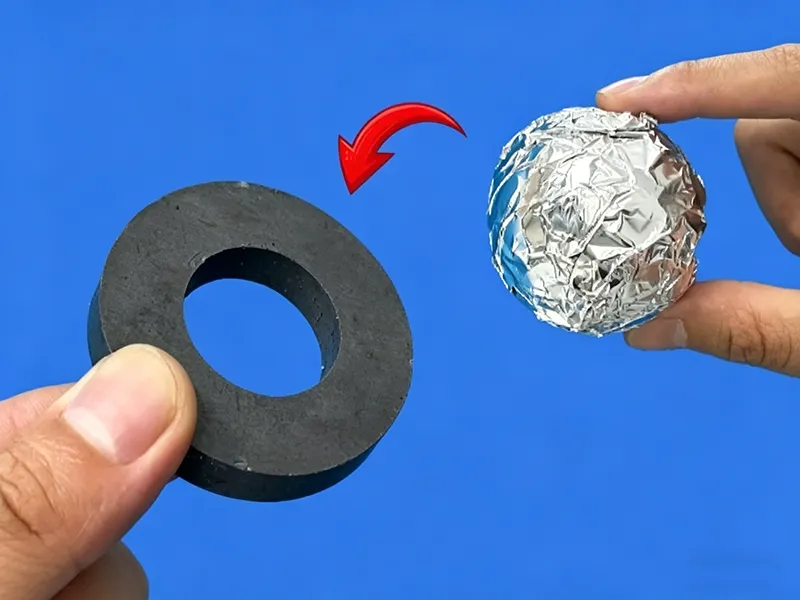
If you mean “Will a normal magnet stick to aluminum?” the answer is usually no. Aluminum is not a ferromagnetic metal like iron, nickel, cobalt, or most carbon steels. That is why a magnet will cling to a steel cabinet, steel screw, or cast-iron pan but usually fall right off an aluminum sheet, extrusion, can, or foil roll. In shop-floor language, that makes aluminum a non-magnetic metal.
If you mean “Does aluminum have any magnetic response at all?” the answer is yes, but very weakly. NIST explicitly identifies aluminum as paramagnetic, which means its magnetic response is positive but tiny. Paramagnetic materials do not keep magnetization after the field is removed, and their response is so small that in everyday conditions it is often imperceptible. That is why “a magnet does not stick” should not be confused with “the material has absolutely no magnetic behavior.”
Why a magnet usually does not stick to aluminum
Ordinary permanent magnets create fields that are strong enough to make ferromagnetic materials react dramatically, but aluminum’s response is much weaker. In practical terms, the force is far too small for a kitchen magnet, pickup magnet, or ordinary shop magnet to grip an aluminum part the way it grips steel. By contrast, engineering references from Hydro describe aluminum as non-magnetic for practical use, which is how most designers, machinists, and recyclers treat it.
People often misread the hand-magnet test because they expect all metals to behave like iron-based metals. They also encounter aluminum in mixed assemblies that include steel fasteners, inserts, bearings, or brackets. In those cases, the magnet is reacting to the other component, not to the aluminum itself. MRI safety guidance from Duke even warns that objects are rarely made of a single metal, which is one reason a magnet test is useful only as a first screening step, not as a complete material identification method.
The Science Behind Aluminum Magnetism
Aluminum and paramagnetism
To understand why aluminum is usually considered non-magnetic, it helps to separate three common magnetic categories. Ferromagnetic materials show a strong attraction to magnetic fields and can retain magnetization. Paramagnetic materials align weakly with an external field and then lose that alignment when the field is removed. Diamagnetic materials respond in the opposite direction and are weakly repelled. The National High Magnetic Field Laboratory notes that only a few naturally occurring materials are ferromagnetic, while all materials show some kind of magnetic response at some level.
Aluminum falls into the paramagnetic category, not the ferromagnetic one. That is the key fact behind the entire “is aluminum magnetic?” question. It means aluminum does respond to a field, but not strongly enough to behave like steel in ordinary life. In design practice, inspection, and purchasing, that weak response is generally so small that engineers describe aluminum as non-magnetic, even though a physicist would call that wording an oversimplification.
Ferromagnetic, paramagnetic, and diamagnetic behavior in simple terms
A useful way to think about the difference is intensity. Ferromagnetic metals such as iron-rich steel react so strongly that a hand magnet makes the effect obvious. Paramagnetic metals such as aluminum react in the same general direction as the external field, but only faintly. Diamagnetic metals such as pure copper react in the opposite direction, also faintly. NIST’s classic copper data identifies pure copper as diamagnetic, while its aluminum data identifies aluminum as paramagnetic, showing that two common nonferrous metals can both look “non-magnetic” to your hand even though their physics is not identical.
This difference matters because a yes-or-no magnet test hides the underlying physics. If a magnet sticks strongly, you are probably dealing with a ferromagnetic material. If it does not stick, the part might be aluminum, copper, brass, certain stainless steels, titanium, or another nonferromagnetic material. So the absence of attraction tells you something useful, but not everything.
Why moving magnetic fields matter more than fridge magnets
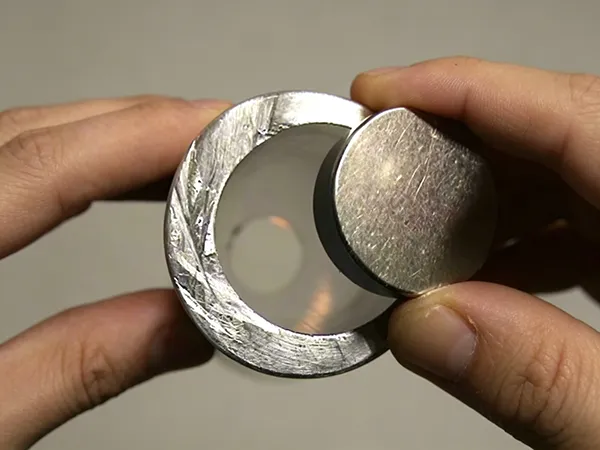
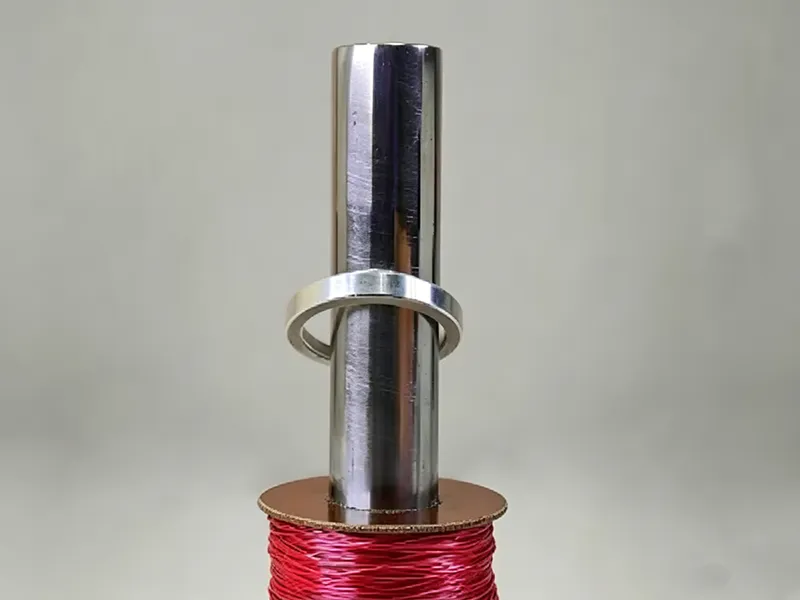
Here is where aluminum becomes more interesting. A moving magnetic field can induce eddy currents in conductive materials such as copper or aluminum. The National High Magnetic Field Laboratory explains that changing magnetic fields create currents in conductors, and those induced currents create magnetic fields that oppose the incoming field. That is a completely different phenomenon from a static magnet merely “sticking” to a part.
That is why a strong magnet can appear to “interact” with aluminum in surprising ways. For example, when a magnet moves relative to an aluminum plate or falls through a conductive tube, the motion can be slowed by eddy-current braking. Recycling systems exploit the same effect at industrial scale: time-varying magnetic fields induce currents in conductive nonferrous particles and deflect them away from the waste stream. So aluminum can absolutely interact with magnets, just not in the ordinary ferromagnetic sense that most people mean when they ask whether a metal is magnetic.
Common Myths and Everyday Examples
Myth: Aluminum is magnetic like steel
This is the most common misunderstanding, and it is false. Steel’s strong magnetic behavior comes from its iron-rich composition; the World Steel Association notes that steel is typically 98% to 99% iron, and that iron atoms give steel its magnetic properties. Aluminum does not share that ferromagnetic structure, so the comparison breaks down immediately. If you hold the same magnet to carbon steel and aluminum, steel normally offers a strong pull and aluminum does not.
Myth: If a magnet does not stick, the metal is not conductive
This is also false. Magnetic behavior and electrical conductivity are not the same property. Aluminum wiring is widely used for transmission and distribution, and the Aluminum Association notes that aluminum provides twice the conductivity per pound compared with copper in wiring applications. Hydro likewise describes aluminum as second only to copper in conductivity while also describing it as non-magnetic. A metal can therefore be a very good conductor and still ignore an ordinary hand magnet.
Myth: All silver-colored metals behave the same around magnets
Everyday appearance is a poor guide to magnetic behavior. Aluminum is weakly paramagnetic, pure copper is diamagnetic, many austenitic stainless steels are effectively non-magnetic to a hand magnet, and many ferritic or martensitic stainless steels are magnetic. The British Stainless Steel Association specifically notes that austenitic stainless steels have very low permeability and can be classed as non-magnetic, whereas ferritic, martensitic, and duplex grades are ferromagnetic. So color tells you almost nothing by itself.
Myth: Aluminum can never interact with magnets
This myth comes from equating “non-magnetic” with “magnetically irrelevant.” In reality, aluminum can interact strongly with changing magnetic fields because it is conductive. The same eddy-current principle that blocks electromagnetic waves in a Faraday cage also makes industrial eddy-current separators useful for sorting nonferrous scrap. In other words, it is entirely possible for aluminum to show a dramatic magnetic-field-related effect without ever behaving like a ferromagnetic metal.
Everyday examples: foil, cans, parts, and electronics
In daily life, aluminum foil and beverage cans are familiar reminders that aluminum is normally treated as non-magnetic. The Royal Society of Chemistry describes aluminum foil as a flexible, durable packaging material and identifies the beverage can as one of aluminum’s most recognizable forms. Those products do not become “magnetic” just because they are metal; a normal magnet still will not stick to them.
The same logic applies to aluminum parts in electronics and consumer devices. Hydro notes that aluminum is used in electrical applications, enclosures, heat sinks, and phone or communication device components because of its conductivity, heat transfer properties, low weight, and non-magnetic nature. So in real life, aluminum’s practical identity is not “a metal magnets love,” but rather “a lightweight, conductive, corrosion-resistant metal that usually stays out of the magnet conversation unless motion or induction is involved.”
Aluminum Compared With Other Metals
Aluminum vs steel
For most people, this is the comparison that matters most. Aluminum is usually chosen when low weight, corrosion resistance, machinability, and minimal response to static magnetic fields are valuable. Steel is chosen when high strength, stiffness, wear resistance, and strong magnetic behavior are advantages. The Aluminum Association emphasizes aluminum’s strength-to-weight ratio and notes that aluminum structures can weigh substantially less than steel while providing comparable strength in many applications, whereas worldsteel highlights steel’s iron-driven magnetic properties.
That difference explains why a magnet is often useful in quick scrap sorting: steel is readily captured by magnetic separation, while aluminum is not. It also explains why aluminum is common in applications where unwanted magnetic attraction would be inconvenient, and why steel remains dominant where magnetic coupling, magnetic transport, or simple magnet-based sorting is helpful.
Aluminum vs iron
Iron is the clearer scientific contrast because it is one of the classic ferromagnetic materials listed by the National High Magnetic Field Laboratory. If you want a metal that obviously reacts to a hand magnet, iron is the textbook example. Aluminum, by comparison, is the metal that helps explain why “metal” and “magnetic” are not synonyms. Iron’s magnetism is strong and easy to observe; aluminum’s is weak and usually invisible outside lab conditions or induction-based systems.
Aluminum vs stainless steel
Stainless steel causes confusion because the word “steel” makes people assume strong magnetism, but stainless families differ significantly. The British Stainless Steel Association explains that austenitic grades are usually described as non-magnetic because their response to a hand-held magnet is negligible, while ferritic, martensitic, and duplex grades are usually classified as magnetic. That means aluminum and some stainless steels can both seem non-magnetic in day-to-day testing, even though they are different materials with different densities, costs, strength levels, and corrosion behavior.
This is one reason a magnet test alone is not enough when trying to identify a silver-gray part. A non-sticking part might be aluminum, but it could also be an austenitic stainless steel grade. That is why technicians usually combine magnet checks with weight, spark behavior, hardness, and sometimes conductivity or XRF analysis before making a final call.
Aluminum vs copper
Aluminum and copper are both common nonferrous engineering metals, but they are not magnetically identical. NIST identifies pure copper as diamagnetic and aluminum as paramagnetic. In normal everyday use, though, both materials tend to seem “non-magnetic” because neither one reacts strongly to a hand magnet. The more relevant engineering differences are often conductivity, density, cost, and weight. Aluminum is lighter; copper is the stronger conductor per cross-sectional area, while aluminum performs very well per unit weight and is widely used in electrical transmission.
Why Aluminum’s Weak Magnetism Matters in Engineering and Recycling
Material selection in manufacturing and electronics
In practical engineering, aluminum’s weak magnetic response is valuable because it combines with several other useful traits. Materials guidance from The Aluminum Association and Hydro repeatedly highlights aluminum’s low weight, corrosion resistance, good conductivity, good heat transfer, and practical non-magnetic behavior. That makes it attractive for electrical enclosures, conduit, busbars, heat sinks, cable housings, and other parts that should not strongly couple with static magnetic fields.
This matters especially in electronics and communications hardware. Hydro explicitly states that aluminum is used for enclosures, cabinets, computer installations, electric motor housings, heat sinks, and communication devices, and describes it as non-magnetic, non-sparking, and rust-resistant. So the answer to “why do engineers care whether aluminum is magnetic?” is not just academic accuracy. The property helps shape real material choices in products people use every day.
Aerospace, medical settings, and consumer products
Aerospace is one of the clearest examples of why aluminum’s broader material package matters, even though magnetism is rarely the only deciding factor. The Aluminum Association explains that aviation and aerospace depend on aluminum because it is lightweight, durable, mechanically stable, and able to manage demanding conditions. In that context, the practical non-magnetic nature of aluminum complements more decisive advantages such as mass reduction and corrosion resistance.
Medical environments add an important nuance: non-ferromagnetic does not automatically mean universally “MRI safe.” Duke’s MRI safety guidance notes that aluminum itself is not ferromagnetic, which is why it does not present the same projectile hazard as steel near an MRI magnet. At the same time, medical references warn that non-ferromagnetic conductive materials can still create heating, induced currents, or image artifacts under some MRI conditions. That is why aluminum can be useful in MRI-compatible designs, but still requires application-specific evaluation rather than blanket assumptions.
Consumer products show the same theme in a simpler form. Phones, laptops, and other communication devices often use aluminum because it is light, durable, thermally useful, and non-magnetic. Here the benefit is not that aluminum “does something magnetic,” but that it does not behave like ferromagnetic steel while still delivering strong electrical and mechanical performance.
Recycling and separation
Recycling is one of the best places to see aluminum’s relationship with magnets in action. In a typical materials recovery process, a conventional magnet removes steel from the stream, but it does not directly pull in the aluminum. The next stage often uses an eddy-current separator, which induces currents in conductive nonferrous scrap and deflects aluminum away from the conveyor path. The Aluminum Association’s container recycling guide describes exactly that sequence.
This is why the question “Can magnets separate aluminum?” needs a careful answer. A static magnet usually cannot capture aluminum the way it captures steel, yet magnetic-field-based technology still plays a major role in aluminum recycling. The difference is the mechanism: direct ferromagnetic attraction for steel, versus induction-driven eddy-current deflection for aluminum. That distinction is foundational in modern scrap sorting and one of the best real-world demonstrations that “non-magnetic” does not mean “unaffected by magnetic systems.”
Alloys, Identification, and Material Choice
Do aluminum alloys change the magnetic behavior?
For most practical purposes, aluminum alloys behave much like pure aluminum: they remain non-magnetic to ordinary hand magnets. A NIST publication on low-temperature magnetic behavior states that all aluminum alloys in the discussed group remained paramagnetic, and Hydro describes common commercial aluminum alloys as non-magnetic in practical use. So the broad rule does not suddenly reverse just because the aluminum contains normal alloying additions.
That said, mixed-material assemblies can still mislead people. An “aluminum part” may include steel inserts, screws, pins, or contamination, and those associated components can give the impression that the aluminum itself is magnetic. Duke’s MRI safety guidance makes the same point in another context: objects are rarely made of a single metal. If a magnet sticks strongly to what is supposed to be an aluminum object, the best assumption is usually not “aluminum has become magnetic,” but rather “there is another magnetic component involved.”
How to tell if a metal is aluminum
A magnet test is useful, but only as a first pass. If the magnet sticks hard, the material is probably ferromagnetic steel or iron, not aluminum. If the magnet does not stick, aluminum becomes a possibility, but so do copper, brass, titanium, and some stainless steels. That is why metal identification guides recommend combining the magnet test with other observations.
The next clues are usually weight, surface appearance, spark behavior, and conductivity. Equal-volume aluminum pieces are much lighter than stainless steel or carbon steel. Identification guides also note that aluminum produces few or no visible sparks in a spark test, while steel produces bright sparks; they also point out that some nonmagnetic stainless steels can fool the magnet test. At professional level, XRF and conductivity testing are more reliable than simple field methods. In short, magnetism helps narrow the options, but it is not enough by itself to prove a metal is aluminum.
Is aluminum better than steel for non-magnetic applications?
Often yes, but not automatically. Aluminum is a strong choice when low weight, corrosion resistance, conductivity, and minimal response to static magnetic fields all matter at the same time. That is why it appears in electrical systems, sensitive cable housings, electronics enclosures, transportation components, and aerospace structures.
Steel still wins in many situations. If you need very high stiffness, heavy-duty wear resistance, heat resistance, or deliberate magnetic capture and handling, steel or a suitable stainless grade may be the better option. And if magnetism must be minimized but strength and corrosion resistance are still critical, some austenitic stainless steels may also compete effectively. The right choice depends less on a yes-or-no “magnetic” label than on the complete engineering requirement.
Summary
So, is aluminum magnetic? In ordinary life, the best answer is no: a normal magnet will usually not stick to aluminum, which is why aluminum is widely treated as a non-magnetic metal in industry. In physics, the more precise answer is that aluminum is paramagnetic, meaning it has a very weak positive response to magnetic fields but not the strong ferromagnetic behavior seen in iron and most carbon steels.
The most important practical point is that aluminum can still interact with magnets through induction and eddy currents. That is why it can slow moving magnets, why it matters in MRI-adjacent design, and why recycling systems can separate aluminum with eddy-current equipment even though ordinary magnets cannot simply pick it up. Combined with low weight, corrosion resistance, conductivity, and ease of fabrication, that practical non-magnetic behavior helps explain why aluminum remains so important across manufacturing, electronics, transport, packaging, and many other fields.
FAQ
Is aluminum magnetic or non-magnetic?
In everyday use, aluminum is treated as non-magnetic because a normal magnet does not stick to it. In physics terms, aluminum is paramagnetic, which means it has a weak magnetic response but not the strong ferromagnetic behavior of iron or steel.
Why does a magnet not stick to aluminum?
A magnet usually does not stick because aluminum’s magnetic response is far too weak for ordinary permanent magnets to create noticeable attraction. Engineers therefore describe aluminum as non-magnetic in practical applications, even though it is not perfectly “magnetically inert.”
Can aluminum interact with a magnetic field?
Yes. Aluminum can interact strongly with changing magnetic fields because those fields induce eddy currents in conductive materials. That interaction can create drag, braking, shielding, or deflection effects, which is very different from the direct magnetic sticking seen with steel.
Are aluminum alloys magnetic?
Most aluminum alloys remain non-magnetic in practical use and paramagnetic in the scientific sense. If a magnet seems to stick to an “aluminum” part, the cause is often a steel insert, fastener, or another mixed-metal component rather than the aluminum alloy itself.
Can magnets separate aluminum in recycling?
Not in the same direct way they separate steel. Conventional magnets remove ferrous metals, while aluminum is commonly recovered by eddy-current separators, which use time-varying magnetic fields to induce currents and deflect conductive nonferrous scrap.
Is aluminum a good choice for non-magnetic applications?
Very often, yes. Aluminum is attractive when you need a material that is light, corrosion-resistant, conductive, easy to fabricate, and not strongly attracted to static magnetic fields. But it is not automatically the best choice in every case; steel or certain stainless steels may still be better when strength, stiffness, temperature resistance, or specific magnetic behavior matters more.